
Quick answer: For most Phoenix drivers, yes, and at $0 out of pocket. Arizona requires insurers to offer glass coverage with no deductible on any comprehensive policy, and a large share of Valley drivers carry it. If you elected it, your replacement and the camera calibration that goes with it are covered. If you only have plain comprehensive, expect to pay your deductible, which often means paying the whole job.
You’re in the Fry’s parking lot at 45th and Thunderbird looking at a chip that wasn’t there this morning. Somewhere between the 51 and here, something found you.
Phoenix drivers deal with this more than almost anyone. The question isn’t really whether it happened. It’s whether you’re about to spend money, and how much of today it’s going to eat.
Both answers are usually better than you’d guess.
Why the Valley breaks so much glass
There’s a reason auto glass shops are on every other corner here and not in, say, Portland.
Start with the roads. The I-10 and I-17 through the core of the metro have been under some form of construction for most of the last decade, and construction means loose aggregate, temporary lane shifts, and trucks running gravel at 70. Add the caliche dust and decomposed granite that lines half the shoulders in Maricopa County.
Then add heat. Arizona State University’s monsoon and desert meteorology overview notes Phoenix averages around 99 days a year above 100 degrees and roughly 21 above 110, and that 2024 set a record with 70 days over 110. Dashboard surfaces in a car parked outside all afternoon run far hotter than the air temperature.
Glass expands when it’s hot. Then you get in at 5pm, blast the AC at 62 degrees, and drive the interior temperature down 40 degrees in ten minutes while the outer layer is still baking. That differential is what turns a stable chip into a crack running toward the A-pillar. Our breakdown of why Phoenix heat makes windshield cracks spread gets into the physics.
Monsoon season adds the other half. Haboob winds push gravel across surface streets and lift road grit onto the freeway, which is why chip volume climbs from July through September.
What your coverage actually says
Glass sits under comprehensive. Not liability, not collision.
Arizona requires more than that, though. Under A.R.S. 20-264, any insurer writing a private passenger policy with comprehensive coverage has to provide, at the option of the insured, complete coverage for repair or replacement of damaged safety equipment with no deductible. Safety equipment includes windshield, door, and window glass.
The phrase that matters is “at the option of the insured.” The carrier has to offer it. You have to take it. Nobody adds it for you.
So there are three kinds of Phoenix driver:
- Comprehensive plus the zero deductible glass option. You pay nothing, calibration included.
- Comprehensive with a $250 to $1,000 deductible and no glass line. You pay up to that amount, and since most jobs cost less than $500, you often pay all of it.
- Liability only. No glass coverage exists on the policy. You’re a cash customer.
Pull your declarations page and look at the comprehensive line before you call anybody. Two minutes. Our guide on when windshield damage is covered under insurance covers the edge cases.
What it costs in Phoenix if you’re paying cash
| Vehicle | Typical Phoenix cash range |
| Older sedan, no camera (pre-2018 Civic, Corolla) | $250 – $400 |
| Common truck or SUV with lane camera (F-150, RAV4, Silverado) | $500 – $900 |
| Luxury or European with acoustic glass | $700 – $1,400 |
| Heads-up display, heated glass, or multi-camera arrays | $900 – $1,800+ |
| Chip repair, any vehicle | $50 – $125 |
Calibration is the line that moves these numbers most, typically adding $150 to $500 depending on whether the vehicle needs a static target setup, a dynamic road drive, or both.
Get the calibration number quoted up front. A quote that looks $250 cheaper than the next shop is sometimes just a quote that left calibration off and plans to add it later.
How the claim actually runs in the Valley
Here’s the sequence, and roughly what each piece takes.
Photograph the damage. Inside and out, with a coin or a key next to it for scale. Thirty seconds now saves an argument later.
Call the shop first, not the carrier. This is the part people get backward. A Phoenix shop that handles glass claims daily already knows which third party administrator each carrier uses and what they’ll ask for. They file it while you’re on the phone.
Have the VIN ready. It’s on the driver-side dash corner and on your insurance card. The VIN determines the exact part: rain sensor or not, acoustic interlayer or not, camera bracket style, heating element in the wiper park area. Guessing here is how the wrong glass shows up.
Coverage gets verified. Usually minutes, sometimes an hour if the carrier’s system is slow.
Scheduling. Common Valley vehicles are frequently same day or next day. Odd trims take longer because the glass has to come in.
Our walkthrough on filing a car insurance claim in Arizona covers the paperwork, and how long windshield insurance claims take sets expectations on timing.
The shop is your choice, not your carrier’s
When you call the claims line, there’s a decent chance you’ll be told they’ll “get you set up” with a network shop.
You can decline. A.R.S. 20-469 gives you the right to choose any glass repair facility for a motor vehicle glass loss. The carrier and its administrator can recommend. They can’t require. And under A.R.S. 20-469.01, when they do recommend, they’re supposed to tell you in the same breath that the choice belongs to you.
Name your shop. Spell it if you have to. The claim processes identically.
Mobile service and Phoenix heat
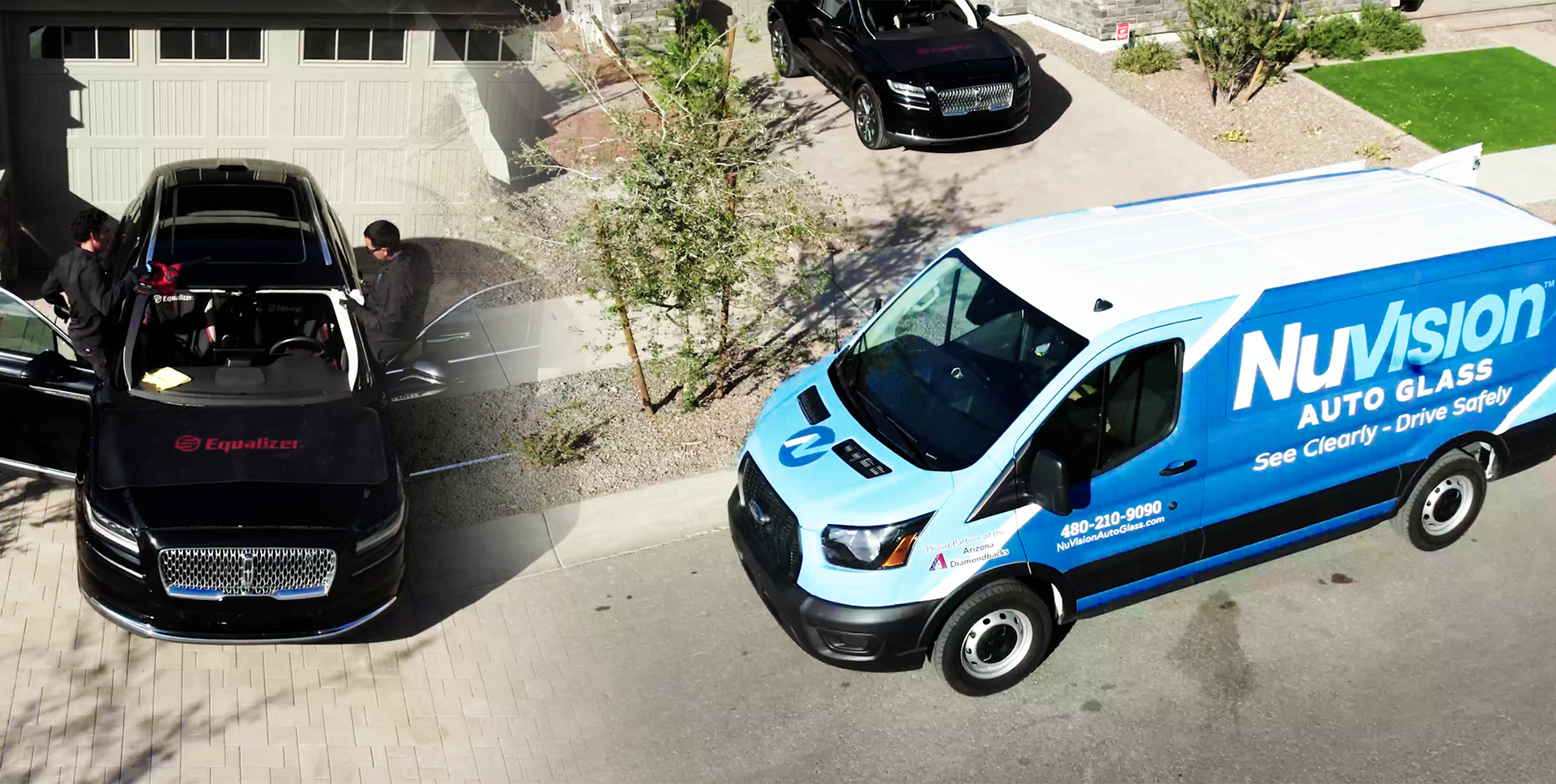
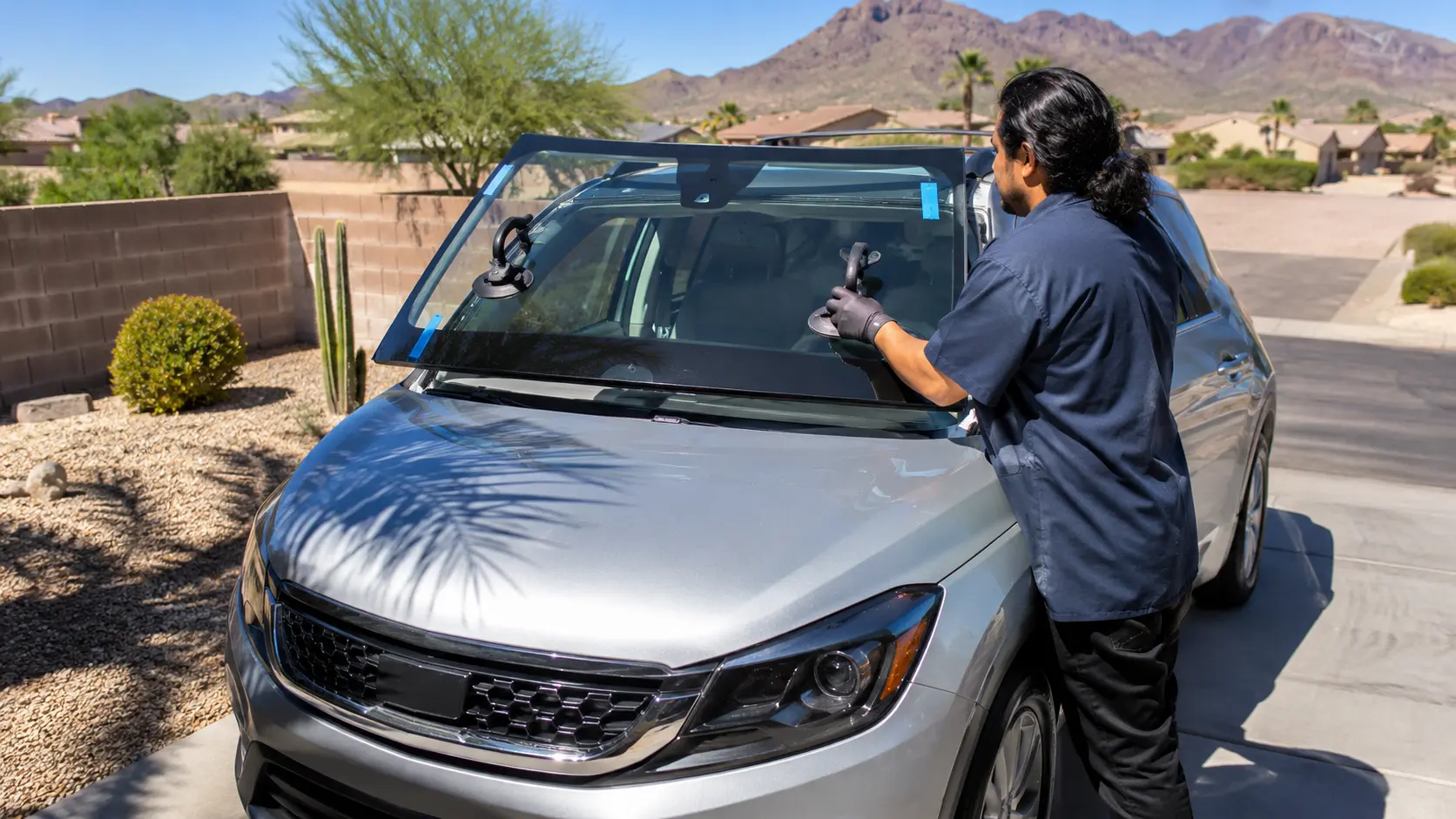
Most Valley replacements happen in a driveway, an office lot, or a covered garage rather than a shop bay. That’s the normal model here, not an upcharge, and a good mobile auto glass service shows up at your workplace so you don’t lose half a day.
Heat gets raised as a concern more than it should be. Automotive urethane cures through moisture and generally cures faster when it’s warm, so a 108-degree afternoon usually shortens the wait rather than lengthening it. What actually matters is that the tech works out of direct sun where possible, preps the pinch weld properly, and gives you an honest safe drive-away time.
That number is commonly one to two hours. Ask for it, and then actually wait. Driving on green urethane is how a windshield ends up sitting a millimeter off and whistling at 65 on the Loop 202. Our guide on how long a new windshield needs to cure explains what’s happening chemically.
One real Phoenix constraint: if your vehicle needs a static ADAS calibration with floor targets, that has to happen on a level, controlled surface with even lighting. A sloped driveway in bright sun isn’t it. Some jobs genuinely need to come into a bay, and a shop willing to tell you that is a shop worth using.
Calibration is not optional, and Arizona says so
Most vehicles from about 2018 onward have a camera mounted behind the windshield running lane keeping, adaptive cruise, and automatic emergency braking. Replace the glass, and that camera’s aim shifts. It has to be recalibrated to the manufacturer’s specification.
Arizona put this in statute. SB 1410, which created A.R.S. 20-463.02, requires a glass facility working on an ADAS-equipped vehicle to inform the customer that recalibration is needed and provide an itemized description of the work. The Arizona Senate fact sheet for the bill confirms it also bars billing for glass or recalibration work that wasn’t performed to the manufacturer’s specifications, with civil penalties running to $2,500.
Translation for you as a customer: if a Phoenix shop replaces camera-equipped glass and never mentions calibration, that’s not a bargain. That’s a compliance problem riding around in your car.
When to repair instead
Not everything needs new glass, and a good shop will tell you so.
Repair generally works when the chip is smaller than a quarter, sits outside your direct line of sight, hasn’t reached the edge of the glass, and hasn’t started to run. Resin injection takes about half an hour and often costs nothing under a comprehensive policy even without the full glass option, because carriers strongly prefer a $90 repair to a $700 replacement.
Repair stops working once a crack crosses the driver’s viewing area or gets near the perimeter. The AS1 line on your windshield marks part of that critical zone. Damage above it behaves differently from damage below it.
In Phoenix specifically, the repair window is shorter than the rest of the country. A chip that would sit stable for a month in San Diego can run six inches in a single afternoon here. If you’re going to repair it, repair it this week.
A Phoenix example of how the math lands
Take a hypothetical case, just to show where the decision points sit.
A 2021 Tahoe owner in Deer Valley picks up a star break on the 101 during the Tuesday commute. She has comprehensive with a $500 deductible and no separate glass line. Quote comes back at $960: $610 for the glass, $350 for static plus dynamic calibration.
Filing the claim means she pays the first $500 and the carrier pays $460. Paying cash means she pays $960 and nothing hits her record. So filing is clearly better here, because the job costs almost twice her deductible.
Flip one detail. If she drove a 2015 Corolla with no camera, the same job would be about $310. Now the claim pays nothing at all, because $310 is under her $500 deductible, and she’d be opening a loss for zero dollars of benefit.
The dividing line is whether the total job exceeds your deductible. Run that number before anyone files anything on your behalf. If a shop wants to file first and price later, slow down.
Five questions worth asking before you book
Ask these on the phone. The answers separate the shops fast.
- Is calibration included in this price, or billed separately? You want one number.
- What glass are you installing, and who made it? OEM, OEE, or aftermarket all exist and all behave differently in the sun.
- What’s the safe drive-away time with the urethane you use today? A shop that quotes a real number based on conditions knows what it’s doing.
- Is my calibration static, dynamic, or both, and can it be done at my location? If it needs a bay, better to hear that now than at 9am in your driveway.
- What does the workmanship warranty actually cover? Leaks and wind noise are the two failures that show up in month three.
Getting pulled over for it
Arizona requires an adequate windshield, and the statute never defines adequate with a measurement, so it’s the officer’s call at the roadside.
In practice, Phoenix enforcement tracks visibility. A crack running through your line of sight is what draws attention. A chip in the lower passenger corner rarely does. Fix-it orders are more common than fines, but a fix-it order still costs you a trip.
What slows Phoenix claims down
The three most common holdups have nothing to do with the damage itself.
Unverified coverage, because the driver assumed glass was included. Missing or mistyped VIN, so the wrong part gets ordered and the appointment gets pushed. Calibration authorization arriving separately from glass authorization, which strands the vehicle mid-job.
All three are avoidable in the first phone call. Our list of common reasons windshield claims get delayed or denied has the rest, and the windshield replacement process walks through what the tech is doing while you wait.
FAQs
How much does windshield replacement cost in Phoenix without insurance? Most standard Phoenix vehicles land between $250 and $800 for the glass and labor. Add roughly $150 to $500 on top if a forward-facing camera has to be recalibrated, which puts a lot of 2018 and newer vehicles in the $600 to $1,300 range. Luxury glass, heads-up display, and heated wiper park zones push it higher.
Can I get same day windshield replacement in Phoenix? Often yes, if the glass for your VIN is sitting in a Valley warehouse and you call early. Common Phoenix vehicles like an F-150, a Camry, or a RAV4 are usually stocked. Less common trims, European models, and anything needing heads-up display glass may take a day or two to source.
Does mobile windshield replacement cost more in Phoenix? It generally should not. Mobile service is the standard delivery model across the Valley rather than a premium add-on, and many shops including NuVision send a technician to your home or workplace at no extra charge. Ask before booking so there are no surprises on the invoice.
How long before I can drive after a windshield replacement in Phoenix? Your technician gives you a safe drive-away time based on the urethane used and the conditions that day, and it is commonly one to two hours. Heat actually speeds most urethane cures, so a July afternoon in Phoenix is not the problem people expect. Wait out the number you are given rather than the number you read online.
Will my Phoenix insurance claim get denied if the crack has been there for months? Age alone rarely gets a comprehensive glass claim denied, but it can complicate things if the carrier suspects the damage predates the policy or was already claimed once. Photograph damage when it happens and report it while it is fresh. Claims tend to slow down over missing VIN details, unverified coverage, and calibration authorization rather than timing.
Is it illegal to drive with a cracked windshield in Phoenix? Arizona requires an adequate windshield, and the statute does not define adequate with a specific crack length, so a Phoenix officer has discretion. Damage sitting in your direct line of sight is the version most likely to draw a citation or a fix-it order. Cracks low on the passenger side are far less likely to attract attention.
What to do this afternoon
Check the comprehensive line on your declarations page, then call a shop with your VIN in hand. If the zero deductible glass option is on there, you’re looking at a free replacement and a technician in your driveway, possibly today.
If it isn’t, get a cash quote with calibration included before anything gets filed, and add the glass option at your next renewal. See what we cover across Phoenix and get it handled before the next monsoon cell rolls through.