
Quick answer: A Tesla windshield replacement typically runs $600 to $1,500 on a Model 3 or Model Y and $800 to $2,400 on a Model S or Model X, including glass, labor and calibration. Tesla’s own service documentation says that after any windshield replacement the camera calibration must be cleared through Controls, Service, Camera Calibration, Clear Calibration on the touchscreen. The cameras then self-calibrate over roughly 20 to 25 miles of driving, and Autopilot stays offline until they finish.
That last part is the step that gets skipped, and it is the reason some owners drive away from a perfectly good glass install with Autopilot throwing errors for a week.
Tesla glass is different from a Corolla windshield in ways that matter to your bill and to your safety systems. Worth understanding both before you approve a quote.
What it costs by model
Quotes on Tesla glass vary more than on almost any other vehicle, because the same job can go through a Tesla Service Center, a Tesla-approved body shop or an independent glass specialist, with either OEM or aftermarket glass.
| Model | Glass and labour | Calibration | Typical all-in |
| Model 3 | $450 to $1,100 | $150 to $450 | $600 to $1,500 |
| Model Y | $500 to $1,200 | $150 to $450 | $650 to $1,600 |
| Model S | $600 to $1,500 | $200 to $500 | $800 to $1,900 |
| Model X | $750 to $1,900 | $200 to $500 | $1,000 to $2,400 |
| Cybertruck | Highest in the lineup, quotes vary widely | $200 to $600 | Get it in writing. |
Real owner reports cluster higher than calculator sites suggest. Model Y and Model 3 quotes in the $1,250 to $2,000 range through Tesla or a national chain are common, and one widely shared account involved a $650 initial quote that became $1,450 once a $750 calibration line appeared.
Two takeaways from that. First, a Tesla quote without a calibration line is incomplete and will grow. Second, the calibration charge itself is where the widest spread lives, and it is worth asking exactly what the shop is doing for that money.
The Cybertruck deserves its own warning. It uses a single enormous flat pane, the vehicle is newer than the aftermarket supply chain, and very few shops have replaced one. Get the quote itemized in writing and confirm the shop has done it before rather than assuming a stainless truck is a truck.
The Model X sits at the top for a physical reason. Its windshield extends up and over the front occupants as a panoramic panel, which makes it a large, heavily curved, expensive piece of glass to manufacture and awkward to handle. The Model S is similar but smaller.
Why Tesla glass costs more than the car’s price bracket suggests
Four reasons, all of them real engineering rather than brand premium.
Acoustic lamination. Every current Tesla windshield uses a sound-damping interlayer. There is no engine to mask tire and wind noise, so the glass does that work. Aftermarket glass that looks identical may not match the acoustic specification, and the difference shows up as a cabin that is suddenly louder at 70 mph. If you want the physics, our guide to acoustic glass for windshields covers how the interlayer works.
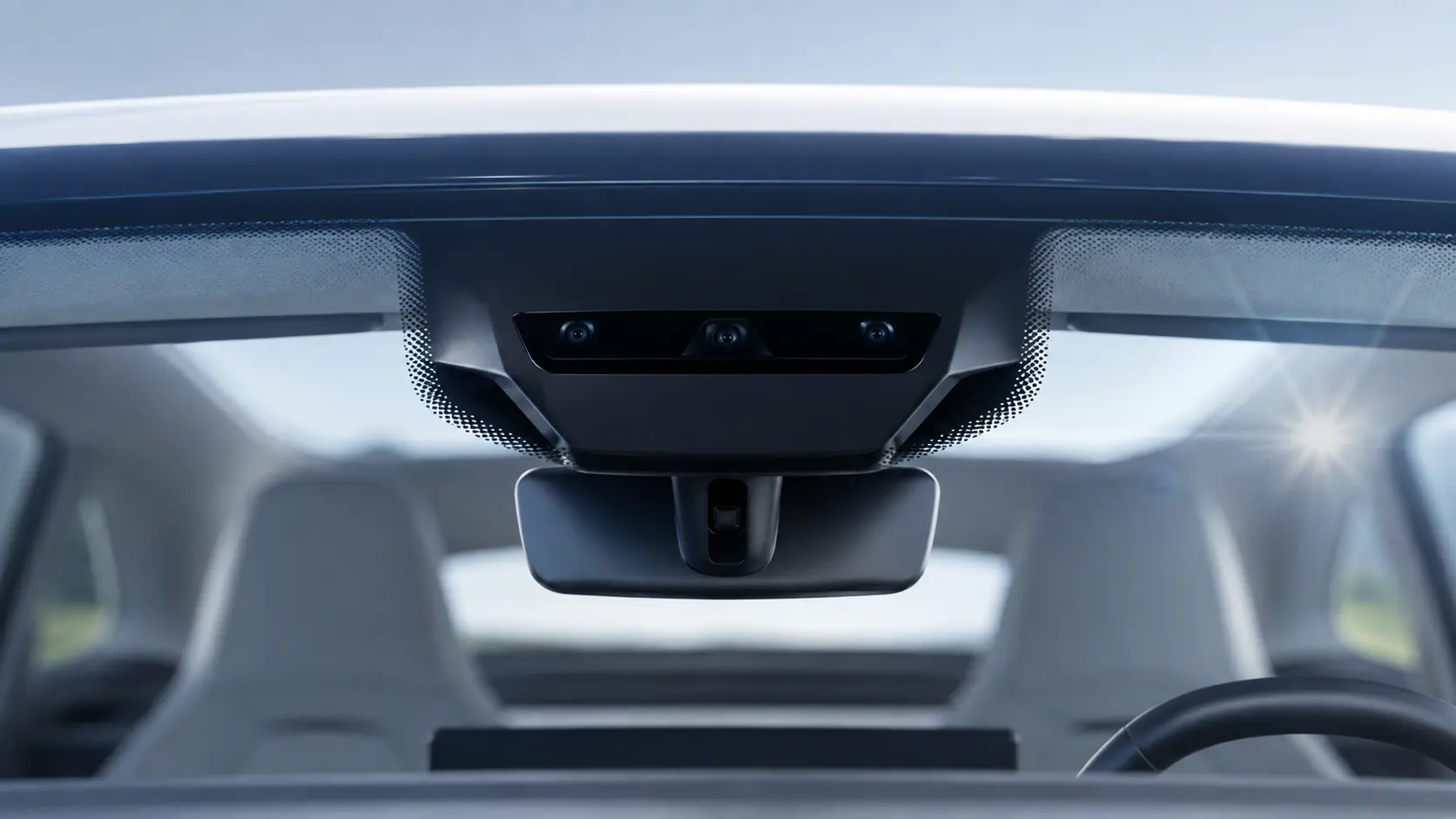
The camera array is the entire sensing suite. Tesla moved to a vision-only approach, dropping radar and then ultrasonic sensors, so the cameras behind that windshield are not one input among several. They are the input. That raises the stakes on mounting geometry considerably compared with a vehicle that still cross-checks camera data against radar returns.
Optical tolerance. The forward cameras look through the glass. Optical distortion that a human eye would never notice can degrade what the camera resolves, which is why glass grade matters more here than on a vehicle where the windshield is just a window.
Thin aftermarket supply. There are fewer aftermarket options for a Model Y than for a Civic, and fewer shops with the experience to do the job cleanly. Less competition, higher prices.
There is one more Tesla-specific angle worth mentioning: glass on EVs increasingly does thermal work too, with infrared reflective coatings that reduce cabin heat load and, by extension, air conditioning draw. We looked at that tradeoff in EV smart windshield glass and battery range.
The calibration step almost everyone gets wrong
Here is where Tesla diverges from nearly every other brand, and where a lot of installs go sideways.
Most manufacturers require a target-board static calibration, a road-test dynamic calibration, or both, performed by the technician with a scan tool before the car goes back to the owner. Tesla’s forward cameras instead run a self-calibration process while you drive. Tesla’s Calibrating Cameras documentation explains that the cameras must complete a self-calibration before some Autopilot features can be used, and that the touchscreen shows a progress indicator while it runs.
But self-calibration does not start on its own after a windshield swap. Someone has to tell the car the cameras moved.
Tesla’s service procedures state that whenever a camera has been moved out of its original position, including a camera or windshield replacement, the calibration data must be cleared through the touchscreen: Controls, then Service, then Camera Calibration, then Clear Calibration. The car displays a warning that clearing calibration resets the stored camera positions and angles, and that Autopilot features will be unavailable until the system recalibrates.
Then you drive. Per Tesla’s guidance, calibration typically completes after 20 to 25 miles, and you should contact Tesla if it has not finished after 100 miles of driving in suitable conditions. It finishes fastest on a straight controlled-access highway with multiple lanes and highly visible lane markings, which is exactly the environment the camera needs to establish reference geometry. Stop-and-go city driving on faded lines will drag it out.
Tesla’s Vehicle Cameras and Autopilot service notes also reference pitch verification for certain cameras after replacement or reinstallation, so on some vehicles there is a verification step beyond clearing and driving.
Why this matters practically: if your shop finishes the install, wipes the glass, and hands you the keys without clearing calibration, the car may keep using stale camera position data. That is a worse outcome than no Autopilot, because the system is confident and slightly wrong rather than disabled. Tesla’s own B-pillar camera procedure documentation spells out the clearing requirement and the up-to-100-mile self-calibration window.
Ask the shop directly: after you set the glass, are you clearing calibration on the touchscreen and confirming it completes before I take the car? A good answer includes the words “confirm it completes.”
Tesla Service Center versus independent shop
Both paths work. They fail differently.
Tesla Service Center. OEM glass, technicians who see Teslas exclusively, and the calibration procedure baked into the workflow. Downsides are cost, which is generally the highest available, and lead time, since glass appointments compete with everything else in the queue.
Tesla-approved body shop. Access to OEM glass and Tesla procedures, often faster than the service center, usually priced between the service center and an independent.
Independent glass specialist. Best pricing and scheduling, and many now stock OE-equivalent Tesla glass. The variable is experience. A shop that has done fifty Model Ys is a different proposition from one doing its first. Ask how many they have done.
A general national chain. Wide availability, and calibration handling varies by location. The owner accounts of surprise calibration charges and defective replacement glass tend to come from high-volume operations where the person quoting is not the person installing.
Whichever you pick, the shop should be following the ANSI/AGSC/AGRSS 005-2022 standard for adhesive selection, surface prep and safe drive-away time. The Auto Glass Safety Council also publishes questions to ask before you book that apply to any vehicle.
For a broader view of how premium and tech-heavy vehicles differ on this, we cover ADAS calibration for luxury vehicles separately.
OEM versus aftermarket on a Tesla, specifically
On a mainstream sedan this is largely a budget question. On a Tesla it is a risk question.
The failure mode owners and shops report is a calibration that will not complete. Aftermarket glass can be dimensionally correct and still position the camera bracket a fraction of a millimeter off the reference plane, or present slightly different optical properties in the camera’s viewing area. When that happens you are looking at a second windshield and a second calibration, which costs more than buying the right glass first.
Where aftermarket is defensible: an older Model 3 without Full Self-Driving, a driver who does not use Autopilot, and a shop willing to warrant that calibration will complete or they will replace the glass. Get that last part in writing.
Where it is not: any vehicle where you rely on Autopilot or FSD daily. If you have never checked whether the glass you are being quoted is OEM, OE-equivalent or generic aftermarket, our explainer on what an OEM windshield actually is covers how to read the markings.
What happens if calibration is skipped or done badly
The systems do not announce that they are miscalibrated. That is the problem.
A camera aimed slightly high reads the horizon as closer than it is, which affects distance estimation for forward collision warning and automatic emergency braking. Aimed slightly off-axis, lane centering drifts toward one side. Owners describe it as the car feeling “off” without a fault code, occasionally with Autopilot sitting a little further into the adjacent lane than it used to.
Sometimes you do get warnings, and they are useful: camera visibility alerts, Autopilot unavailable messages, or intermittent phantom braking. We catalogued the specific consequences in what happens if a windshield is not calibrated, and the shop-side errors in common ADAS calibration mistakes.
If you are new to how these systems read the road, the background is in our overview of what ADAS is and how it works, and the reason the step is not negotiable is covered in why calibration matters after windshield replacement.
Insurance, and why you probably should file
The math on a Tesla is different from a mainstream car. A $1,500 job against a $500 deductible clearly favors filing. A $600 job against the same deductible is closer.
State rules decide most of it. Florida waives the windshield deductible by statute. South Carolina waives it on safety glass through December 31, 2026. Arizona requires insurers to offer a zero-deductible glass option, which you have to elect on your policy. Colorado applies your normal comprehensive deductible unless you bought a separate glass endorsement.
One Tesla-specific wrinkle from owner reports: some carriers reimburse at a market rate rather than the Tesla Service Center rate, leaving the owner covering the gap. Confirm the authorized amount before you commit to the most expensive channel.
Aftercare, which matters more on a Tesla than you think
The adhesive holds the glass to the body, and that bond does structural work. It needs time.
Follow whatever safe drive-away time your installer specifies, and treat the following 24 to 48 hours gently: no high-pressure car wash, no slamming doors with all the windows closed, keep a window cracked slightly so cabin pressure spikes are not pushing on fresh urethane. On a Tesla the doors seal tightly, which makes the pressure point more relevant than on an older car. Our guide to how long a new windshield needs to cure has the specifics.
And plan the calibration drive. If your install finishes at 5pm, a highway loop with clear lane markings will get you calibrated faster than crawling home through surface streets.
Frequently asked questions
How much does a Tesla windshield replacement cost?
Expect $600 to $1,500 for a Model 3 or Model Y and $800 to $2,400 for a Model S or Model X, including glass, labor and calibration. Tesla Service Centers generally sit at the top of those ranges and owners frequently report quotes near $1,500 to $2,000 on a Model 3 or Y. Independent shops using OEM or OE-equivalent glass are usually several hundred dollars lower.
Does a Tesla need camera calibration after windshield replacement?
Yes. Tesla’s service documentation states that whenever a camera has been moved out of its original position, including during a windshield replacement, the calibration data must be cleared using Controls, Service, Camera Calibration, Clear Calibration on the touchscreen. The cameras then self-calibrate while you drive.
How long does Tesla camera calibration take after new glass?
Calibration typically completes after 20 to 25 miles of driving, and Tesla advises contacting them if it has not finished after 100 miles in suitable conditions. It completes fastest on a straight multi-lane highway with clearly visible lane markings. Autopilot features stay unavailable until it finishes.
Can I use aftermarket glass on a Tesla?
You can, and it is cheaper, but the aftermarket pool for Tesla is thinner than for a Camry and the risk profile is different. Tesla glass is acoustically laminated, and the camera bracket tolerance is tight enough that a fractionally different mounting geometry can leave a calibration unable to complete. On a vehicle where cameras are the entire sensing suite, OEM or OE-equivalent glass is the lower-risk choice.
Will insurance cover a Tesla windshield replacement?
Comprehensive coverage handles it in every state, and glass claims are treated as no-fault losses by most carriers. Florida waives the deductible on windshields by statute, South Carolina waives it on safety glass through the end of 2026, Arizona requires insurers to offer a zero-deductible glass option you have to elect, and Colorado applies your standard comprehensive deductible.
Can I clear the Tesla camera calibration myself?
Yes. The procedure lives in the owner-accessible menu at Controls, Service, Camera Calibration, Clear Calibration, and the car warns you that clearing it removes Autopilot features until recalibration completes. Doing it yourself is fine, but a shop that hands the car back without clearing it has left a step undone.
What to do next
Get one quote that itemizes glass, labor and calibration separately, and ask whether the glass is OEM, OE-equivalent or aftermarket. Those two answers tell you whether you are comparing like with like.
Our team handles Tesla glass and ADAS calibration as a single visit across Arizona, Florida, South Carolina and Colorado, including confirming on the touchscreen that calibration completed before the car goes back to you.
Pricing in this guide reflects market ranges observed in 2026 and is not a quote. Procedures described are drawn from Tesla’s published service documentation, which Tesla updates. Confirm current procedure for your model and hardware version.