5 Best Windshield Care Practices for Long-Term Car Ownership
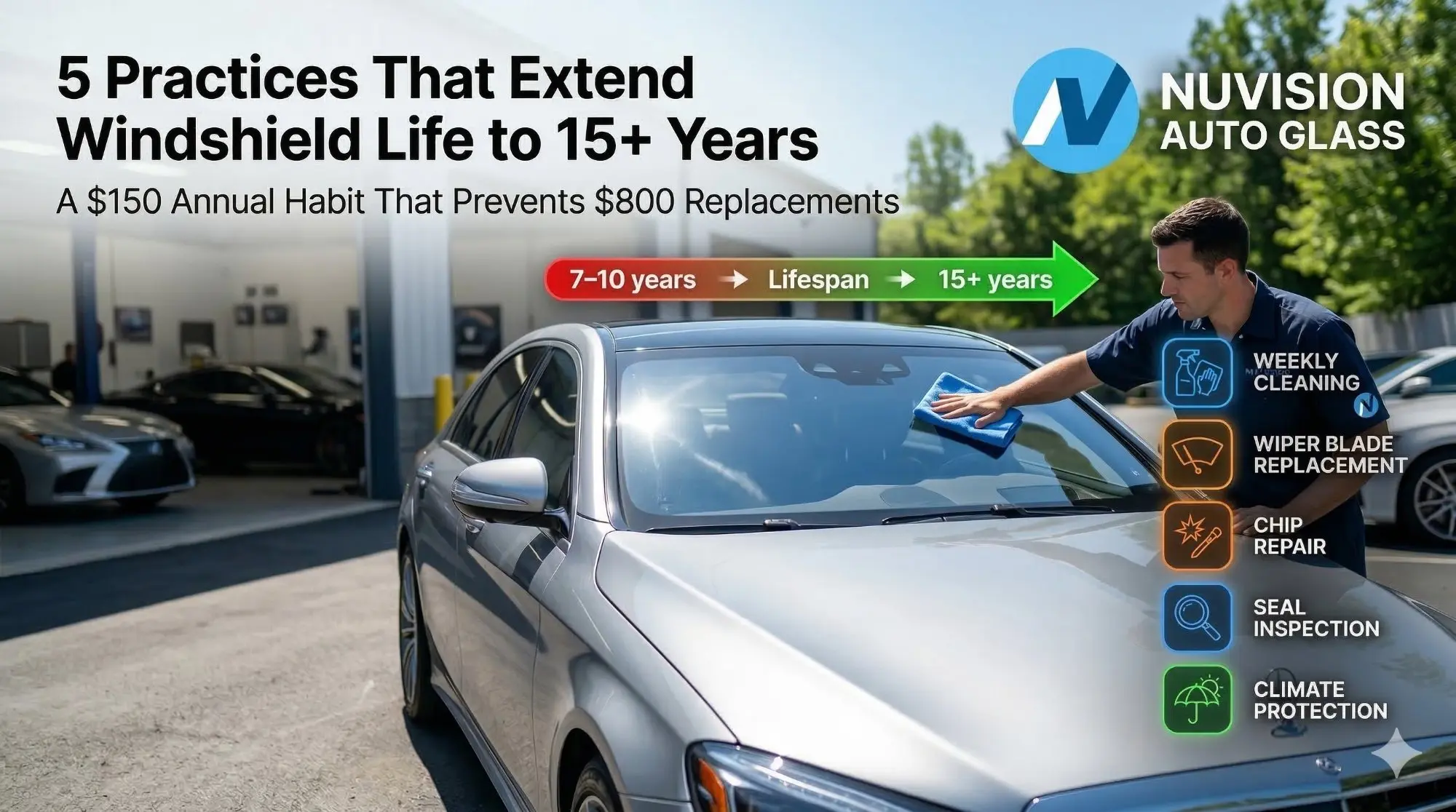
Five core practices extend windshield lifespan from the industry average of 7 to 10 years to 13 to 15+ years: weekly cleaning with ammonia-free glass cleaner, wiper blade replacement every 3 to 6 months, bi-annual seal inspections, immediate chip repair within 48 hours of discovery, and climate-appropriate protection strategies. The annual investment runs about $125 to $150 in materials. The savings from avoided replacements and prevented insurance premium increases total $930 to $2,330 over a typical ownership period.
Your windshield provides up to 45% of your vehicle’s cabin structural integrity in a collision and up to 60% in a rollover, according to the Auto Glass Safety Council (AGSC). Roughly 15 million windshields get replaced in the U.S. every year across 264 million registered vehicles. A significant portion of those replacements trace back to neglected chips and poor maintenance habits that could have been prevented.
This guide covers each practice in detail, climate-specific strategies for Arizona, Florida, South Carolina, and Colorado, product selection guidelines, and a full cost-benefit analysis.
What Does a Proper Weekly Cleaning Routine Look Like?
Weekly cleaning takes about 10 minutes and prevents three problems that lead to premature replacement: mineral deposit buildup, contaminant etching, and missed damage discovery.
Materials You Need
| Item | Cost | Lasts |
|---|---|---|
| Ammonia-free auto glass cleaner | $4-$7 per bottle | 3-4 months |
| Microfiber cloths (min. 300 GSM, 2 minimum) | $8-$12 for 6-pack | 6-12 months |
| Distilled water for dilution (optional) | $1-$2 per gallon | 2-3 months |
The Right Technique
Park in shade first. Cleaning in direct sun causes the cleaner to evaporate before you can wipe it, leaving streaks and spots.
Spray exterior, wipe horizontal then vertical. Horizontal passes first, then vertical. If you see streaks after both passes, you know which direction missed and can target it.
Clean interior with a separate cloth. Cross-contamination between exterior (road grime, bugs) and interior (dust, off-gassing residue) leaves residue on both surfaces. Dedicate one microfiber for each side.
Clean wiper blades during the same session. Wipe down the rubber edge of each blade with the same cloth and cleaner. This removes embedded grit that would otherwise scratch your glass on the next activation. Our wiper scratch removal guide covers what to do if damage has already occurred.
Inspect for damage while cleaning. This is the real bonus. Weekly cleaning gives you 52 opportunities per year to catch a new chip before it spreads. That alone justifies the habit.
Products to Avoid
Never use Windex or ammonia-based household cleaners. Ammonia damages window tint and dries out rubber seals. Never use vinegar solutions (they etch glass over time), abrasive cleaners (create microscopic scratches), or paper towels (leave lint and create micro-scratches). Stick with automotive-specific ammonia-free products like Invisible Glass ($5 to $7), Stoner Glass Cleaner ($6 to $8), or Sprayway Glass Cleaner ($4 to $6).
How Often Should You Replace Wiper Blades?
Wiper blades are the cheapest protection against one of the most expensive windshield problems: surface scratching from degraded rubber dragging debris across the glass.
| Climate | Replacement Frequency | Why |
|---|---|---|
| Standard / moderate | Every 6 months | Normal rubber degradation from UV and use |
| Arizona extreme heat | Every 3-4 months | 115°F+ heat cracks and hardens rubber rapidly |
| Florida humidity | Every 4-5 months | Humidity softens rubber; mold growth on blade edges |
| South Carolina freeze zones | Before winter (Nov) and after (Mar) | Freeze-thaw cracks rubber; ice scraping causes damage |
Quality matters more than frequency. Premium blades ($15 to $25 per pair) last 30 to 50% longer than economy blades ($8 to $12). Beam-style blades perform better on curved windshields, which covers most modern vehicles. Our wiper replacement guide walks through the full installation process.
After installation, test immediately. Listen for squeaking (improper installation or defective blade). Check for streak-free operation. Verify the blade makes full contact across the entire sweep area. Squeaking wipers aren’t just annoying. They indicate uneven contact that concentrates abrasion on specific glass areas. See our guide on stopping windshield wipers from squeaking for troubleshooting.
Why Do Bi-Annual Seal Inspections Matter?
The black urethane seal around your windshield perimeter does two jobs: it keeps water out and it bonds the glass to the vehicle frame for structural integrity. When seals fail, you get water intrusion (which causes mold, electrical damage, and interior corrosion) and reduced crash protection.
Inspect in May and November. These months catch seal damage from summer heat exposure and winter freeze-thaw cycles respectively.
What to check: Look for cracks, gaps, or separations in the black urethane perimeter. Check for moisture stains on the headliner or A-pillar trim inside the vehicle (these indicate leaks). Inspect the molding and trim around the glass for warping or lifting.
DIY seal test: Park in shade, spray the windshield perimeter with a garden hose, and have someone inside check for water intrusion. Mark any leak locations. If you find leaks, get a professional assessment immediately. Failed seals compromise both waterproofing and structural integrity.
Seal failures are particularly common in Florida (humidity degrades urethane faster) and South Carolina (freeze-thaw cycles stress the bond). Arizona’s UV intensity also accelerates seal degradation on exposed vehicles.
Why Is the 48-Hour Chip Repair Rule So Critical?
Addressing chip damage within 48 hours of discovery prevents roughly 78% of chip-to-crack progression. Temperature changes cause chip expansion within 2 to 7 days. After 30 days untreated, about 80% of chips develop into cracks that require full replacement rather than simple repair.
The cost difference is dramatic. A chip repair costs $75 to $150. Arizona’s zero-deductible insurance covers it at $0. Florida’s statutory deductible waiver often covers repairs at no cost. Even in South Carolina, repair is usually well below any deductible.
A full replacement runs $300 to $800 for standard glass, $600 to $1,200 for ADAS-equipped vehicles requiring calibration. For a full breakdown, see our windshield replacement cost guide.
Temporary protection until repair: Place clear packing tape over the chip to prevent moisture intrusion. Avoid car washes (high pressure can worsen damage). Park in covered areas when possible. And schedule professional repair immediately. For help deciding between insurance and cash payment for the repair, see our cash vs. insurance decision guide.
What Climate-Specific Protection Does Each State Need?
Arizona: Heat and UV Management
Covered parking is the single most effective windshield protection for Phoenix, Mesa, Scottsdale, and Chandler drivers. It reduces interior temperatures 40 to 50°F and extends windshield life 30 to 40% compared to exposed vehicles.
When covered parking isn’t available, use a windshield sunshade ($15 to $30). It reduces windshield surface temperature significantly and prevents the thermal shock that occurs when you blast the AC on a 185°F windshield. Face north when possible to minimize direct sun exposure.
UV-protective treatments (ceramic coating at $150 to $300 or UV film at $50 to $150) provide long-term protection against glass clarity degradation, particularly valuable on vehicles you plan to keep 8+ years.
Monsoon season (July through September) demands post-storm cleaning to remove dust and debris before wiper use grinds silica particles into the glass.
Florida: Humidity and Salt Control
Coastal drivers in Tampa, Miami, Orlando, and Jacksonville face salt spray that etches glass surfaces over time. Coastal vehicle windshields degrade about 40% faster than inland vehicles.
Monthly thorough cleaning with salt-neutralizing cleaners ($8 to $12 per bottle) prevents permanent damage. Rinse windshields after every beach visit. Immediate post-storm cleaning removes debris before it bonds to the glass surface.
High humidity pushes moisture into existing chips and cracks, accelerating spread. If you have any existing damage, Florida’s conditions make the 48-hour repair window even more critical.
South Carolina: Winter Preparation
Freeze-thaw cycles cause the most rapid damage progression outside of direct impact. Drivers in Charleston, Columbia, Greenville, and Myrtle Beach need a pre-winter preparation routine.
Switch to winter-grade washer fluid ($5 to $8) with freeze protection by November. Use plastic ice scrapers only, never metal ($3 to $6). Never pour hot water on a frozen windshield as the thermal shock can crack even undamaged glass instantly. Complete a pre-winter seal inspection in October and a post-winter comprehensive check in March/April.
Seasonal damage accounts for roughly 35% of regional windshield replacements in South Carolina. Most of that is preventable with proper winter care.
Colorado
Colorado combines South Carolina’s freeze-thaw challenges with extended winter seasons. Drivers in Denver and Colorado Springs should follow South Carolina’s winter protocol from November through March, with added attention to altitude-related pressure differentials that can stress glass with existing chips during mountain driving.
Are Windshield Treatments and Coatings Worth the Investment?
| Treatment | Cost | Lifespan | Primary Benefit | Best For |
|---|---|---|---|---|
| Hydrophobic (Rain-X, etc.) | $15-$25 DIY | 3-6 months | Water repellency, improved rain visibility (40-60%) | All climates, all drivers |
| Ceramic coating | $150-$300 professional | 2-3 years | Scratch resistance, UV protection, easier cleaning | Long-term owners (10+ years) |
| UV protection film | $50-$150 | 5+ years | Blocks 99% UV, reduces interior heat, extends glass clarity | Arizona, Florida (high UV exposure) |
Hydrophobic treatments are worth it for every driver. The $15 to $25 per application (every 4 to 6 months) dramatically improves rain visibility and reduces wiper friction, which slows blade degradation and reduces glass scratching.
Ceramic coating pays for itself on vehicles you plan to keep 10+ years. Professional application ($150 to $300) lasts 2 to 3 years and provides superior scratch resistance that DIY products can’t match.
UV film is a high-value investment specifically for Arizona and Florida drivers. It blocks 99% of UV rays, reducing dashboard fading, interior heat, and long-term glass clarity degradation. At $50 to $150 for 5+ years of protection, the cost-per-year is minimal.
What Does a Smart Parking and Driving Strategy Look Like?
Following distance matters more than most people think. Maintaining a 3 to 4 second gap behind the vehicle ahead reduces debris strike risk by roughly 60%. Behind trucks, increase to 5 to 6 seconds. Debris impact force increases exponentially with speed. The difference between 55 mph and 75 mph represents 85% more impact energy.
Construction zones are the primary chip source. Reduce speed 10 to 15 mph below the posted limit and maximize following distance to 6+ seconds. If alternate routes are available during active construction, take them.
Parking choices compound over time. Covered parking reduces chip risk from falling debris by approximately 70% and extends overall windshield life 30 to 40%. End spots in parking lots reduce adjacent vehicle risks. Avoid parking directly under trees during storm seasons (falling branches) and avoid proximity to shopping cart corrals.
What Does Windshield Care Actually Cost Over 15 Years?
| Annual Maintenance Item | Frequency | Cost Per Year |
|---|---|---|
| Glass cleaner | 3 bottles/year | $18 |
| Microfiber cloths | 2 sets/year | $16 |
| Wiper blades | 2-4 sets/year | $40-$60 |
| Washer fluid | 4 gallons/year | $20-$24 |
| Hydrophobic treatment | 2 applications/year | $30 |
| Total annual investment | $124-$148 |
The 15-Year Comparison
Neglected windshield: Original glass lasts roughly 7 years. First replacement at year 7 ($450). Second replacement at year 14 ($550). Total replacement cost: $1,000. Add potential insurance premium increases from replacement claims ($450 to $750) and you’re looking at $1,450 to $1,750 in windshield-related expenses.
Well-maintained windshield: Original glass lasts 13 to 15 years. One replacement over the ownership period ($500). Annual maintenance cost: $136/year ($2,040 total over 15 years). But factor in prevented chip-to-crack conversions (3 to 5 catches over 15 years saving $450 to $750 in avoided replacements) and insurance premium protection (avoiding 1 to 2 replacement claims saves $600 to $1,200).
Net lifetime savings from proper care: $930 to $2,330. That works out to $62 to $155 per year in savings beyond the maintenance investment.
What Are the Most Expensive Maintenance Mistakes?
Using household glass cleaners. Ammonia damages tint and dries rubber seals. The $3 you save on Windex instead of automotive cleaner costs $100 to $200 in premature seal degradation.
Delaying chip repairs. “I’ll get to it next month” converts a $100 repair into a $500+ replacement. About 78% of untreated chips become cracks within 30 days.
Running worn wiper blades. Degraded blades scratch glass permanently. Those microscopic grooves accumulate dirt and scatter light, creating the hazy appearance that reduces visibility. The damage is irreversible. A $25 blade replacement every 3 to 6 months prevents hundreds in potential glass polishing or replacement costs.
Ignoring seals. Failed seals allow water intrusion that causes mold, electrical damage, and reduced structural integrity. A bi-annual 5-minute check prevents problems that cost $100 to $200 to fix professionally.
Cleaning in direct sunlight. Cleaner evaporates before proper wiping, leaving mineral deposits that etch the glass over time. Always clean in shade or overcast conditions.
Frequently Asked Questions
How long should a windshield actually last?
A well-maintained windshield can last 13 to 15+ years. Without maintenance, the industry average drops to 7 to 10 years. OEM windshields are designed to last the life of the vehicle (10 to 12 years average), but road conditions, climate, and maintenance habits create the real-world variance.
Can I use vinegar to clean my windshield?
No. Vinegar is acidic and etches glass over time. The effect is subtle and cumulative, so you won’t notice damage immediately, but after months of use the glass develops a hazy, cloudy appearance that can’t be reversed. Use ammonia-free automotive glass cleaner instead.
How much does it cost to maintain a windshield per year?
About $125 to $150 for materials (cleaner, microfiber cloths, wiper blades, washer fluid, hydrophobic treatment). Less than most monthly streaming subscriptions. The return on that investment runs $62 to $155 per year in avoided replacement and insurance costs.
Is ceramic coating worth it for windshields?
For vehicles you plan to keep 10+ years, yes. Professional application ($150 to $300) lasts 2 to 3 years and provides scratch resistance, UV protection, and easier cleaning that DIY products can’t match. For shorter ownership periods, hydrophobic treatments ($15 to $25 every 4 to 6 months) deliver most of the benefit at a fraction of the cost.
Should I replace wiper blades more often in Arizona?
Yes. Every 3 to 4 months rather than the standard 6 to 12 months. Arizona’s extreme heat cracks and hardens wiper rubber far faster than moderate climates. Hardened blades drag debris across the glass and create scratches that are permanent. Our wiper replacement guide covers the process step by step.
Does covered parking really extend windshield life?
By 30 to 40%. Covered parking reduces UV exposure, temperature extremes, debris strikes from above, and seal degradation. If you’re choosing between covered and uncovered parking, the $50 to $100/month premium pays for itself in extended glass and vehicle interior lifespan.
What should I do if I find a chip during cleaning?
Document it with a dated photo immediately. Apply clear packing tape over the chip as temporary protection. Avoid car washes. Schedule professional repair within 48 hours. In Arizona, zero-deductible insurance covers the repair at $0. In Florida, the statutory deductible waiver often applies. For more on how to handle the insurance decision, see our insurance claim filing guide.
Does NuVision offer maintenance services?
Yes. Free windshield inspections any time, any reason. Chip repair ($75 to $150, often $0 with insurance). Wiper blade installation with purchase. Washer fluid top-off during service visits. Full windshield detail ($50 to $75). All available across Arizona, Florida, South Carolina, and Colorado. Visit our Arizona location or Florida location on Google Maps.
Invest 10 Minutes a Week, Save Thousands Over Ownership
Windshield care compounds. Weekly cleaning catches chips early. Quarterly wiper replacement prevents scratching. Bi-annual seal checks catch leaks before they cause structural damage. Climate-specific strategies address the exact conditions your glass faces daily. The total investment is $125 to $150 per year and about 10 minutes per week. The return is $930 to $2,330 in savings and a windshield that lasts the life of your vehicle.
When you find damage during your routine, or when professional assessment is needed, NuVision provides free inspections, expert repair, and full replacement with ADAS calibration across all four states.
Schedule Your Free Windshield Inspection →
Call 1-855-213-0100 or request a quote online. Same-day mobile service available. Whether you need a chip repaired, blades replaced, or a full assessment, we come to you.