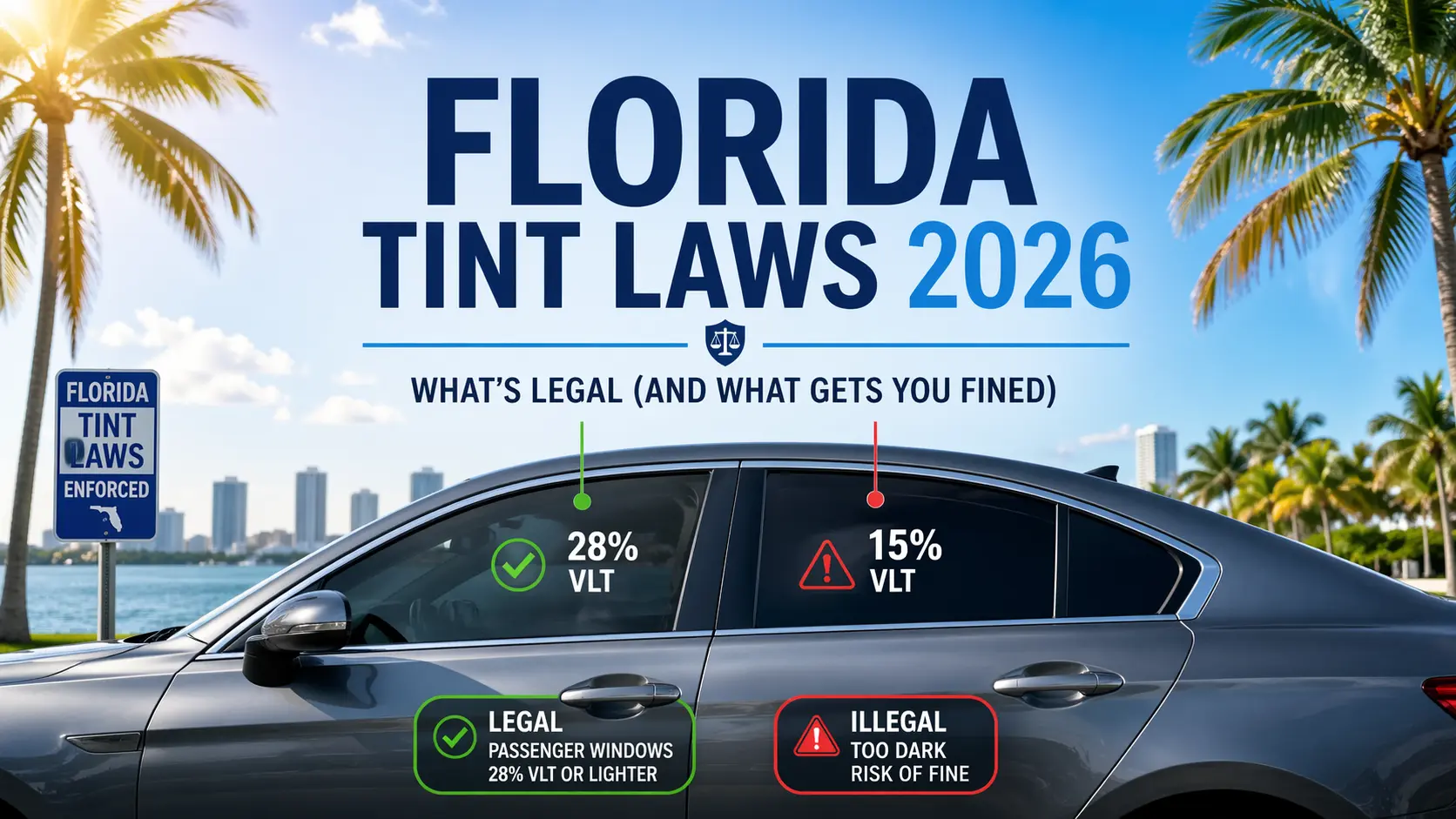
If you drive in Florida, the darkest legal tint on your front side windows is 28% VLT. Rear side and back windows are more lenient, and SUVs, trucks, and vans get even more room. Everything else, the windshield, reflectivity limits, colored film, and medical exemptions, sits in the fine print most drivers never read until they get pulled over.
We’re NuVision Auto Glass. We install windshields and handle ADAS calibration across Florida every day, from Miami to Tampa to Jacksonville, and tint questions come up constantly. This guide covers the 2026 rules your car has to follow, what happens if it doesn’t, and the one question almost every auto glass blog skips: what actually happens to your tint when your windshield is replaced. If you’re new here, our Florida service area lists every metro we cover.
What is VLT? Visible Light Transmission, or VLT, is the percentage of visible light that passes through a window. A 20% VLT film is dark (only 20% of light gets through), while 70% is nearly clear. Florida measures tint legality using the combined VLT of your factory glass plus any aftermarket film.
Legal Tint Percentages in Florida by Vehicle Type
Florida sets different tint rules for sedans and multi-purpose vehicles. The statute calls SUVs, trucks, vans, and station wagons multipurpose passenger vehicles, or MPVs. That label matters, because MPVs have no VLT floor on the windows behind the driver.
Here’s the breakdown drivers actually need:
|
Vehicle Type |
Front Side Windows | Rear Side Windows | Rear Window | Windshield |
| Sedan | 28% VLT minimum | 15% VLT minimum | 15% VLT minimum | Non-reflective tint above AS-1 line only |
| SUV / Truck / Van (MPV) | 28% VLT minimum | No VLT restriction | No VLT restriction | Non-reflective tint above AS-1 line only |
In plain English:
- Every passenger car in Florida needs at least 28% of light coming through the front side windows.
- Sedan rear windows can drop to 15% VLT.
- MPV rear windows can go to limo-dark, roughly 5% to 6%, without violating the statute.
- Your windshield gets a thin strip of tint at the top, and nothing below it (with one exception covered later).
Important: The 28% rule is about what hits the officer’s tint meter, which reads your factory glass and the film together. The film rating alone is not what determines legality. More on that measurement process below.
The Windshield Rule: Why You Can Only Tint the Top Strip
Florida only allows non-reflective tint above the AS-1 line on your windshield. That’s it. No full windshield tint, no full-face ceramic film, no clear-looking-but-actually-tinted product marketed as legal for windshields.
The AS-1 line is a small marker the manufacturer etches into the side of the windshield, usually about 5 inches down from the roof. It runs parallel to the top edge. The statute refers to this zone as the AS-1 portion, and that’s the only windshield real estate Florida permits you to cover with aftermarket film.
Florida is strict here for three reasons:
- Driver forward visibility is non-negotiable, especially at night.
- Modern vehicles have forward-facing ADAS cameras mounted behind the windshield near the AS-1 area, and film over the camera path degrades accuracy.
- Laminated windshield glass is safety glass. Aftermarket film over the main viewing area can interfere with how the glass performs in a crash.
When we install a replacement windshield at NuVision, the AS-1 marker comes etched on every OEM grade windshield we use. Many new windshields even ship with a factory-integrated sun strip (sometimes called a shade band) built into the top of the glass, so you don’t need to add film at all to get shade at the top. If your vehicle needs replacement, our windshield replacement service covers the Florida metros where tint enforcement is most active.
Reflectivity, Colors, and Rules Most Drivers Miss
Darkness gets all the attention, but Florida cares about three other things that trip drivers up.
Reflectivity. Front side windows cannot exceed 25% reflectivity. Rear side windows max out at 35%. Mirrored or metallic-looking film is the usual culprit. If your tint throws off a chrome-like glare in sunlight, it may be outside these limits even if the darkness is legal.
Colored film. Red, amber, and blue tints are prohibited on any window of any vehicle in Florida. These colors are reserved for emergency signaling, and law enforcement takes this seriously. A color violation can flag other inspection items on your car too.
Dual side mirrors. If your rear window is tinted to any degree, your vehicle must have functional side mirrors on both the driver and passenger sides. This rule exists because dark rear tint limits rearview mirror visibility.
Compliance sticker. Florida requires a small tint certification sticker affixed to the inside of the driver’s side door jamb. The sticker shows the VLT rating of the film and the installer’s information. Reputable shops apply this automatically. If you bought a used car with tint and no sticker, you’re legally obligated to verify the film is compliant, even though you didn’t install it.
How Florida Law Enforcement Measures VLT
Officers in Florida use handheld tint meters. The tool clamps over the glass, shines a calibrated light through, and reads the combined VLT of the factory glass and any film on it. That reading is what determines legality, not the rating on the film itself.
This is where a lot of drivers get burned. Factory auto glass is never fully clear. Most modern vehicles leave the factory with glass in the 70% to 80% VLT range. Add a 35% film on top of 75% factory glass, and the math looks like this:
0.75 × 0.35 = 0.2625 combined VLT, or about 26%.
That’s below 28%, which makes it illegal on a Florida front side window, even though the film you bought is technically a 35% film. Cheap installers either don’t know this or don’t tell you. Our customers ask about this constantly when we’re out doing mobile windshield work in Miami and Tampa, because they got tinted somewhere else and didn’t realize their car wouldn’t pass a roadside meter.
Pro tip: Ask your tint installer to measure the combined VLT on your actual car before you pay. A reputable shop does this automatically.
Penalties and Fines for Illegal Tint in Florida
A first-offense tint violation in Florida is a non-criminal traffic infraction. Most drivers pay around $116 per window, and illegal tint does not add points to your license. No points means no automatic insurance premium impact, because this is not a moving violation.
Here’s how enforcement typically plays out:
- Traffic stop. The officer notices dark tint and runs the meter. Every non-compliant window can become its own ticket.
- First offense. Expect $116 to $150 per window, sometimes with a fix-it citation giving you 15 to 30 days to remove or replace the film.
- Repeat offense. Fines climb past $211 per window, and continued non-compliance can block your registration renewal.
- Registration hold. If you try to renew tags on a car flagged for repeat tint violations, Florida can refuse the renewal until the film is brought into compliance.
Enforcement varies by county. Miami-Dade and Broward officers are known for strict tint stops, especially during summer. Jacksonville and rural panhandle counties tend to issue fewer standalone tint tickets, though any traffic stop for another reason can surface a tint violation. There is no grace period anywhere in the state, so saying you just got it done will not help.
Medical Exemption: Who Qualifies and How to Apply
Florida offers a medical exemption for drivers with qualifying medical conditions that make sunlight exposure dangerous. Qualifying conditions include photosensitivity, lupus, skin cancer, and certain dermatologic disorders. With an approved exemption, you can run tint darker than the statutory limits, including below the AS-1 line on your windshield in some cases.
Here’s the process:
- Get the form. Download FLHSMV Form HSMV 83390 from the Florida Department of Highway Safety and Motor Vehicles website.
- Visit a licensed medical provider. A Florida-licensed physician, physician assistant, or advanced registered nurse practitioner must complete and sign the form, certifying the medical need.
- Carry the certificate. Once approved, the exemption is issued to you, not to your vehicle. You have to keep the certificate in any car you drive with darker-than-legal tint.
- Use a qualified installer. Installers familiar with the exemption process can apply darker film with documentation of your approval.
The exemption covers medical necessity only. It is not a loophole for drivers who just want darker tint. Applications with weak medical justification get denied.
What Happens to Your Tint When You Replace a Windshield
The windshield sun strip, any aftermarket film above the AS-1 line on your windshield, gets removed with the old glass. Your new windshield comes in clean.
This is where most auto glass content online goes silent. We will fill the gap.
Here’s what actually happens when we replace a windshield on a Florida vehicle:
- Windshield film goes with the old glass. If you had a sun strip or top tint, it’s attached to the glass we’re removing. The new windshield arrives without it. Many OEM grade windshields include a factory-integrated shade band at the top, which often eliminates the need for aftermarket film entirely.
- Side window tint is not touched. A windshield replacement does not affect your driver, passenger, or rear side window film. That tint stays on the vehicle because we’re not replacing those panels.
- If you also need side glass replaced, any film on those windows goes with the removed glass. Reinstalling new film is a separate job from the replacement itself, and most auto glass companies (including us) do not bundle tint installation into a side window replacement.
- Sequence matters. If you’re planning both a windshield replacement and new tint, do the glass first. Applying film before replacement means the film gets thrown out with the glass.
Because we run 100% mobile service across Florida, we bring the windshield and all calibration equipment to your driveway, home, or office. You do not need a shop visit, and you do not have to rearrange your tint install around ours. NuVision note: if you tell our scheduling team up front that you plan to retint, we’ll coordinate the glass replacement, including the factory sun strip, before you book the tint shop.
Tint, ADAS Cameras, and Why Placement Matters
If your vehicle is a 2015 or newer model, there is a good chance it has forward-facing ADAS cameras mounted near the top center of the windshield, close to the AS-1 line. ADAS, short for Advanced Driver Assistance Systems, covers forward collision warning, lane departure alerts, automatic emergency braking, and adaptive cruise control. All of these rely on the camera having a clean optical path through the glass.
Improperly placed aftermarket film over the camera zone can cut light transmission, skew color calibration, and cause calibration failures. That’s why we bundle ADAS calibration into every windshield replacement where the vehicle requires it. Static calibration runs in a controlled space with targets, dynamic calibration happens on a specific road route at set speeds, and many vehicles need both. Skipping calibration means your safety systems might look fine on the dashboard while quietly missing alignment by several degrees. Florida’s laminated windshield standard plus strict AS-1 tint rules exist to protect exactly this kind of sensor performance.
Insurance, Florida Coverage, and Tint
A tint ticket in Florida is a non-criminal infraction with no points, so it does not raise your auto insurance premium on its own. That’s the good news.
Here’s what is often misunderstood: if you have a cracked windshield that needs replacement, your comprehensive coverage pays for the glass, even if you have aftermarket tint above the AS-1 line. The tint does not void the claim. What you lose is the tint itself, because film goes with the old windshield.
Florida comprehensive coverage typically handles windshield replacement at no out-of-pocket cost, especially if your policy has a low or zero deductible. We handle the claim paperwork, bill the insurer directly, and you sign off on the work. For a deeper look at what comprehensive covers, see our guide on windshield insurance coverage in Florida.
If you’re paying cash and driving without comprehensive, a windshield replacement on a modern ADAS-equipped vehicle runs more than older cars because of calibration requirements. Get a written quote before you schedule.
Florida Window Tint Laws FAQ
Is 20% tint legal in Florida?
A 20% tint is legal on the rear side windows and back window of sedans, SUVs, trucks, and vans. It is not legal on front side windows of any vehicle, because Florida requires at least 28% VLT up front.
Can I tint my entire windshield in Florida?
No. Florida only allows non-reflective tint above the AS-1 line on your windshield, which is roughly the top 5 inches. Tinting the full windshield is illegal for passenger vehicles unless you have an approved medical exemption.
What is the fine for illegal tint in Florida?
A first-offense tint violation is typically $116 per window. Each non-compliant window can be ticketed separately. Repeat violations can exceed $211 per window and may block your vehicle registration renewal.
Does a tint ticket give you points in Florida?
No. Florida tint violations are non-criminal traffic infractions, and they do not add points to your driver’s license or automatically raise your insurance premium.
How do I get a medical exemption for darker tint in Florida?
File FLHSMV Form HSMV 83390, signed by a Florida-licensed physician, physician assistant, or advanced registered nurse practitioner. Once approved, keep the certificate in your vehicle whenever you drive it.
How do Florida police measure window tint?
Officers use handheld tint meters that clamp over the glass. The meter reads the combined VLT of your factory glass and any film on it, not the rating printed on the film box.
Does replacing my windshield remove my tint?
Any film on the windshield itself, including a sun strip above the AS-1 line, goes with the old glass. Side window tint is not affected unless a side window is also replaced.
Is a tint certification sticker required in Florida?
Yes. Florida requires a compliance sticker affixed to the inside of the driver’s side door jamb for any legally tinted vehicle. The sticker shows the film’s VLT rating and installer details.
Get a Florida-Compliant Windshield That’s Ready to Tint
If your windshield is cracked, chipped, or marked for replacement, we install OEM grade glass with the AS-1 line pre-etched, handle ADAS calibration on the same visit, and file your insurance claim so you’re not stuck on the phone. Mobile service covers Miami, Tampa, Orlando, Jacksonville, and the rest of Florida, with same-day appointments and our 100% lifetime workmanship warranty on every job. Request a quote to book today.
200,000+ customers served | 4.5 stars on Google | A+ BBB Rating | 2,823+ Birdeye reviews | Preferred shop for major insurers