
Quick answer: Yes, if you carry comprehensive coverage. Arizona law requires every insurer writing comprehensive auto policies to offer glass coverage with no deductible. The catch is that it is an option you elect, not something that switches on by itself. If you took it, your replacement costs you nothing. If you did not, your standard comprehensive deductible applies and you may end up paying the full bill.
A rock came off a dump truck on the 101 and now there’s a crack running toward your inspection sticker. The first thing most Arizona drivers do is start doing math in their head about what this is going to cost.
Here’s the thing about Arizona: the math is probably better than you think. This state has one of the most driver-friendly glass laws in the country, and a lot of people are covered without knowing it. A lot of other people think they are covered and are not.
The difference between those two groups comes down to one line on a document most of us never read.
What Arizona law actually requires
The statute doing the work here is A.R.S. 20-264. It says any insurer writing private passenger auto insurance that includes comprehensive coverage has to provide, at the option of the insured, complete coverage for repair or replacement of damaged safety equipment without regard to any deductible.
“Safety equipment” is defined right in the statute. It covers the glass in your windshield, doors and windows, plus the glass or plastic in your lights.
Read that phrase again: at the option of the insured. The law forces the carrier to put the option on the table. It does not force you to take it, and it does not add it silently. That single word is why two neighbors in Gilbert with the same carrier can get completely different answers on the same day.
Arizona also requires your car to have what A.R.S. 28-957.01 calls an adequate windshield. The statute never defines “adequate” with a crack length or a chip diameter, which leaves it to the officer’s judgment at the roadside. Our breakdown of Arizona windshield laws covers where that discretion tends to land.
Comprehensive is the coverage that pays
Three coverages sit on a typical policy, and only one of them touches your glass.
Liability pays for what you do to other people. Collision pays when you hit something. Comprehensive handles the rest: theft, fire, hail, animals, vandalism, and the rock that flew off a gravel hauler on the I-10.
Glass sits under comprehensive. Always. If your policy is liability only, which is common on older paid-off vehicles, there is no glass coverage to argue about and you are a cash customer.
That surprises people who have carried insurance for twenty years. Worth checking before you make the call.
Zero deductible is an option, not a default
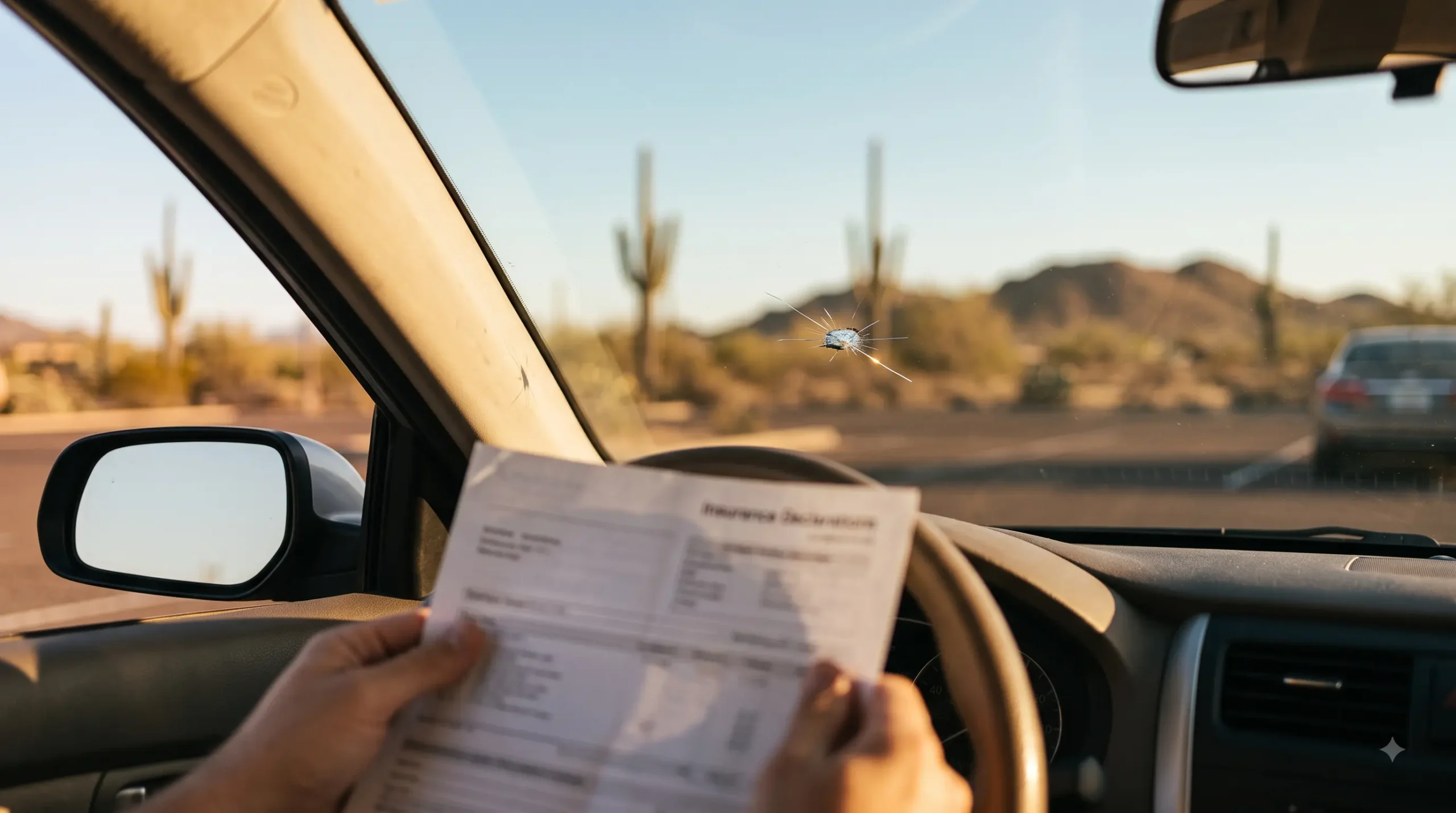
Pull up your declarations page. Not the ID card in the glovebox, the multi-page document your carrier sends at renewal. Most carriers keep it in the app under “policy documents.”
Look at the comprehensive line. If there is a separate entry that says glass, full glass, safety glass, or shows a $0 deductible next to a glass item, you elected the coverage. If comprehensive shows $250, $500, or $1,000 and there is no glass line anywhere, you did not.
Three minutes with the PDF. Faster than the hold music.
If you cannot find it, call and ask this exactly: “Does my policy include the zero deductible safety glass option under A.R.S. 20-264, and does it apply to full replacement or repair only?” Naming the statute changes the conversation. Some reps will tell you glass is covered when they mean repair is covered, which is a different thing entirely. Our comparison of full glass coverage versus standard coverage spells out where those two diverge.
What you pay in each scenario
| Your policy | Chip repair | Full replacement |
| Comprehensive with zero deductible glass | $0 | $0 |
| Comprehensive, $250 deductible, no glass option | Often $0, many carriers waive for repair | You pay the first $250 |
| Comprehensive, $500 deductible, no glass option | Often $0 | Usually the entire bill, since most jobs land under $500 |
| Liability only | Full cash price | Full cash price |
That third row is the one that stings. A $500 deductible on a $420 replacement means the claim pays nothing and you carry the whole cost. Filing it anyway just puts a loss on your record for no benefit. Our guide to windshield replacement cost without insurance walks through when paying cash is the smarter call.
As an example of how far apart those rows sit: picture two drivers who take the same rock on the same stretch of the 202. One has a 2019 RAV4 with a lane-departure camera and the zero deductible glass option. Glass plus calibration bills out around $700 and she pays nothing. The other has a 2016 Civic, comprehensive with a $500 deductible, no glass line. His replacement is $340, which is under the deductible, so the claim would pay him zero. Same rock, same road, and one of them is writing a check. The only difference is a checkbox from a renewal he clicked through in about nine seconds.
That is also why the question “is a zero deductible windshield replacement really free” has an annoying answer. Free at the counter, yes. Free overall depends on what the option costs you every six months.
Repair and replacement are not the same claim
Carriers love repairs. A resin injection on a quarter-sized chip runs a fraction of what a replacement does, so many policies waive the deductible for repair even without the full glass option.
Repair works when the damage is small, outside your direct line of sight, not touching the edge of the glass, and has not started to run. Once a crack passes roughly six inches, crosses the driver’s sight line, or reaches within a couple of inches of the frit band around the perimeter, resin is not the answer and no honest tech will tell you otherwise.
Arizona makes this decision on a shorter clock than most states. Summer surface temperatures on a dark dash push a chip from stable to spreading in a day or two, and that same heat differential shows up again in Flagstaff in reverse when a windshield goes from a frozen morning to a defroster on high. A chip you could have fixed for under a hundred dollars on Monday can be a full replacement by Thursday.
Fix it while it’s still small. That is the whole strategy.
Will a glass claim raise your rates?
Short answer: it should not. Here’s the longer one, because most articles on this stop at the reassurance.
A.R.S. 20-263 says no insurer shall increase the motor vehicle insurance premium of an insured as a result of an accident not caused or significantly contributed to by the actions of the insured. Any insurer that does raise a premium over accident involvement has to notify the insured of the reason. If the Director finds a violation after a hearing, the carrier can be ordered to refund the increase and hit with a civil penalty of up to $300.
A rock thrown by a truck ahead of you is squarely a loss you did not cause. So a single glass claim should not move your premium.
What the statute does not do is freeze your entire underwriting profile. Carriers still look at total claim frequency at renewal, and a driver with five comprehensive losses in two years is a different risk than a driver with one, even when none were their fault. Nobody gets surcharged for the rock. Patterns still get noticed. Our piece on how filing a windshield claim affects your insurance goes deeper on that distinction.
Not every broken window is a comprehensive claim
Glass coverage handles glass losses. It does not handle every way glass ends up broken, and this trips people up.
Break the windshield in a collision and the whole repair, glass included, usually goes under collision with your collision deductible, not under your $0 glass line. Same story if you back into a low garage beam.
Somebody smashes a side window in a Tempe parking garage and takes a laptop? That is comprehensive, and the zero deductible safety glass option covers door and window glass too, since the statute defines safety equipment to include glass used in doors and windows. The stolen laptop is a renters or homeowners question, not an auto one.
Hail is comprehensive. Monsoon debris is comprehensive. A shopping cart in the Fry’s lot on a windy afternoon is comprehensive, assuming nobody left a note.
Ask which coverage the adjuster is opening the claim under before you agree to anything. The deductible attached to it is the number that decides your day.
You pick the shop, not your carrier
This one saves people real aggravation.
A.R.S. 20-469 gives you the right to choose any glass repair facility for a motor vehicle glass loss. Your insurer or the third party administrator handling glass claims on its behalf can recommend a shop. Under A.R.S. 20-469.01, when they make that recommendation they have to tell you at the same time that the choice is yours, and independent adjusters and appraisers inspecting glass work are barred from recommending any particular facility at all.
So when the claims line says “we’ll get you scheduled with our network shop,” you can say no. Name the shop you want. They process it the same way.
ADAS calibration and who pays for it
If your vehicle is roughly 2018 or newer, there is a good chance a forward-facing camera is mounted to the back of your windshield running lane keeping, adaptive cruise, and automatic emergency braking. Pull the glass, and that camera’s aim changes. It has to be recalibrated to the manufacturer’s specification or those systems can read the road wrong.
Arizona wrote rules around this. SB 1410, which added A.R.S. 20-463.02, requires an auto glass facility working on an ADAS-equipped vehicle to inform the customer that recalibration is needed, provide an itemized description of the work, perform the recalibration to meet or exceed manufacturer specifications, and refrain from telling the customer that insurance will pay the entire amount unless the policy actually covers it in full. Civil penalties run to $2,500 per violation.
Most carriers now pay calibration as part of a covered glass loss. Ask for it in writing on the authorization before the tech shows up, not after. Our guide on whether your car needs calibration after windshield replacement lists the features that trigger it.
Filing the claim without wasting an afternoon
- Photograph the damage from inside and outside, with something for scale next to it.
- Confirm your glass coverage on the declarations page before you call anyone.
- Pick your shop first. A good one files the claim for you and already knows the carrier’s process.
- Have the VIN ready. It determines the exact glass part, including rain sensor, acoustic layer, and heads-up display variants.
- Get the authorization in writing, with the calibration line included.
- Ask for the safe drive-away time when the tech finishes and actually wait it out.
Step three is where most of the time gets saved. Our walkthrough on filing a claim for windshield replacement through car insurance covers the paperwork side.
Mistakes that cost Arizona drivers money
Assuming comprehensive means glass is free. It means glass is covered subject to your deductible. Different sentence.
Taking “no cost to you” at face value. A.R.S. 20-463.01 makes it an unlawful practice for a glass seller or repairer to represent that the work will be paid entirely by the insurer at no cost to the policyholder unless coverage has actually been verified with the carrier or its third party administrator and confirmed in writing. A shop promising free before it has checked anything is telling you something about itself.
Filing when your deductible exceeds the price. Get the cash quote first, compare, then decide.
Waiting out the summer. A repairable chip in June is often a replacement in July.
Skipping calibration to save an hour. Those systems will still show green on the dash while pointing at the wrong part of the road.
FAQs
Is windshield replacement really free in Arizona?
It is free out of pocket if you carry comprehensive coverage and you elected the zero deductible glass option that A.R.S. 20-264 requires insurers to offer. If you skipped that option, your normal comprehensive deductible applies, and on a $500 deductible with a $400 replacement you pay the whole thing yourself.
Does liability only insurance cover a cracked windshield in Arizona?
No. Liability pays for damage you cause to other people and their property. Glass damage to your own vehicle sits under comprehensive. If your policy is liability only, you are paying cash for the repair or the replacement.
Will filing a windshield claim raise my rates in Arizona?
A single rock chip claim should not raise your premium. A.R.S. 20-263 bars insurers from increasing a premium because of a loss the insured did not cause or significantly contribute to, and it requires them to tell you the reason for any increase they do make. Frequency across your whole claim history is a separate question, so keep an eye on how many you file in a policy period.
Can my insurance company make me use a specific glass shop?
No. A.R.S. 20-469 gives you the right to choose any glass repair facility for a motor vehicle glass loss. Your carrier or its third party administrator can recommend a shop, but when they do, A.R.S. 20-469.01 requires them to tell you at the same time that the choice is yours.
Does Arizona glass coverage pay for ADAS calibration?
Usually yes, because calibration is part of restoring the vehicle after a covered glass loss, and most carriers now treat it as a standard line on the claim. Get it confirmed in writing before the install. A.R.S. 20-463.02 bars a shop from telling you insurance will pay the entire amount unless your policy actually covers it in full.
How much does the zero deductible glass option add to my premium?
It is priced per carrier and per vehicle, so ask yours for the exact figure rather than trusting a number from a blog. Compare that annual add-on against one replacement at $300 to $900 and decide from there. Most Arizona drivers who add it are betting on rock damage happening at least once every few years, which in this state is a reasonable bet.
Your next move
Open your declarations page and find the comprehensive line. That tells you which conversation you are about to have. If the zero deductible glass option is there, book the windshield replacement and let the shop handle the carrier. If it is not, get a cash number first and compare it against your deductible before anything gets filed.
Either way, start with a quote so you know the real figure instead of guessing at it. And if the coverage turns out to be missing, add it at renewal. In Arizona, it pays for itself faster than almost anywhere else.