
Quick answer: There is no single best shop in Phoenix, because the right choice depends on your vehicle. Camera-equipped vehicles from 2018 on need a shop that calibrates in house. Luxury and heads-up display glass often belongs at a dealership. Everything else comes down to whether mobile service is included, what glass grade you get, and what the warranty covers. Compare those four things and the list gets short fast.
Search this and you get a wall of directory listings sorted by review count. Useful for finding phone numbers. Useless for figuring out which one should touch your car.
Star ratings measure whether the tech was polite and showed up on time. Both good things. Neither tells you whether the camera behind your glass got calibrated to spec, or whether the urethane bead was laid on a properly primed pinch weld.
So this piece starts with the criteria, then applies them.
The four things that actually separate Phoenix shops
1. Who does the ADAS calibration
This is the big one, and it’s where the Valley market splits hardest.
If your vehicle is roughly 2018 or newer, there’s a camera mounted behind your windshield running lane keeping, adaptive cruise, and automatic emergency braking. Replace the glass and that camera’s aim moves. It has to be recalibrated.
Arizona regulates this. SB 1410, which created A.R.S. 20-463.02, requires a glass facility to inform you that recalibration is needed and hand you an itemized description of the work. The Arizona Senate fact sheet for the bill confirms it also prohibits billing for glass or recalibration work not performed to manufacturer specifications, backed by civil penalties up to $2,500.
Some Phoenix shops calibrate in house. Some subcontract it to a mobile calibration outfit. Some skip it and hope you don’t notice. Ask directly, and ask for the printed calibration report afterward.
2. What glass they’re installing
OEM glass carries the automaker’s branding and comes off the same line as the original. OEE, or original equipment equivalent, is built to the same spec by a major manufacturer without the badge. Aftermarket varies more widely.
For a Camry, OEE is usually fine. For a windshield with a heads-up display projection zone or a specific acoustic interlayer, the tolerances are tighter and mismatches show up as ghosting or added road noise. Our comparison of OEM versus aftermarket windshields covers where the difference is real and where it’s marketing.
Ask who made the glass. A shop that won’t name the manufacturer is telling you something.
3. Whether mobile service is included
Across the Valley, mobile installation is the default rather than a luxury. Most shops here will come to your driveway in Ahwatukee or your office lot in Tempe.
What varies is whether they charge for it, and whether they’ll be honest about the jobs that shouldn’t be done outdoors. Static calibration needs a level surface, even lighting, and room to place targets at measured distances. A sloped driveway at 2pm in July doesn’t qualify.
4. What the warranty actually says
“Lifetime warranty” appears on nearly every Phoenix shop’s homepage. The wording underneath varies enormously.
Look for whether it covers leaks and wind noise specifically, whether it’s transferable if you sell the car, whether it covers the calibration or only the glass, and whether it survives the shop closing. Our guide to comparing auto glass warranty programs breaks down the language.
One more filter worth applying: the Auto Glass Safety Council maintains the AGRSS standard for safe installation and runs an accreditation program. Registration isn’t a guarantee, but it means the shop has agreed to a written installation standard.
The eight options, and who each one fits
These are grouped by service model rather than ranked one through eight, because the model is what determines fit. Verify current pricing, hours, and coverage areas directly, since all of that moves.
1. NuVision Auto Glass
Best for: Insurance claims in Arizona, and drivers who want calibration and cash back handled in one call.
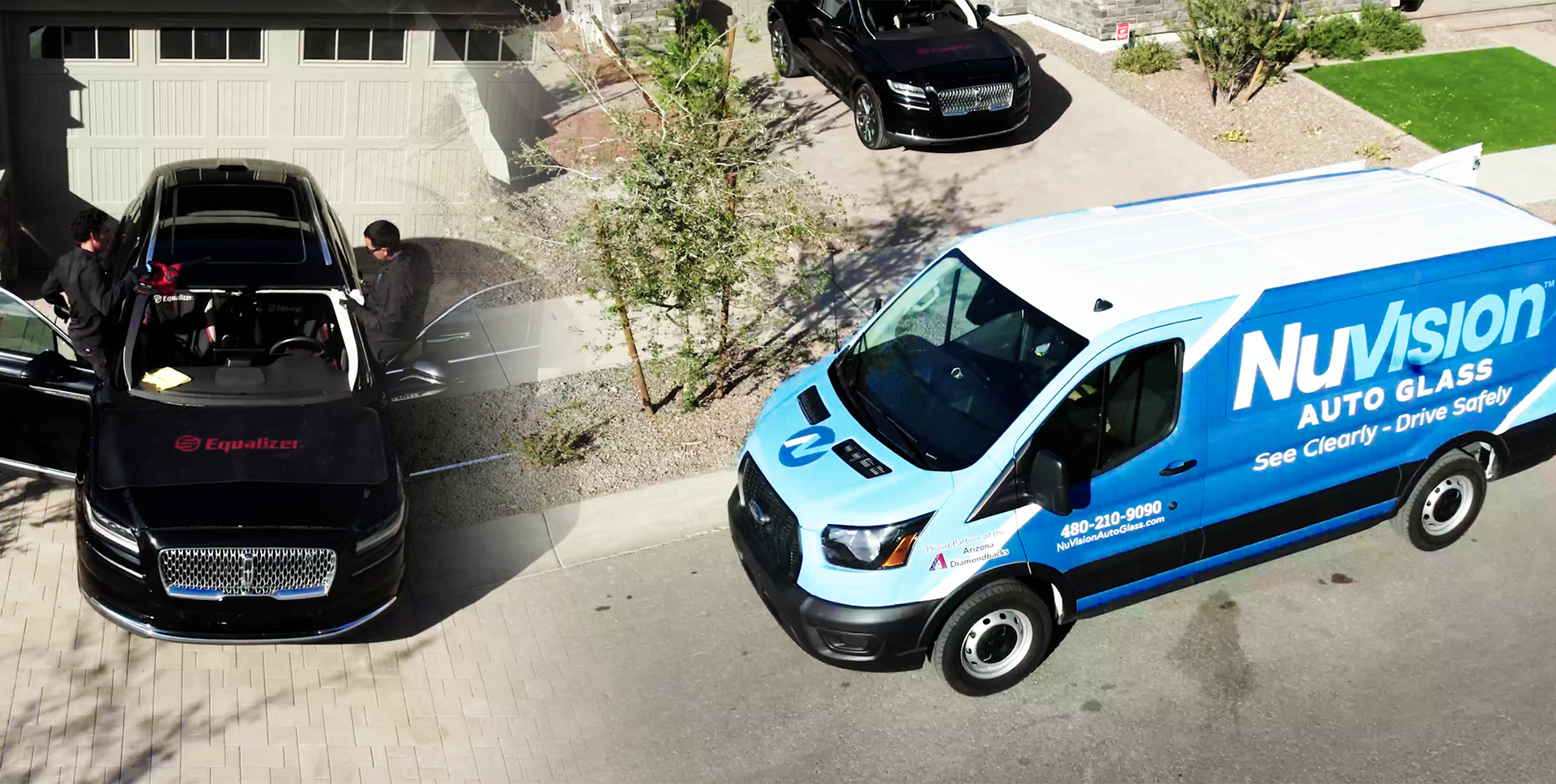
Mobile-first across the Phoenix metro with technicians dispatched to home or workplace at no extra cost. Published service times are 60 to 90 minutes for a replacement and typically under 30 minutes for a chip repair. Warranty is lifetime workmanship covering leaks and wind noise, and the company is BBB accredited with 24/7 customer service.
The differentiator in Arizona specifically is the cash back program: up to $375 issued as a virtual Visa card on insurance-paid replacements, plus a dinner voucher. That’s Arizona only, and it’s tied to a verified qualifying claim rather than a cash-pay job. ADAS calibration is quoted as part of the replacement rather than added afterward. Our Phoenix service area page lists coverage across the Valley.
Watch for: Cash back requires eligible comprehensive glass coverage. Liability-only policies don’t qualify.
2. Safelite AutoGlass
Best for: Drivers who want a national brand their carrier already has on file, or who are traveling.
The largest chain in the country, with multiple Phoenix locations including a North Phoenix shop, plus mobile service. Publishes a nationwide lifetime warranty, which is genuinely useful if you move states or your car does. Online scheduling is straightforward and most major carriers have them integrated.
Watch for: They’re the default network shop for several carriers, which is exactly the situation A.R.S. 20-469 exists to protect. Defaulting to them because a claims rep suggested it is different from choosing them.
3. Your vehicle’s dealership
Best for: Luxury vehicles, heads-up display glass, lease returns, and anything still under a factory warranty you don’t want to complicate.
Factory glass, factory calibration equipment, factory documentation. On a European vehicle or anything with a projection zone in the windshield, that combination is hard to beat.
Watch for: Typically the highest price and the longest wait, often several days, and rarely mobile. Our comparison of dealership versus auto glass shop covers when the premium is worth paying.
4. Blue Chip Auto Glass
Best for: Drivers who want a long-established Valley independent with both shop and mobile options.
Consistently among the highest-reviewed independents in Phoenix search results, offering mobile windshield replacement alongside in-shop work.
Watch for: Independents vary in how they handle calibration. Confirm whether it’s in house or subcontracted before booking.
5. Expert Auto Glass Repair
Best for: Straightforward replacements where responsiveness matters more than brand.
Another highly rated Phoenix independent that appears near the top of local directory results, with a mobile service model.
Watch for: Ask about glass grade explicitly. Smaller shops often offer several tiers and default to the cheapest unless you specify.
6. Mountainside Glass
Best for: Drivers who want a shop handling auto, home, and business glass under one roof.
A Phoenix mobile glass company covering windshield replacement and front camera work along with residential and commercial glass.
Watch for: Broad-service shops sometimes have narrower auto glass inventory, which can mean a longer wait on less common parts.
7. Flux AutoGlass
Best for: Valley-wide mobile coverage outside the central Phoenix core.
Delivers mobile windshield replacement and auto glass repair across Phoenix and surrounding communities.
Watch for: Confirm they cover your specific city. Mobile radius claims and actual dispatch areas aren’t always the same thing.
8. Gerber Collision & Glass
Best for: Glass damage that came with body damage attached.
A collision-first operation with glass capability, which matters if the windshield broke in an accident rather than from a rock. Handling both under one claim saves you coordinating two shops.
Watch for: Turnaround follows body shop scheduling, so it’s slower than a dedicated glass call.
Quick comparison
| Type | Speed | Mobile | Calibration | Best fit |
| Specialist mobile shop | Same or next day | Standard | Varies, ask | Most Valley drivers |
| National chain | 1-2 days | Yes | In house | Travelers, multi-state |
| Dealership | 3-7 days | Rarely | Factory | Luxury, HUD, lease return |
| Local independent | Same to 2 days | Usually | Varies, ask | Mainstream vehicles |
| Collision center | Follows body work | No | Via partner | Accident damage |
What a fair Phoenix price looks like
Directory listings almost never tell you this, which makes it hard to know whether a quote is reasonable. Rough benchmarks for the Valley:
| Vehicle | Glass and labor | Calibration | Realistic total |
| Pre-2018 sedan, no camera | $250 – $400 | None | $250 – $400 |
| 2018+ sedan with lane camera | $300 – $550 | $150 – $350 | $450 – $900 |
| Full-size truck or SUV with camera | $400 – $700 | $200 – $400 | $600 – $1,100 |
| Luxury or acoustic glass | $600 – $1,100 | $250 – $500 | $850 – $1,600 |
| Heads-up display windshield | $800 – $1,500 | $300 – $500 | $1,100 – $2,000 |
| Chip repair | $50 – $125 | None | $50 – $125 |
Two quotes on the same vehicle in the same week can differ by $300, and that gap is almost always calibration, glass grade, or hardware, not somebody being greedy.
Here’s how that plays out. Say a Chandler driver with a 2020 Silverado gets three quotes: $520, $760, and $890. The $520 turns out to be aftermarket glass with calibration billed separately. The $760 is OEE glass with dynamic calibration included. The $890 is OEM glass with static and dynamic calibration plus new mouldings. Once you normalize them, the $520 becomes roughly $820 and the cheapest quote stops being the cheapest.
Ask for the total installed price. Then compare.
Six questions that sort the list for you
Run these on the phone before you book. Our longer list of questions to ask any auto glass shop expands on each.
- Is ADAS calibration included in this quote, and do you do it in house?
- Who manufactured the glass you’re installing?
- What’s the safe drive-away time with today’s urethane and today’s temperature?
- Does the warranty cover leaks and wind noise, and is it transferable?
- Can you do this at my location, or does the calibration require a bay?
- What’s the total installed price including mouldings and clips?
A shop that answers all six without hedging is a shop worth booking. Our feature comparison across local shops covers what good answers sound like.
How fast this actually moves
Speed in the Valley is mostly a parts question, not a labor question.
Glass for high-volume Phoenix vehicles sits in local warehouses. An F-150, a Camry, a RAV4, a Silverado, a Civic: call before mid-morning and same day is realistic. The install itself runs 60 to 90 minutes.
Less common trims, European models, and heads-up display glass often have to come from a regional distribution point, which adds a day or two. Calibration adds 30 to 90 minutes on top, more if the vehicle needs both static and dynamic procedures.
Then there’s cure time. Whatever safe drive-away number the tech gives you, build it into your afternoon rather than treating it as a suggestion.
Red flags in the Phoenix market
“It’s completely free” before anyone has checked your policy. A.R.S. 20-463.01 makes it an unlawful practice to represent that a repair will be paid entirely by the insurer at no cost unless coverage has actually been verified with the carrier or its administrator and confirmed in writing.
A flat price quoted without your VIN. Rain sensor, acoustic layer, heating element, and camera bracket all change the part. Nobody can price it accurately without the VIN.
No mention of calibration on a 2019 vehicle. That’s the tell.
A drive-away time that’s always “about an hour.” Real numbers move with the adhesive and the weather.
Pressure to sign an authorization before you’ve seen the price. Slow down.
If something already went wrong, the signs of a bad windshield replacement usually show up within the first few weeks as water intrusion or noise at freeway speed.
FAQs
What makes one Phoenix windshield shop better than another? Four things separate them in practice: whether ADAS calibration is done in house or subcontracted, what grade of glass they install, whether mobile service is included or billed extra, and what the workmanship warranty actually covers. Price differences between Phoenix shops are usually explained by one of those four rather than by quality alone.
Should I use a dealership or an auto glass shop in Phoenix? A dealership gives you factory glass and factory calibration equipment, which matters most on luxury vehicles, heads-up display windshields, and anything still under a lease return inspection. It usually costs more and takes longer. A specialist glass shop is faster and often mobile, and for mainstream vehicles the outcome is comparable when the shop calibrates to manufacturer specification.
Does my insurance company get to pick my Phoenix glass shop? No. A.R.S. 20-469 gives you the right to choose any glass repair facility for a motor vehicle glass loss. Your carrier or its third party administrator can recommend a shop, and A.R.S. 20-469.01 requires them to tell you the choice is yours at the same time they make that recommendation.
How do I know if a Phoenix shop is cutting corners? The clearest signal is silence about calibration on a camera-equipped vehicle. Others include refusing to name the glass manufacturer, quoting a flat price without your VIN, giving a safe drive-away time that never changes regardless of conditions, and promising the job is free before your coverage has been verified with the carrier.
Is the cheapest Phoenix windshield quote usually a bad deal? Not always, but check what is missing from it. A quote that is $250 below the rest of the market has usually left out ADAS calibration, moved you to a lower glass grade, or excluded moulding and clips that will be added at the door. Ask for the total installed price with calibration included and compare those numbers instead.
Can any Phoenix shop do ADAS calibration on site? No. Dynamic calibration happens on a road drive and can be done from almost anywhere, but static calibration needs a level floor, controlled lighting, and space to position targets accurately. A sloped driveway in direct Phoenix sun does not meet those conditions, so vehicles needing static calibration often have to come into a bay.
Picking one
Narrow it by vehicle first. Heads-up display or a luxury badge sends you to the dealership. A 2020 pickup with a lane camera sends you to whoever does ADAS calibration in house. A 2014 sedan with no camera opens the field to everybody, so optimize for speed and warranty.
Then call two shops with your VIN and ask the six questions. The gap between the answers usually makes the decision for you. If you want the same-day mobile route, here’s how that compares to the alternatives, and why Valley drivers tend to land where they do.