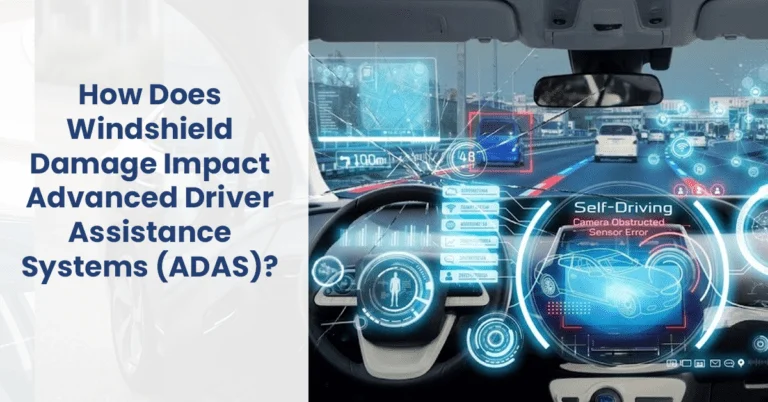

Windshield damage directly compromises Advanced Driver Assistance Systems (ADAS), with even minor chips in camera viewing zones causing 35–75% degradation in system performance. Forward-facing cameras mounted behind windshields rely on optical clarity to detect lane markings, vehicles, pedestrians, and traffic signs. Cracks, chips, or improper windshield replacements without recalibration create false alarms, system deactivation, or, most dangerously, failure to intervene during actual collision scenarios.
With 68% of vehicles now equipped with ADAS and that number rising to 95%+ for 2024–2026 models, windshield damage affects far more than visibility. It disables safety systems designed to prevent the crashes that injure 2.3 million Americans annually. For drivers in Arizona, Florida, and South Carolina, understanding how windshield condition affects these systems and why recalibration after replacement is mandatory prevents dangerous situations where drivers believe they’re protected by technology that’s actually non-functional.
Which ADAS Systems Depend on Your Windshield-Mounted Camera?
Modern vehicles integrate multiple ADAS technologies that rely on forward-facing cameras positioned behind the windshield. Each system processes visual data through the glass, meaning anything affecting optical clarity between the camera lens and the road directly impacts safety performance.
Automatic Emergency Braking (AEB). The camera detects vehicles ahead, calculates closing speed, and automatically applies brakes if a collision is imminent and the driver hasn’t responded. AAA research shows AEB reduces rear-end collisions by 50% when functioning correctly. Federal regulations will require AEB on all new vehicles by 2029.
Lane Departure Warning (LDW) and Lane Keep Assist (LKA). The camera tracks lane markings and warns when the vehicle drifts without turn signal activation. Advanced systems (LKA) provide steering input to maintain lane position. Functional LDW/LKA reduces lane departure crashes by 40%.
Adaptive Cruise Control (ACC). The camera, sometimes combined with radar, monitors vehicles ahead, adjusting speed to maintain a preset following distance. ACC requires constant visual assessment of traffic density and closing rates.
Traffic Sign Recognition (TSR). The camera reads road signs, speed limits, stop signs, and yield signs, displaying information to the driver and sometimes adjusting speed automatically.
Pedestrian Detection. Advanced AEB systems identify pedestrians in the vehicle’s path, applying emergency braking if a collision is predicted. These systems reduce pedestrian strikes by 23%.
Forward Collision Warning (FCW). The preemptive warning system alerts drivers to potential collisions before the AEB activation threshold is reached, providing the driver time to react independently.
These systems are safety-critical. Insurance companies offer premium discounts of 10–15% for ADAS-equipped vehicles due to demonstrated crash reduction rates. When windshield damage degrades camera performance, you lose both the safety protection and the economic benefit of these systems.
What Does an ADAS Camera Require From Your Windshield?
ADAS cameras require optical clarity equivalent to or exceeding human vision standards. The camera’s field of view typically spans 30–60 degrees horizontally and 15–30 degrees vertically, centered on the camera position behind the windshield. Within that zone, the camera needs a resolution of 1–2 megapixels minimum for lane marking detection, frame rates of 30–60 frames per second for real-time processing, a dynamic range sufficient for bright sunlight and darkness, and an optical distortion tolerance of less than 0.1 diopter.
That last specification is critical. Federal Motor Vehicle Safety Standard 205 allows up to 0.25 diopter distortion for human windshield visibility standards, but ADAS cameras require less than 0.1 diopter. Your eyes can compensate for minor distortion by refocusing or looking around obstacles. Cameras cannot. They process exactly what the lens captures, cracks, chips, and distortion included.
How Does Each Type of Windshield Damage Affect Camera Function?
Cracks create sharp edges that refract light unpredictably. Lane markings appear bent, broken, or multiplied into false images. The camera’s software interprets these as actual road features, triggering incorrect responses. A crack crossing the camera’s field of view is the single most disruptive form of damage.
Chips act as lenses, focusing or scattering light at the damage point. A chip might make a vehicle ahead appear as two vehicles or cause its position to be miscalculated. Even a small chip within the camera zone degrades target detection accuracy.
Haze or delamination reduces contrast, making it difficult for cameras to distinguish lane markings from pavement or vehicles from background. This is particularly problematic in low-contrast conditions like dawn, dusk, overcast skies, and rain.
Improper repairs leave optical artifacts, slight color variations, residual distortion, or surface irregularities that confuse camera algorithms. Even a successful resin repair that restores structural integrity may leave optical imperfections that cameras detect even when human eyes don’t notice them.
A Society of Automotive Engineers study found that ADAS cameras viewing through windshields with even minor damage—1–2 inch cracks outside the direct center of the camera view—experienced a 35–50% increase in false alarms and a 20–30% failure rate in detecting actual hazards. That means damage you might consider cosmetic is creating measurable safety degradation.
Why Are ADAS False Alarms More Dangerous Than They Seem?
When ADAS systems trigger false alarms due to windshield damage, drivers’ initial response is annoyance. Lane departure warnings beep when you’re properly centered in your lane. Forward collision warnings flash when nothing is ahead. Adaptive cruise control brakes unnecessarily.
The real danger emerges from behavioral adaptation. After experiencing multiple false alarms, drivers ignore warnings or, worse, disable systems entirely. Insurance Institute for Highway Safety (IIHS) research indicates that drivers experiencing frequent ADAS false alarms are 45% less likely to respond appropriately to genuine warnings compared to drivers whose systems function correctly.
The progression follows a predictable pattern. In the first week, the driver experiences occasional unexpected warnings and attributes them to the system “being sensitive.” Over weeks two through three, false alarms increase in frequency, and the driver begins questioning system reliability. By week four and beyond, the driver disables systems or consciously ignores warnings. The outcome: a real hazard occurs, the driver doesn’t respond to a legitimate warning, and a crash that ADAS should have prevented occurs because the user disabled or ignored a system made unreliable by windshield damage.
What Happens When ADAS Systems Silently Deactivate?
Some vehicles respond to persistent ADAS malfunctions by deactivating systems automatically. Dashboard warnings appear—”AEB Unavailable,” “LKA System Fault,” “Camera “Obstructed”—but drivers often ignore these messages, assuming they’re temporary or irrelevant.
The danger is that drivers believe they have active safety systems when they don’t. A driver who has operated for months with functional AEB may unconsciously rely on that backup protection following more closely or paying less attention because “the car will brake if needed.” When windshield damage causes system deactivation, the driver continues operating as though protection exists.
Common deactivation messages related to windshield damage include “Front Camera Blocked” (system detects obscured view), “Forward Safety Systems Unavailable” (camera can’t process reliable images), “Lane Keep Assist Not Available” (can’t detect lane markings), “Adaptive Cruise Control Disabled” (can’t track vehicles ahead), and “Collision Warning System Fault” (general malfunction indication).
If you see any of these warnings persistently, your windshield condition should be the first thing you investigate not the camera hardware. A professional glass assessment can determine whether damage in the camera zone is causing these alerts.
What Does Catastrophic ADAS Failure Look Like on Arizona, Florida, and South Carolina Roads?
The most dangerous scenario isn’t false alarms or deactivation warnings it’s silent failure. The system remains active, displays no warnings, but doesn’t function when needed. This failure mode is particularly insidious because it’s unpredictable. The system might work correctly 90% of the time, but that 10% failure rate under specific conditions creates unacceptable risk.
Phoenix I-10 morning commute. A driver with a 3-inch windshield crack partially in camera view travels at 75 mph. Traffic ahead slows suddenly a common I-10 congestion pattern. AEB should detect stopped vehicles and brake automatically. However, the crack refracts morning sun directly into the camera. The computer vision algorithm can’t distinguish vehicles from glare artifacts. No braking occurs. The driver realizes too late. Rear-end collision at 60+ mph. In Phoenix, where I-10 commuter speeds regularly exceed 70 mph with sudden congestion transitions, this scenario plays out with real consequences.
Florida I-95 rain. A driver with a chip in the windshield camera zone uses adaptive cruise control during an afternoon thunderstorm. The system tracks the vehicle ahead normally in dry conditions. Rain fills the chip, creating additional refraction. The system loses track of the lead vehicle. Adaptive cruise doesn’t maintain proper following distance. The lead vehicle brakes for standing water. The trailing vehicle continues at cruise speed. On Tampa and Miami stretches of I-95, afternoon thunderstorms are near-daily summer events making this scenario routine rather than exceptional.
South Carolina US-17 coastal. A driver with a cracked windshield uses Lane Keep Assist on a two-lane coastal highway near Charleston. The system functions normally most of the time. A specific sun angle reflecting off marsh water creates glare through the crack. The system misinterprets lane marking position. LKA steers toward the oncoming traffic lane. The driver must override aggressively to avoid a head-on collision.
These aren’t hypothetical. The NHTSA crash investigation database includes incidents where ADAS failure or malfunction contributed to crashes that systems should have prevented.
Why Is Recalibration Mandatory After Windshield Replacement?
Even when windshield damage is properly addressed through replacement, the camera’s position relative to the vehicle centerline changes by millimeters during the process. This seems negligible, but ADAS cameras operate with tolerances of 1–2 degrees. Even 3–5mm displacement causes significant pointing error. At 200 feet ahead, a 2-degree error means the camera is looking 7 feet to the side of where it should be.
Static calibration positions the vehicle in a controlled environment with specific targets placed at precise distances and angles. The camera adjusts its reference points to these known positions. This requires level ground, 30+ feet of clear unobstructed space, and manufacturer-specific target boards.
Dynamic calibration requires driving the vehicle on marked roadways at specified speeds while the system learns lane marking positions and adjusts calibration automatically. Some vehicles require specific speed ranges (typically 25–50 mph) for a set distance.
Hybrid calibration combines static and dynamic processes, required by manufacturers whose systems use both fixed-reference and road-learned calibration data.
Failure to recalibrate after windshield replacement leaves ADAS systems aimed incorrectly. Lane departure systems trigger when you’re properly centered (because the camera thinks lanes are offset). Forward collision systems don’t detect vehicles directly ahead (because the camera is aimed slightly off-center). The margin of error may only be 2–3 degrees, but the safety consequences are measured in lives.
NuVision Auto Glass includes ADAS recalibration as standard service for all equipped vehicles it’s built into every quote, not treated as an upsell. Every technician carries calibration equipment and follows manufacturer-specific procedures for your exact vehicle, including popular makes like Honda, Toyota, Ford, and Tesla. See how customers describe the calibration process in our NuVision Auto Glass customer reviews.
How Do Arizona, Florida, and South Carolina Conditions Affect ADAS Performance?
Regional climate and driving conditions interact with windshield damage to create compounding ADAS challenges in each of NuVision’s service states.
Arizona. Intense sun creates camera exposure challenges even with intact windshields. Damaged windshields exacerbate this glare, which overwhelms camera sensors already operating at light intensity limits. Arizona drivers report higher rates of “camera blocked” warnings during May through September when sun angle and intensity peak. Desert dust coats windshields rapidly, and dust accumulation on damaged areas (chips hold dust, cracks collect debris) amplifies camera obstruction. Regular cleaning helps, but damaged areas retain embedded contamination even after washing.
Florida. Humidity and rain create specific ADAS challenges. Water collecting in windshield chips and cracks acts as additional lenses, creating unpredictable refraction. Florida drivers using ADAS during frequent summer thunderstorms face higher failure rates when windshield damage exists. Salt air in coastal regions accelerates windshield seal degradation, potentially allowing moisture between glass layers, creating internal fogging that cameras interpret as obstructions. Combined with surface damage, this creates compounding optical problems that degrade visibility for both driver and camera.
South Carolina. Temperature variability affects both windshield condition and camera function. Cold mornings cause delamination in damaged areas to worsen; the PVB layer contracts differently than glass, creating haze in camera viewing zones. Mountain terrain in the Upstate region creates rapidly changing light conditions as vehicles enter and exit tree shade. ADAS cameras require time to adjust exposure, and damaged windshields reduce the system’s ability to adapt quickly, causing brief periods of compromised function during transitions.
What Are the Insurance and Liability Consequences of ADAS Failure From Windshield Damage?
If ADAS malfunction due to windshield damage contributes to a crash, insurance liability becomes complex. A driver with known windshield damage evidenced by a delayed insurance claim or declined repair who experiences AEB system failure during a rear-end collision faces difficult questions during investigation. Insurers may argue the driver knew damage existed, chose not to repair, and continued relying on safety systems known to be compromised. Claim payouts may be reduced by 40–50% due to comparative negligence.
If windshield replacement occurred without required recalibration, liability may extend to the glass shop. However, most shops include recalibration disclaimers. If the owner declined recalibration to save money, liability returns to the owner. This is why asking the right questions before booking specifically “Do you calibrate ADAS in-house?” is essential.
Documentation as protection. Maintaining records of windshield damage, repair timing, recalibration completion, and system function checks protects against liability claims. If damage occurred and was promptly addressed with proper recalibration documented, crash investigations can’t attribute fault to negligent ADAS maintenance. Filing insurance claims promptly creates a maintenance record that demonstrates responsible vehicle ownership.
Comprehensive insurance typically covers windshield replacement, including all necessary procedures for proper installation recalibration included. Understanding your deductible and whether you carry full glass coverage determines your out-of-pocket exposure. In most cases, the cost of windshield replacement even without insurance is far less than the liability exposure of driving with compromised ADAS systems.
How Do You Identify Whether Your Vehicle Has Windshield-Mounted ADAS?
Not all vehicles have windshield-mounted ADAS cameras. Identifying whether yours does determines how urgently windshield damage must be addressed.
Camera location. Look at your windshield behind the rearview mirror. Most ADAS cameras are visible as small black boxes, often with manufacturer logos. Some systems have cameras integrated into the rearview mirror housing itself.
Owner’s manual. Check for sections on “Driver Assistance,” “Safety Systems,” “Forward Collision,” or “Lane Keeping.” These headings indicate ADAS presence and will specify which systems depend on the windshield-mounted camera.
Dashboard indicators. Look for buttons or settings labeled FCW, AEB, LDW, LKA, ACC, or similar acronyms. If you can toggle these systems on and off, your vehicle has them.
Windshield markings. Some vehicles have viewing area markings on the windshield indicating the camera zone, often a small rectangle outline or shaded area behind the mirror. Any damage within or near this zone requires immediate professional assessment.
If uncertain, professional glass shops, including NuVision Auto Glass across Arizona, Florida, and South Carolina, can identify ADAS presence during a free assessment and determine whether recalibration will be required if the windshield is replaced.
When Does ADAS Camera Zone Damage Require Replacement vs. Repair?
For ADAS-equipped vehicles, damage tolerance is lower than for non-equipped vehicles. The camera’s optical requirements are stricter than human vision standards, meaning damage that passes a visibility test for your eyes may still fail the camera’s requirements.
Immediate replacement required: any chip or crack within 2 inches of camera centerline, damage directly in the camera’s marked viewing zone, multiple chips across the windshield (even outside the camera zone, due to light scattering), any damage causing persistent “camera blocked” or similar dashboard warnings, and cracks longer than 6 inches anywhere on the windshield. Even cracks outside the camera’s direct view create scattered light that affects image processing.
Repair may be acceptable: very small chips (under dime-size) more than 3–4 inches from the camera center, damage on the passenger side far from the camera view, and chips without radiating cracks that are promptly repaired before propagation.
However, err toward replacement for ADAS vehicles. The safety systems represent several thousand dollars of technology designed to prevent crashes. Compromising their function to avoid a $300–$500 windshield replacement makes no economic or safety sense especially when your windshield also provides up to 45% of your vehicle’s structural rigidity in a rollover.
ADAS Adoption and Crash Reduction: The Numbers
| ADAS System | Crash Reduction | Camera Dependent | Windshield Damage Impact |
| Automatic Emergency Braking (AEB) | 50% rear-end reduction | Yes | Failure to detect stopped vehicles; delayed or no braking |
| Lane Departure Warning / Lane Keep Assist | 40% lane departure reduction | Yes | False lane position reading; incorrect steering input |
| Pedestrian Detection | 23% pedestrian strike reduction | Yes | Failure to identify pedestrians; delayed braking response |
| Forward Collision Warning | Pre-AEB crash avoidance | Yes | False alarms leading to driver disablement; missed warnings |
| Adaptive Cruise Control | Maintained following distance | Yes (often + radar) | Loss of lead vehicle tracking; inappropriate speed maintenance |
| Traffic Sign Recognition | Speed compliance support | Yes | Misread or missed signs; incorrect speed adjustment |
With 95%+ of 2024–2026 models equipped with at least AEB and FCW, windshield condition has become a safety variable affecting the majority of new vehicles on the road. The features you compare across auto glass shops particularly in-house ADAS calibration, directly determine whether these crash reduction statistics apply to your vehicle after service.
Frequently Asked Questions
Can I repair a chip in the ADAS camera viewing area?
Possibly, but professional assessment is required. Even if resin repair restores structural integrity, optical artifacts may remain that compromise camera function. Many manufacturers recommend replacement rather than repair for camera zone damage because the camera’s optical tolerance (less than 0.1 diopter) is stricter than what resin repairs can consistently achieve.
How do I know if my windshield replacement included proper ADAS recalibration?
Request documentation: a calibration completion certificate with specific targets achieved. Reputable shops provide this automatically. If you don’t have documentation from a previous replacement, return to the shop for verification or schedule a mobile assessment to confirm calibration status.
Will my ADAS systems warn me if windshield damage is affecting them?
Sometimes, but not always. “Camera blocked” warnings appear for obvious obstructions, but gradual degradation from worsening cracks may not trigger alerts. The 35–50% increase in false alarms documented by SAE researchers occurs without any dashboard warning indicating the root cause. Rely on proactive damage assessment, not system alerts.
Do all ADAS vehicles need recalibration after windshield replacement?
Not all, but most. Generally, vehicles 2015 and newer with camera-based systems require it. Over 95% of 2024–2026 models require recalibration. Consult your owner’s manual or have the glass shop verify requirements for your specific vehicle before work begins.
Is ADAS recalibration covered by insurance?
Typically yes, when windshield replacement is covered. Comprehensive policies that cover glass usually include all necessary procedures for proper installation, including recalibration. Verify with your insurer before service, and if your shop doesn’t include recalibration in the quote, that’s a red flag about their ADAS capability.
Can I perform ADAS recalibration myself?
No. Proper recalibration requires manufacturer-specific equipment costing $15,000–$30,000, proprietary software, precision targets, and trained technicians. DIY attempts create liability if systems malfunction later. Always use AGSC-certified technicians with documented calibration procedures.
How much does ADAS recalibration cost without insurance?
Standalone recalibration typically runs $150–$400 depending on the manufacturer, calibration type (static, dynamic, or hybrid), and your vehicle’s specific requirements. At NuVision, recalibration is included in every ADAS-equipped windshield replacement quote, not billed separately.
Does windshield damage void my vehicle’s ADAS warranty?
Not directly, but if ADAS systems malfunction due to windshield damage that the owner failed to address, warranty claims may be denied on the basis that the malfunction resulted from owner neglect rather than a manufacturing defect. Prompt damage assessment and repair documentation protects your warranty position.
Advanced Driver Assistance Systems represent the most significant automotive safety advancement since seatbelts and airbags, reducing crash rates by 25–50% across multiple collision types. But these systems are only as reliable as the windshield-mounted cameras they depend on. Damage that might be tolerable on a non-ADAS vehicle becomes a critical failure risk on equipped models, and with 95%+ of new vehicles now shipping with these systems, that describes most vehicles on the road.
If you have an ADAS-equipped vehicle with windshield damage, schedule an immediate assessment. NuVision Auto Glass provides free evaluations across Arizona, Florida, and South Carolina, determines whether damage affects camera function, and includes required ADAS recalibration in every equipped-vehicle windshield replacement. Check our NuVision Auto Glass reviews from ADAS-equipped vehicle owners to see how we handle calibration across every make and model.
The systems designed to prevent crashes can’t function through damaged glass. Don’t disable safety technology through windshield neglect.
Get a Free ADAS Assessment — Calibration Included, Every Vehicle, Every Time →