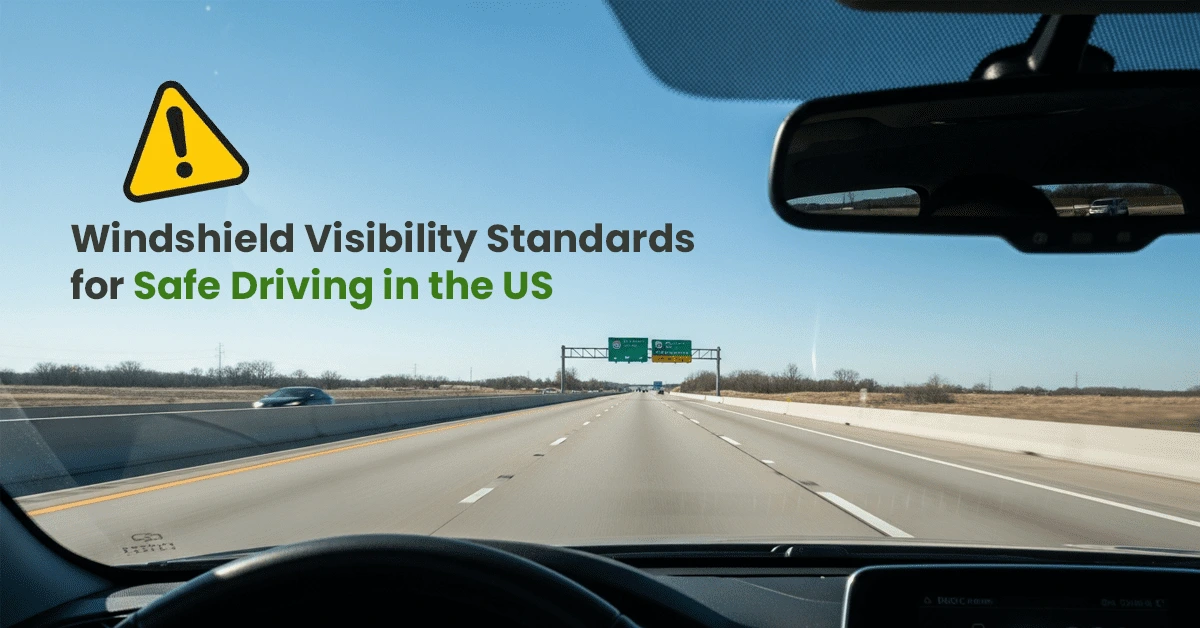

Federal Motor Vehicle Safety Standard (FMVSS) 205 requires windshields to provide unobstructed forward visibility across a minimum 90-degree horizontal field and 30-degree vertical field from the driver’s eye position. Any crack, discoloration, or damage within this critical viewing zone violates federal standards and creates unsafe driving conditions. State laws in Arizona, Florida, and South Carolina build on these federal baselines, each prohibiting windshield damage that impairs driver vision — though enforcement and specific definitions vary.
Understanding visibility standards isn’t just about avoiding tickets. These regulations exist because adequate forward visibility directly correlates with crash avoidance. Research from the National Highway Traffic Safety Administration shows that 94% of serious crashes involve driver error, with visibility impairment contributing to 23% of these incidents. For drivers in Arizona’s bright sun, Florida’s frequent rain, and South Carolina’s varied terrain, maintaining standard-compliant windshield visibility is essential for safe driving.
What Are the Federal Windshield Visibility Standards?
FMVSS 205, established by NHTSA, sets minimum requirements for automotive glazing used in motor vehicles. The standard addresses optical quality, light transmission, and impact resistance, but its most relevant provision for everyday drivers concerns unobstructed visibility.
Critical viewing area requirements:
- Horizontal field: Minimum 90 degrees of unobstructed view centered on driver position
- Vertical field: Minimum 30 degrees from horizontal plane upward
- Optical quality: No more than 0.25 diopter distortion across viewing area
- Light transmission: Minimum 70% visible light transmittance through windshield
- Discoloration prohibition: No tinting or aftermarket films in critical viewing zone
The “critical viewing area” extends from the driver’s eye point — defined as 635mm behind the steering wheel centerline and 64-78mm above the seat reference point — through the windshield. Any damage, tint, or modification in this zone that exceeds distortion limits violates federal standards.
FMVSS 205 also addresses windshield retention during crashes — the structural safety role your windshield provides — but the visibility requirements directly impact daily driving safety. The Insurance Institute for Highway Safety (IIHS) notes that windshield compliance with FMVSS 205 optical standards reduces “looked but didn’t see” accidents by an estimated 15-20%. First established in 1972 and updated periodically for modern vehicles, the standard applies to all vehicles manufactured for sale in the U.S. and is enforced at the manufacturing stage, with states developing their own enforcement mechanisms for non-compliant modifications or damage.
How Does Arizona Enforce Windshield Visibility Laws?
Arizona Revised Statute 28-959 requires that windshields be “free from any crack or discoloration which would impair the driver’s vision.” The statute doesn’t define specific crack sizes or locations — enforcement relies on officer discretion about whether damage impairs vision.
Officers typically cite windshield violations when cracks cross the driver’s direct sight line, roughly the area behind the steering wheel extending upward. Small chips outside this zone rarely trigger stops, but any crack visible in the critical viewing area may result in citations.
Arizona’s extreme sun exposure creates unique visibility challenges. Windshield cracks amplify glare during the state’s 300+ sunny days annually. Morning and evening sun on east-west highways like I-10 and I-8 becomes blinding when light refracts through damaged glass. Officers are more likely to stop vehicles with obvious cracks during peak glare hours, particularly on routes where sun angle creates dangerous conditions.
Arizona-specific enforcement factors:
- Citation fine: $150-200 for windshield violations, often issued as a “fix-it ticket” dismissed upon repair proof
- No inspection program: Arizona doesn’t require periodic safety inspections, so compliance depends on traffic enforcement
- Tint regulations: Front windshield tinting prohibited below the AS-1 line (approximately 4-6 inches from top)
- Sun glare liability: Crashes attributed to sun glare where windshield damage exists may affect insurance liability determinations
Phoenix, Tempe, Mesa, Chandler, and other metro areas see more consistent enforcement than rural areas. However, highway patrol on I-10, I-17, and US-93 actively enforces equipment violations including windshield damage. Tucson and southern Arizona corridors face similar scrutiny, particularly along I-10 between Phoenix and Tucson where sunrise and sunset glare is notorious.
What Are Florida’s Windshield Visibility Requirements?
Florida Statute 316.610 mandates that windshields be “in good condition” with “safety glazing” that provides “adequate vision.” Like Arizona, Florida doesn’t specify exact crack measurements — compliance is subjective based on whether damage impairs safe operation.
Florida’s 2023 auto glass reforms (SB 1002) primarily addressed insurance fraud and prohibited inducements, but the law reinforced existing visibility standards. The Department of Highway Safety and Motor Vehicles now emphasizes windshield condition during traffic stops, particularly in areas with high accident rates.
Florida enforcement patterns: South Florida (Miami-Dade, Broward, Palm Beach) sees stricter enforcement than rural northern Florida. I-95 and Florida’s Turnpike have heavy law enforcement presence monitoring equipment violations. Officers issue windshield citations when damage is clearly visible or when they observe unsafe driving behaviors that might relate to visibility impairment.
Florida’s frequent rain creates additional visibility challenges. Cracks that seem minor in clear weather become serious obstructions when rain fills the damage and creates refraction. Officers are more likely to cite windshield violations during or after rain events, particularly if they observe erratic driving suggesting visibility problems.
Florida-specific considerations:
- Citation range: $116-158 for windshield violations (varies by county)
- No inspection requirement: Florida eliminated vehicle inspections, relying on traffic enforcement
- Hurricane-related damage: Post-hurricane periods see increased scrutiny of windshield damage from debris
- Tourist vehicle enforcement: Rental vehicles with damage may face immediate citations, affecting tourists unfamiliar with local standards
Major cities (Jacksonville, Tampa, Orlando, Miami) have police departments that prioritize equipment violations as part of traffic safety initiatives. Rural highways see less consistent enforcement, but State Troopers actively monitor I-75, I-4, and I-10.
How Does South Carolina Handle Windshield Compliance?
South Carolina Code 56-5-5010 requires windshields to be “free from any crack or discoloration which would impair the driver’s vision.” The language mirrors Arizona’s statute, creating similar officer discretion in enforcement.
South Carolina’s geography creates varied enforcement environments. Coastal regions (Charleston, Myrtle Beach, Hilton Head) see heavy tourist traffic and more visible law enforcement presence. Upstate (Greenville, Spartanburg) and Midlands (Columbia) regions have different enforcement priorities, with interstate highways receiving most attention.
Highway Patrol focuses on I-95, I-26, I-85, and I-77, where commercial and interstate traffic create safety concerns. Officers are trained to identify equipment violations including windshield damage during routine stops. Unlike Arizona and Florida, some South Carolina counties offer voluntary safety inspection programs. While not mandatory statewide, participation in these programs can identify windshield violations before they result in traffic citations.
South Carolina enforcement considerations:
- Citation fines: $100-200 depending on jurisdiction
- County variation: Enforcement intensity varies significantly between counties
- Voluntary inspections: Some counties offer safety checks that include windshield assessment
- Agricultural vehicle exemptions: Farm equipment has different standards, though personal vehicles must comply fully
What Does “Impaired Vision” Actually Mean Under the Law?
State laws reference “impaired vision” without precise definitions. Courts and law enforcement interpret this based on reasonable person standards — would the damage prevent a typical driver from seeing hazards, reading signs, or maintaining lane position?
Location: Damage in the driver’s direct sight line clearly impairs vision. Cracks crossing the area behind the steering wheel extending upward will almost certainly be cited if noticed.
Size: Small chips under 1 inch outside the direct sight line rarely qualify as vision-impairing. Cracks longer than 6 inches anywhere on the windshield increasingly appear to impair safe operation, even if not directly in the sight line. What starts as a small chip can quickly become a major safety hazard — especially in Arizona heat or Florida humidity where propagation accelerates.
Distortion: Cracks that create visible light refraction, starbursts at night, or distorted images of vehicles and signs qualify as vision-impairing regardless of size.
Multiple damage points: Several chips or cracks across the windshield, even if individually minor, collectively impair vision by creating visual noise.
Context: Damage evaluated in bright sunlight or at night may appear more or less impairing. Officers often assess visibility from the driver’s seat perspective, not from outside the vehicle.
A 2019 study by the Virginia Tech Transportation Institute found that drivers with windshield cracks in their sight line experienced 18% longer hazard identification times compared to drivers with clear windshields. This objective data supports subjective “impaired vision” determinations in court.
Court precedent guidance: Cracks in the driver’s direct forward view are consistently upheld as vision-impairing. Chips and cracks on the passenger side rarely meet the impairment threshold unless extensive. Combinations of multiple small damages can constitute impairment. And officer testimony about inability to make eye contact through the windshield is often sufficient for conviction.
How Does Optical Distortion Affect Windshield Compliance?
Beyond legal definitions, optical distortion provides an objective measure of windshield quality. FMVSS 205 limits distortion to 0.25 diopter across the critical viewing area. This specification ensures that straight lines remain straight when viewed through the windshield, preventing visual confusion about object positions.
Undamaged windshields meeting FMVSS 205 create virtually no distortion — a straight highway lane marking appears straight through the glass. Cracks and chips disrupt this optical clarity. The damaged area acts as an unintended prism, bending light at incorrect angles.
Practical distortion assessment: View a straight edge (fence line, building, road marking) through the windshield. If it appears bent, wavy, or discontinuous, the glass creates unacceptable distortion. At night, view streetlights or headlights through different windshield areas. If lights appear as single points in undamaged areas but create starbursts or halos through cracks, optical distortion exists.
Modern windshields integrate ADAS cameras behind the glass. These cameras require even stricter optical standards — distortion that might be tolerable for human vision renders camera systems unreliable. Any damage in the camera’s field of view typically exceeds acceptable distortion limits for system function. This is why glass quality matters so much during replacement. Understanding the difference between OEM and aftermarket glass quality tiers is critical because economy glass not carrying proper FMVSS 205 certification may not meet the optical standards required for both human vision and ADAS camera performance.
Sources of optical quality degradation: Cracks create sharp changes in light direction causing distortion and glare. Chips act as lenses, focusing or scattering light unpredictably. Improper repairs can leave resin with a different refractive index than the glass. Economy aftermarket glass may not meet OEM optical quality standards. And UV exposure over time can degrade the lamination layer, creating haze that reduces light transmission below the 70% federal minimum.
How Do Regional Environmental Conditions Affect Windshield Visibility?
Arizona, Florida, and South Carolina present distinct environmental challenges for windshield visibility that accelerate damage and degrade optical quality differently.
Arizona’s intense sun: With 300+ days of sunshine and summer temperatures exceeding 110°F, Arizona windshields face constant UV exposure. This accelerates PVB (polyvinyl butyral) layer degradation, creating haze that reduces light transmission below the 70% federal minimum. Dust storms coat windshields in fine particles that, if not cleaned properly, create permanent light-scattering damage. East-west highways face severe sun glare during morning and evening commutes, and I-10 between Phoenix and Tucson is particularly notorious for blinding sunrise and sunset conditions. Any windshield damage amplifies this natural glare into dangerous visibility impairment.
Florida’s humidity and rain: Florida averages 50-65 inches of annual rainfall with near-daily summer thunderstorms. Rain reveals windshield problems — cracks fill with water, creating additional refraction. Humidity accelerates PVB delamination, causing the cloudy appearance that reduces light transmission. Salt air in coastal regions corrodes windshield mounting hardware and can penetrate chips, causing internal damage that degrades optical quality. Urban pollution in Miami and Tampa also deposits films that reduce windshield clarity.
South Carolina’s temperature swings: South Carolina experiences 90°F+ summers and below-freezing winters, particularly in the Upstate region. This temperature cycling stresses windshields, causing expansion and contraction that degrades optical quality over time. The state’s position between mountains and coast creates varied weather — drivers may encounter fog in the morning, rain at midday, and clear sun in the afternoon, all requiring optimal windshield visibility.
| State | Primary Challenge | Visibility Impact | Recommended Response |
|---|---|---|---|
| Arizona | UV exposure, dust, extreme heat | Accelerated haze, amplified glare | Replace windshields showing haze; clean frequently |
| Florida | Humidity, salt air, heavy rain | Delamination, crack water retention | Address damage before rainy season; annual inspections |
| South Carolina | Temperature cycling, varied weather | Stress-related degradation, fog challenges | Replace damaged windshields before winter |
What Is the AS-1 Line and How Does It Affect Tinting Rules?
The “AS-1 line” appears on most windshields as a subtle marking 4-6 inches from the top edge. This designation indicates the area where factory tinting is permitted. Above the AS-1 line, windshields may have sun-shading tint. Below it, glass must maintain minimum 70% light transmission to comply with FMVSS 205.
Arizona, Florida, and South Carolina all prohibit aftermarket tinting below the AS-1 line on front windshields. This regulation protects the critical viewing area’s light transmission. However, damage to factory-tinted areas above the AS-1 line can still impair vision if extensive or in the driver’s sight line.
Tint and visibility considerations: Factory tint bands reduce glare but shouldn’t extend into the critical viewing area. Aftermarket windshield replacement must replicate factory tint placement. Damage to tinted areas still creates distortion even if outside the primary viewing zone. And illegal tinting below the AS-1 line creates compounded visibility problems if damage occurs in the same area.
When Does Windshield Damage Cross Into Non-Compliance?
Federal and state standards together create clear compliance thresholds. Here’s how damage severity maps to compliance status:
Definite non-compliance:
- Any crack crossing the driver’s direct sight line
- Damage causing light transmission below 70% (advanced haze or delamination)
- Optical distortion exceeding 0.25 diopter (visible bending of straight lines)
- Discoloration from attempted repairs or contamination in viewing area
- Cracks longer than 12 inches anywhere on windshield
Probable non-compliance:
- Cracks 6-12 inches in length within 12 inches of the driver’s head position
- Multiple chips (3+) within the critical viewing zone
- Star breaks or bull’s-eye chips in the sight line
- Edge cracks (within 2 inches of the frame) that create visible distortion
Likely compliant but should be repaired:
- Single small chips outside the direct sight line
- Very short cracks (under 3 inches) in passenger areas
- Minor damage more than 18 inches from the driver’s head position
- Damage that doesn’t create visible distortion or glare
The conservative approach: if you notice damage while driving and find yourself adjusting your head position to see around it, the windshield doesn’t meet visibility standards regardless of technical measurements.
What Are the Insurance and Liability Implications of Non-Compliant Windshields?
Driving with windshield damage that violates visibility standards creates insurance liability concerns well beyond traffic citations. If you’re involved in an accident where visibility was relevant, insurance adjusters will examine windshield condition.
Liability scenarios that affect real claims:
You fail to yield at an intersection, claiming you didn’t see the other vehicle. Investigators find windshield cracks in your sight line. Your insurance company may reduce or deny your claim, arguing that non-compliant glass contributed to the crash.
You rear-end a vehicle that braked suddenly. Your windshield has extensive damage creating night vision impairment. Even if the crash occurred during daylight, the damaged windshield suggests a pattern of negligent vehicle maintenance, potentially affecting liability determination.
A pedestrian enters a crosswalk and you don’t stop in time. Windshield damage in your viewing area becomes evidence of inadequate visibility, strengthening the pedestrian’s injury claim against you.
Insurance considerations: Comprehensive coverage typically includes glass damage — often with zero deductible under full glass coverage. Glass claims don’t typically affect premiums because they’re classified as comprehensive, not collision. Filing a windshield claim promptly and documenting the repair protects against future liability claims. However, driving with known non-compliant windshields may void certain coverage protections. Understanding your deductible structure helps you make the right financial decision on timing.
NuVision Auto Glass works directly with all major insurance providers in Arizona, Florida, and South Carolina. Claims processing is streamlined, often resulting in zero out-of-pocket costs for replacement. Given the liability exposure from non-compliant windshields, utilizing available insurance coverage is prudent risk management.
When Does Windshield Damage Require Replacement vs. Repair?
Not all windshield damage requires replacement to restore visibility compliance, but repair success depends on damage characteristics.
Repairable damage (maintains visibility standards): Chips under 1 inch outside the critical viewing zone, short cracks under 3 inches not in the direct sight line, damage more than 3 inches from the sight line center, chips without radiating cracks, and recent damage without contamination. Professional resin repair restores 80-90% of original optical clarity. While not perfect, properly repaired chips don’t violate visibility standards if done correctly. However, repairs in the driver’s direct sight line may leave visible artifacts that technically impair vision even if minor.
Replacement necessary (repair won’t restore compliance): Any crack in the driver’s direct sight line, cracks longer than 6 inches, edge cracks within 2 inches of the frame, multiple intersecting cracks, chips that have propagated during delay, and previously repaired areas with new damage. For drivers paying out of pocket, understanding the full cost breakdown of windshield replacement without insurance helps you budget appropriately. Arizona allows cashback incentives (currently up to $375 with NuVision), making replacement economically attractive. Florida and South Carolina prohibit cashback but insurance coverage typically results in minimal out-of-pocket expense.
Why Does Professional Assessment of Compliance Matter?
DIY assessment provides general guidance, but professional evaluation ensures compliance. Certified technicians understand federal standards, state requirements, and practical enforcement patterns. Before choosing a shop, knowing the right questions to ask any auto glass provider ensures you get accurate compliance assessment — not just a sales pitch for unnecessary replacement.
Professional assessment includes: Optical distortion testing from the driver’s position, light transmission measurement, evaluation of damage location relative to the critical viewing zone, assessment of repair feasibility vs. replacement necessity, and ADAS camera field-of-view impact determination. For vehicles with advanced safety systems, the camera’s optical requirements are even stricter than what human vision demands — damage that looks “minor” to you may render your automatic emergency braking system non-functional.
NuVision Auto Glass offers free windshield assessments at all Arizona, Florida, and South Carolina locations. Our mobile service brings assessment to your location — technicians evaluate compliance and provide documentation of findings. If replacement is recommended, same-day service is typically available. See what customers say about our assessment accuracy and service quality on our verified Google Business Profile.
Frequently Asked Questions
Are windshield stickers and decals legal?
Small registration stickers in the lower corners are permitted. Larger decals, hanging objects, or dashboard decorations that obstruct the view violate visibility standards in all three states. If the object blocks any part of the critical viewing area, it’s a citable violation.
Can I be cited for a crack outside my direct sight line?
Yes, if officers determine it impairs safe operation. Long cracks, multiple damages, or extensive passenger-side damage can trigger citations even if not directly in the driver’s view. Cracks longer than 12 inches anywhere on the windshield are generally considered non-compliant.
Do aftermarket windshields meet the same visibility standards as OEM?
Quality aftermarket glass meeting FMVSS 205 certification equals OEM optical standards. However, economy glass not carrying proper certifications may not comply. Always verify that replacement glass is FMVSS 205 certified, and for Honda and other ADAS-equipped vehicles, confirm OEM-equivalent optical quality from a reputable manufacturer like Pilkington, Saint-Gobain, AGC, or Guardian.
Will I fail inspection with windshield damage?
Arizona and Florida don’t have mandatory inspections. Some South Carolina counties offer voluntary inspections that include windshield checks — significant damage would result in a failed inspection. Even without mandatory inspections, traffic enforcement can cite non-compliant windshields during any routine stop.
How quickly should I repair windshield damage to maintain compliance?
Immediately. Damage worsens rapidly, particularly in Arizona heat where thermal expansion propagates cracks within days and Florida humidity where moisture penetrates chips and accelerates internal degradation. What’s compliant today can become non-compliant within days.
Does my insurance cover replacement for visibility compliance?
Yes. Comprehensive coverage includes glass damage regardless of whether it formally violates standards or just creates risk. You don’t need to prove non-compliance — the damage itself justifies coverage. Most glass claims result in zero premium increase.
Compliance Equals Safety
Federal and state visibility standards exist because clear windshields save lives. The 90-degree horizontal, 30-degree vertical critical viewing area requirements ensure drivers can identify hazards, read signs, and maintain safe vehicle control. Damage that violates these standards — whether through location, optical distortion, or reduced light transmission — creates dangerous driving conditions and real liability exposure.
Key takeaways:
- FMVSS 205 requires minimum 70% light transmission and maximum 0.25 diopter distortion
- Arizona, Florida, and South Carolina all prohibit damage impairing driver vision
- Cracks in the driver’s sight line clearly violate compliance standards across all three states
- Enforcement relies on officer discretion but focuses on obvious impairment
- Insurance covers repair and replacement with minimal out-of-pocket cost in most cases
- Liability exposure from non-compliant windshields exceeds citation risk
For drivers in Arizona, Florida, and South Carolina, maintaining visibility-compliant windshields is straightforward: address damage promptly, use certified repair and replacement providers, and verify that work meets federal and state standards. NuVision Auto Glass provides free compliance assessments, works directly with insurance, and uses only FMVSS 205-certified glass. Check our Google Business Profile to see how customers rate our service, then schedule your assessment.