How Windshield Damage Affects Night Driving & Headlight Glare?
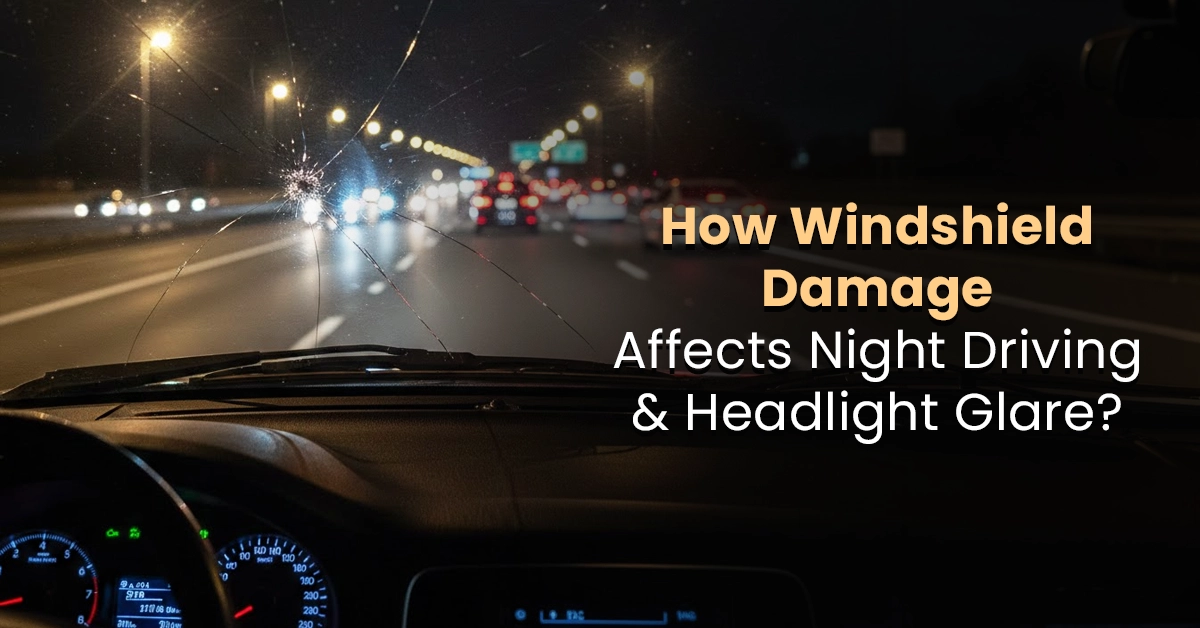
Windshield damage amplifies headlight glare by 300-500%, creating starbursts, halos, and light scattering that severely impair night vision. Cracks and chips refract light at irregular angles, turning oncoming headlights into blinding visual obstacles. Research shows that drivers with damaged windshields require 2-3 seconds longer to identify road hazards at night, a delay that can mean traveling an additional 176-264 feet (nearly a football field) before reacting to danger.
For drivers in Arizona, Florida, and South Carolina, night driving with windshield damage is particularly hazardous. Arizona’s rural highways have limited lighting with long stretches between cities. Florida’s I-95 and I-75 corridors see heavy nighttime traffic with constant headlight exposure. South Carolina’s winding two-lane roads through rural areas combine darkness with oncoming traffic on narrow lanes. This article examines how windshield damage interacts with light, the physiological impact on your vision, and when damage becomes critically dangerous after sunset.
The Physics of Light Refraction Through Damaged Glass
Intact windshield glass is engineered for optical clarity, with specific refractive properties that minimize distortion. The laminated structure, two glass layers bonded to PVB (polyvinyl butyral) plastic, maintains uniform light transmission. Understanding what makes an OEM windshield different helps explain why glass quality directly affects how light passes through. When cracks or chips disrupt this structure, light behaves unpredictably.
A crack creates multiple surfaces and angles where none should exist. When headlight beams strike these irregular surfaces, light refracts (bends) at different angles. Instead of passing cleanly through the windshield, the beam scatters in multiple directions. Your eyes receive light from the intended source plus dozens of scattered rays, creating the starburst effect that makes it impossible to judge the actual position and distance of oncoming vehicles.
Chips create similar problems through a different mechanism. The impact point creates a crater with radiating fractures. Each tiny fracture line acts as a prism, splitting and redirecting light. A chip the size of a quarter can create 20-30 individual light-scattering points. When headlights hit this damaged area, you see a bright, amorphous glow rather than distinct light sources. Over time, environmental exposure can worsen these impact points through a process known as windshield pitting.
The problem intensifies with modern LED and HID headlights, which produce more focused, higher-intensity light than older halogen bulbs. According to the American Automobile Association (AAA), LED headlights measure 2,000-3,000 lumens compared to 700-1,200 lumens for halogens. When this intensified light strikes damaged glass, the scattered effect is proportionally more blinding.
| Damage Type | Light Scattering Pattern | Nighttime Impairment Level |
| Vertical crack (2-6″) | Linear starburst across sight line | Severe – blocks central vision |
| Horizontal crack | Wide horizontal flare | Moderate-Severe – obscures horizon |
| Star chip | 360-degree starburst radiating from point | Severe – creates bright “bloom” |
| Bull’s eye chip | Circular halo effect | Moderate – concentrated glow |
| Edge crack | Asymmetric scatter toward damage | Moderate – peripheral distraction |
| Multiple small chips | Scattered points of glare across windshield | Severe – continuous distraction |
Physiological Impact: How Your Eyes Respond to Scattered Light
Night vision depends on your pupils dilating to allow more light into your eyes. In darkness, pupils expand to 6-8mm diameter compared to 2-3mm in daylight. This increased opening makes your eyes more sensitive to bright light, and more vulnerable to glare.
When scattered light from damaged windshield glass enters your dilated pupils, your eyes experience several detrimental effects:
Photophobia Response
Sudden bright light causes pupils to constrict reflexively, reducing your ability to see darker areas of the road. You lose night vision for 3-5 seconds every time oncoming headlights hit your windshield crack. On a two-lane highway, you might encounter oncoming vehicles every 10-15 seconds, meaning you’re effectively night-blind 30-50% of the time.
Halos and Starbursts
Scattered light creates perception errors. Your brain tries to process multiple conflicting light sources and can’t accurately determine the position of the actual headlight. This makes it difficult to judge whether an oncoming vehicle is in its lane, how far away it is, or even how many vehicles are approaching.
Reduced Contrast Sensitivity
Glare from damaged glass reduces your ability to distinguish objects against dark backgrounds. Pedestrians, animals, disabled vehicles, and road debris blend into darkness because your eyes are overwhelmed by scattered light from the windshield. This is also the moment when your windshield’s structural role as an airbag deployment backstop matters most, because impaired visibility raises the odds of a collision in the first place.
Eye Strain and Fatigue
Constant glare forces your eyes to work harder, causing strain, watering, and fatigue. On long night drives, this accumulates into severe discomfort and reduced alertness, exactly when you need maximum vigilance.
A study by the University of Michigan Transportation Research Institute found that drivers over age 50 experience twice the glare sensitivity of younger drivers. For older drivers in Arizona’s retirement communities or Florida’s senior population, windshield damage creates exponentially greater night vision impairment.
- 2-3 seconds longer to identify hazards with damaged windshields at night
- 176-264 feet additional distance traveled before hazard recognition (at 60 mph)
- 300-500% amplification of headlight glare through cracks and chips
- 3-5 second night vision loss during each glare event
- 2x glare sensitivity in drivers over age 50
Regional Night Driving Hazards
Arizona Challenges
The state’s extensive rural highway system means long stretches of darkness interrupted only by occasional oncoming traffic. When headlights do appear, they’re often visible for miles, and if your windshield is damaged, those lights become sources of continuous glare approaching for 30-60 seconds before passing.
Arizona’s I-10 between Phoenix and Tucson, I-17 north to Flagstaff, and US-93 toward Las Vegas traverse remote desert with minimal ambient light. Wildlife crossings are common (deer, javelina, coyotes), and reduced visibility from windshield glare eliminates your ability to spot animals on the roadside before they enter your path.
Additionally, Arizona’s large senior driving population, particularly in communities like Sun City, Green Valley, and Prescott, means more drivers with naturally reduced night vision. Windshield damage compounds this age-related decline, creating dangerous conditions for a vulnerable population. For more on managing glare, see our guide on tips to minimize windshield glare for safer driving.
Florida Challenges
The state’s humid climate creates additional light-scattering conditions even without windshield damage. Add cracks or chips, and glare becomes overwhelming. Florida’s frequent night thunderstorms combine rain, road spray from other vehicles, and headlight reflection, all multiplied by damaged glass.
Florida’s urban corridors (I-4, I-95, I-75) have constant traffic, meaning continuous headlight exposure. Unlike rural Arizona stretches where glare is intermittent, Florida night driving involves near-continuous glare events. If your windshield has multiple chips or cracks, you’re essentially driving through a kaleidoscope of scattered light. Drivers in Miami, Tampa, Orlando, and Jacksonville face this every night.
Florida also sees high rates of nighttime pedestrian and bicycle accidents. The National Highway Traffic Safety Administration reports that Florida consistently ranks in the top three states for pedestrian fatalities. Windshield damage that impairs your ability to see pedestrians in crosswalks or along roadways significantly increases this risk.
South Carolina Challenges
The state’s topography creates unique night driving difficulties. Mountain roads in the Upstate region near Greenville (US-25, SC-11) have tight curves, elevation changes, and limited shoulders, all demanding maximum visibility. Windshield glare on these roads eliminates the advance warning you need to navigate safely.
South Carolina’s two-lane rural highways represent a large portion of the state’s road network, meaning frequent oncoming traffic at close range. A crack in your windshield turns each passing vehicle into a blinding event. US-17 along the coast near Charleston, US-278 toward Hilton Head, and US-321 through the Midlands near Columbia all see heavy traffic with limited lighting.
The state also has significant agricultural vehicle traffic at night during planting and harvest seasons. Slow-moving equipment with limited lighting requires distance judgment that’s impossible when headlight glare obscures your vision.
Regional factors comparison:
| State | Primary Night Challenge | High-Risk Corridors | Additional Factors |
| Arizona | Remote darkness, wildlife crossings, senior drivers | I-10, I-17, US-93 | Desert glare, elevated altitude reducing air density |
| Florida | Constant urban traffic, pedestrian exposure, rain | I-4, I-95, I-75, US-1 | Humidity amplifying scatter, year-round tourism traffic |
| South Carolina | Winding rural roads, agricultural traffic, coastal routes | US-17, US-25, SC-11 | Varied terrain, limited shoulders, frequent fog in Lowcountry |
Modern Headlight Technology Amplifies the Problem
The shift from halogen to LED and HID (High-Intensity Discharge) headlights over the past decade has dramatically increased glare problems for drivers with damaged windshields. While these technologies improve visibility for the vehicle operator, they create much more intense light that, when scattered by windshield damage, becomes severely blinding.
- Halogen headlights (older technology): 700-1,200 lumens, warm yellowish light with softer beam edges. More forgiving when scattered by windshield damage
- LED headlights (standard in most new vehicles): 2,000-3,000 lumens, cool white light with sharp beam pattern. Creates intense starbursts and halos when scattered by cracks
- HID headlights (high-end vehicles): 3,000-5,000 lumens, extremely intense focused beam. Most problematic when encountering damaged windshields
According to AAA, complaints about headlight glare increased by 47% between 2015 and 2022, corresponding with widespread LED adoption. While some of this increase relates to brightness of the lights themselves, damaged windshields dramatically worsen the effect.
This applies to every vehicle on the road, whether you drive a Toyota, a Honda, a Ford, a Tesla, or a Chevrolet. The physics of light scattering through damaged glass remain the same regardless of make or model.
ADAS Systems and Night Vision Safety
Vehicles equipped with ADAS (Advanced Driver Assistance Systems) rely on forward-facing cameras mounted behind the windshield to monitor road conditions. These systems struggle significantly at night, and windshield damage compounds their limitations.
Automatic Emergency Braking (AEB): Cameras detect vehicles ahead and calculate closing distance. At night, reduced contrast and reliance on reflective surfaces make detection more difficult. Windshield cracks or chips in the camera’s field of view can create false readings, triggering unnecessary braking or failing to detect actual vehicles obscured by glare.
Lane Departure Warning / Lane Keep Assist: These systems track lane markings, which are reflective and thus bright in headlights. Windshield damage distorts the camera’s view of lane markings, causing false warnings or failing to detect when you’re actually drifting out of your lane.
Traffic Sign Recognition: This system reads speed limit and other signs, many of which are reflective. Glare from damaged windshields makes it impossible for the camera to interpret signs correctly, providing false information to the driver.
A study by the Society of Automotive Engineers found that ADAS camera performance degraded by 35-50% when windshields had damage in the camera’s field of view. At night, this degradation increased to 60-75% due to the additional challenge of interpreting scattered light. After any windshield replacement, proper ADAS calibration is essential to ensure these systems function correctly.
- Automatic Emergency Braking (AEB): False triggering or failure to detect vehicles
- Lane Departure Warning (LDW): Inability to track lane markings accurately
- Lane Keep Assist (LKA): Erratic steering inputs based on misread lanes
- Adaptive Cruise Control (ACC): Distance miscalculation in low light
- Traffic Sign Recognition: Inability to read reflective signs
- Automatic High Beam Control: Failure to detect oncoming vehicles properly
When Night Driving Becomes Immediately Unsafe
Certain damage patterns make night driving so hazardous that you should avoid it entirely until replacement:
Critical Damage for Night Driving
- Any crack in driver’s direct sight line: Guaranteed glare from every oncoming headlight
- Vertical cracks: Create linear starbursts that bisect your entire view
- Star chips or bull’s-eye chips in central windshield: Create bright “bloom” effects that obscure large portions of your view
- Multiple chips across windshield: Each becomes a glare source, creating continuous visual noise
- Cracks longer than 6 inches: Extensive scattering across wide areas
- Edge cracks combined with any other damage: Structural concerns plus vision impairment
Damage Allowing Careful Night Driving
- Small chips in passenger areas: Minimal impact on driver’s sight line
- Very small chips (under dime size): Limited scatter effect when not in direct sight line
- Cracks contained to far passenger side: Outside primary field of view
If your damage falls in the second category, our windshield repair service may be able to restore optical clarity without a full replacement. For sudden or severe damage, our emergency auto glass repair service is available across all service areas.
If You Must Drive at Night with Windshield Damage
- Step 1 – Reduce speed: Drop 10-15 mph to increase reaction time
- Step 2 – Increase following distance: Maintain 4-5 seconds vs. the standard 3 seconds
- Step 3 – Look right: Shift your gaze slightly right of oncoming headlights to minimize direct glare
- Step 4 – Anti-reflective glasses: Night driving glasses with anti-reflective coating can reduce glare 15-20%
- Step 5 – Clean your glass: Thoroughly clean interior and exterior windshield surfaces (any film amplifies scatter)
- Step 6 – Dim interior lights: Turn down dashboard brightness and minimize phone and passenger device screens
- Step 7 – Choose well-lit routes: Plan on well-lit roads rather than dark rural highways
However, the safest approach is simple: don’t drive at night with damaged windshields. If damage occurs during the day, get it repaired before sunset.
The Compounding Effect of Other Factors
Windshield damage doesn’t exist in isolation. Other common conditions multiply night vision impairment:
Dirty windshields: Interior and exterior film scatters light even without cracks. Combine film with damage, and glare becomes exponentially worse. Smokers, drivers who use in-vehicle air fresheners, and those who don’t regularly clean windshields experience much more severe night vision problems when damage occurs.
Worn wiper blades: Streaking and smearing from old wipers creates additional scatter points. In Florida’s frequent rain, this combination of damage and poor wipers makes night driving nearly impossible.
Interior lighting: Dashboard lights, phone screens, and passenger device light reflect off the windshield interior. These reflections interact with glare from headlights, creating visual chaos. Your side windows can contribute to this problem as well, since light enters from every angle at night.
Eye conditions: Astigmatism, cataracts, and normal age-related vision changes all increase glare sensitivity. The American Academy of Ophthalmology reports that 90% of people over 65 have some cataract development, which inherently increases glare sensitivity. Add windshield damage, and night vision can become completely impaired.
Fatigue: Tired eyes are more sensitive to glare and less able to recover from bright light exposure. Long night drives with damaged windshields lead to cumulative fatigue that reduces alertness.
Costs of Night Vision Impairment vs. Replacement
Driving with impaired night vision creates risks far exceeding the cost and inconvenience of windshield replacement:
Accident risk: National Safety Council data shows night driving is three times more dangerous than daytime driving. Reduced visibility from windshield damage increases this risk exponentially. A single accident can result in injuries, vehicle damage, increased insurance rates, and potential liability.
Stress and anxiety: Drivers report significant stress when forced to drive at night with damaged windshields. This psychological burden affects overall well-being and may lead to panic responses during critical moments.
Avoided trips: Many drivers simply stop driving at night when windshields are damaged, limiting their mobility and independence. This is particularly problematic for people who work evening shifts or have medical emergencies requiring night travel.
Compare these consequences to replacement costs:
- With insurance: Typically $0-100 out of pocket (most comprehensive policies cover glass fully)
- Without insurance: $300-500 for standard replacement
- Time investment: 60-90 minutes for mobile service
- Result: Restored night vision safety, reduced stress, full mobility
For a full breakdown of what to expect, check our guide on how much it costs to replace a windshield.
NuVision Auto Glass offers same-day replacement in most areas throughout Arizona, Florida, and South Carolina. Mobile service means technicians come to your home or workplace, and by the time you finish dinner or your workday, your vehicle is ready with clear, safe glass.
Proper Installation for Optimal Optical Clarity
Even new windshields can cause night vision problems if improperly installed. Quality matters:
- OEM-equivalent optical quality: Cheap aftermarket glass often has optical distortions, waviness, or tinting inconsistencies that create glare even when new. Quality glass meeting FMVSS 212 ensures optical clarity matching factory specifications. Learn how to verify if your replacement windshield is OEM
- Proper alignment: Windshields must be installed with precise alignment. Even slight misalignment can create visual distortion at night
- Clean installation: Adhesive smears, fingerprints on interior glass surfaces, or contaminants in the urethane bond can all create scatter points that cause glare
- Tint matching: If your vehicle has factory-tinted windshields, replacement glass must match exactly. Mismatched tint creates visual adaptation problems as your eyes constantly adjust to different light levels
NuVision Auto Glass uses only quality OEM-equivalent glass, maintains rigorous installation procedures, and trains technicians specifically on optical clarity standards. Every installation at Scottsdale and across all our service areas is inspected for alignment, cleanliness, and proper curing before completion.
Conclusion: Clear Glass Is Non-Negotiable for Night Safety
Windshield damage turns night driving from routine to hazardous. The 300-500% increase in glare, 2-3 second delay in hazard recognition, and impairment of ADAS systems create compounding risks that no driver should accept. Modern LED and HID headlights make the problem significantly worse than just a few years ago.
- Glare amplification makes hazard recognition 2-3 seconds slower (176-264 feet at 60 mph)
- Modern LED headlights create 200-300% more glare through damaged glass than halogens
- Drivers over 50 experience twice the glare sensitivity with windshield damage
- ADAS systems lose 60-75% effectiveness at night with windshield damage
- Insurance typically covers replacement at minimal or no cost
For Arizona, Florida, and South Carolina drivers who regularly drive at night, windshield damage isn’t a minor inconvenience, it’s a critical safety issue. Regional factors (Arizona’s dark rural highways, Florida’s constant traffic, South Carolina’s winding roads) make night vision impairment even more dangerous.
If you’re experiencing headlight glare, starbursts, or halos due to windshield damage, don’t risk your safety or others’ by driving with impaired night vision. Replacement is fast, affordable, and potentially life-saving.
Get a Free Quote in 60 Seconds →
Frequently Asked Questions
Can I wear sunglasses at night to reduce glare from my damaged windshield?
No. Sunglasses further reduce light reaching your eyes, making it even harder to see road hazards. Night driving glasses with anti-reflective coating may provide 10-15% glare reduction but won’t eliminate the problem from windshield damage.
Does cleaning my windshield reduce glare from cracks?
Yes, somewhat. Interior and exterior film amplifies scatter, so thorough cleaning helps. However, it doesn’t eliminate the fundamental problem of light refraction through damaged glass.
Are LED headlights illegal because they’re too bright?
No. Properly aimed LED headlights meeting Federal standards are legal. The problem isn’t the lights themselves, it’s how windshield damage scatters their intense beams.
How quickly should I replace a windshield if I need to drive at night regularly?
Within 24-48 hours maximum. Night driving with damaged windshields is genuinely dangerous, particularly on high-speed highways or rural roads with wildlife.
Will insurance cover replacement if my only complaint is night vision problems?
Yes. Any crack or chip is legitimate damage covered by comprehensive policies. You don’t need to prove a specific safety threshold. The damage itself justifies replacement.
Can I just use high-beam headlights to see better with a damaged windshield?
No. This makes oncoming glare even worse for you (your high beams reflect off your own damaged glass) and blinds other drivers. Never use high beams to compensate for windshield damage.