#1 Smart Glazing: What Electrochromic Glass Does, Which Cars Have It, and What It Means When It Breaks
A customer in Scottsdale called us last month after his BMW iX panoramic roof got a crack from a falling tree branch. He knew it wasn’t a standard glass job. The roof panel uses electrochromic glass — the kind that tints or clears at a button press. He wanted to know whether we could handle it and what it would cost versus the dealer.
We replaced it. But the conversation that followed was one we’re having more often now, because electrochromic glass is no longer limited to $100,000 vehicles. It’s appearing in mid-range models, EVs, and even some mainstream SUVs — and most drivers have no idea how it works, what breaks it, or what a replacement actually involves.
The short answer
Electrochromic glass tints or clears on demand via a small electric current through a tungsten oxide layer. Over 60% of new luxury vehicles now include it. It’s expanding to mid-range models fast. When it breaks, standard aftermarket glass restores structure but not function — the replacement spec matters.
How Does Electrochromic Glass Actually Work?
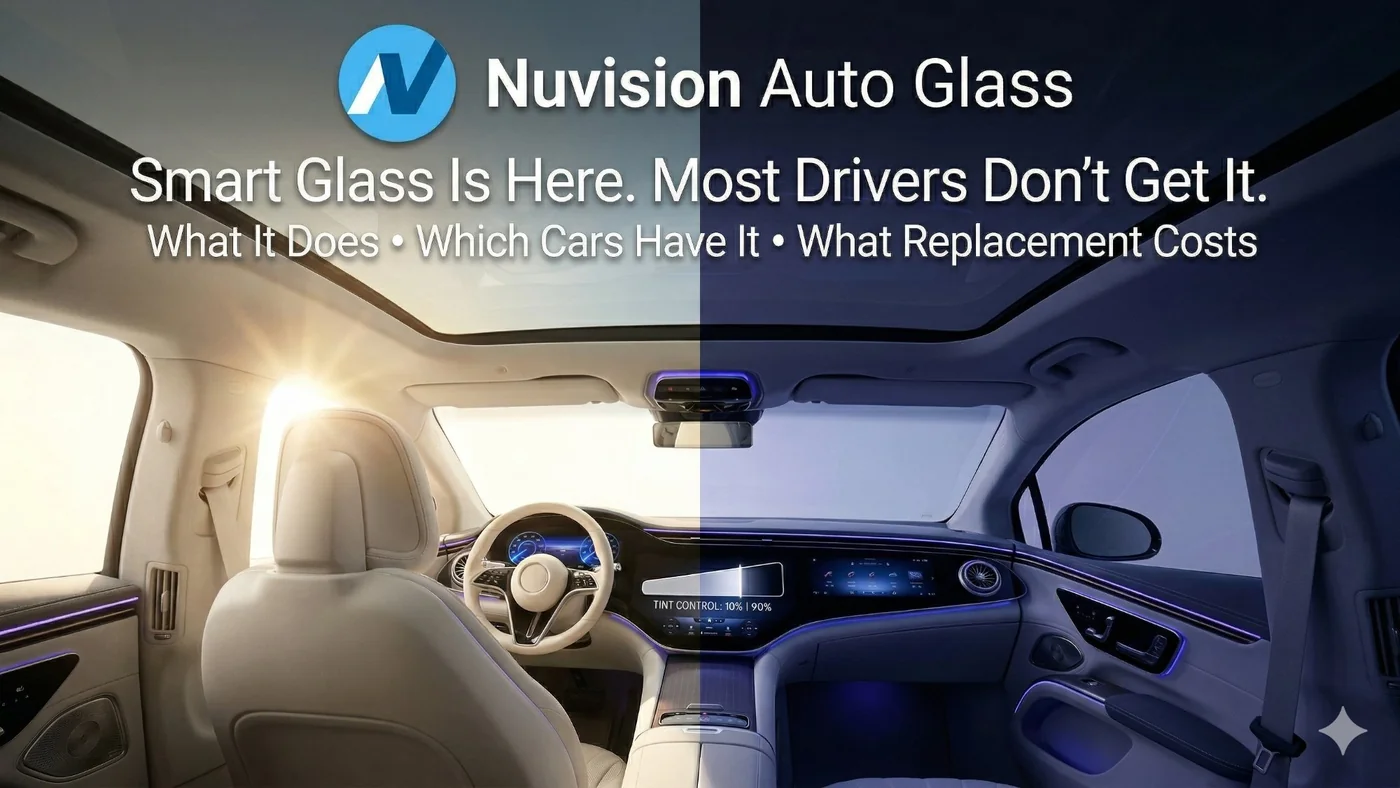
Regular tinted glass has a fixed shading level built into the glass during manufacture — it can’t change. Electrochromic glass is different. Inside the laminated structure, a thin layer of tungsten oxide sits between conductive coatings. When a small electric current flows through the layer, tungsten oxide ions rearrange — the glass shifts from clear to tinted. Reverse the current and it shifts back.
The process is entirely contained within the glass itself. No film, no shade mechanism, nothing moving. The current required is low enough that it doesn’t register as meaningful battery draw even in an EV.
Switching speed depends on panel size. A small rearview mirror dims in under a second. A large panoramic roof panel — some now exceed 1.5 metres across — can take 5–15 seconds to fully transition. It’s gradual, not instant, which is actually by design. Abrupt tint changes in the driver’s peripheral vision would be distracting.
| Technology | Switching Speed | Best For | Common In |
|---|---|---|---|
| Electrochromic (EC) | 5–15 seconds | Energy efficiency, comfort, UV blocking | Panoramic roofs, sunroofs, windshields |
| Suspended Particle Device (SPD) | 1–3 seconds | Rapid shading, privacy | Luxury sunroofs, high-end sports cars |
| PDLC (Polymer Dispersed Liquid Crystal) | Under 1 second | Instant privacy — clear or fully opaque only | Rear windows, interior partitions |
Electrochromic leads the market with around 46% share as of 2025 because it offers the best balance of gradual control, energy efficiency, and durability for large automotive glass surfaces.
Which Cars Have Electrochromic Glass Right Now?
Five years ago the answer was primarily high-end European marques and Tesla. The list has expanded considerably.
Tesla Cybertruck — dimmable electrochromic roof panel, controlled via the centre screen. One of the largest single-panel implementations in a production vehicle.
BMW iX — the SkyLounge panoramic roof uses Suspended Particle Device glass that transitions in under two seconds. BMW has been running electrochromic technology in their rearview mirrors across the range for years.
Mercedes EQS — optional Panoramic Sliding Sunroof with electrochromic tinting. The EQS also uses electrochromic glass on the rear side windows in some configurations.
Cadillac CELESTIQ and Ferrari Purosangue — both use Gauzy SPD technology on their roof glass. The CELESTIQ allows individual zone control, so front and rear passengers can set different tint levels.
Nissan Leaf — one of the first mainstream non-luxury models to add the technology to its panoramic roof. This is the canary for broader mid-range adoption — if it makes economic sense on a Leaf, expect it on mainstream SUVs within a few model years.
Audi has had electrochromic auto-dimming mirrors as standard across much of its range since the early 2010s. The step from mirror to roof glass to side window is a matter of cost curve, not technology maturity.
Why Does Electrochromic Glass Matter More in Hot Climates?
The functional benefit scales directly with sun exposure. In a mild climate, the difference between smart glass and standard tinted glass is mostly comfort and aesthetics. In a hot climate, it has a measurable impact on cabin temperature — and on EV range.
A parked vehicle in direct sun accumulates heat through the glass before the driver even gets in. Standard glass transmits roughly 70–75% of near-infrared solar radiation into the cabin. Electrochromic glass at maximum tint cuts that to around 30–40%. The cabin temperature difference at peak exposure is up to 20°F.
For EVs — where air conditioning draws directly from the battery — that 20°F head start means the AC runs at lower load to achieve a comfortable temperature. Over a day of short trips with frequent parking cycles, the cumulative range benefit is real.
Arizona. Phoenix gets over 300 days of direct sun per year. Vehicle interior temperatures regularly hit 140–160°F on summer afternoons. Electrochromic glass set to maximum tint on a parked vehicle actively suppresses that heat accumulation in a way that fixed tint can’t — fixed tint is calibrated for a balance between light transmission and UV blocking, not for maximum heat rejection on demand. For EV drivers in Phoenix, smart glass is a range tool, not a luxury feature.
Florida. High humidity compounds the heat load. A vehicle with a large panoramic roof — increasingly common on modern SUVs — absorbs solar heat through that glass all day. Electrochromic tinting on demand, particularly when the vehicle is parked, is one of the more practical comfort upgrades for Florida drivers who can’t always access shade.
South Carolina. The benefit is seasonal. May through September the solar load is high enough to justify the technology on comfort and efficiency grounds. The winter benefit is minimal — and in some configurations, drivers can clear the glass to maximise solar heat gain on cold mornings, which is an advantage fixed tint doesn’t offer.
What Happens to ADAS Systems When Electrochromic Glass Is on the Windshield?
Most current electrochromic applications are on roofs and sunroofs — not windshields. But that’s changing. Saint-Gobain and AGC have validated laminated windshields with a partial electrochromic interlayer specifically designed to work around the ADAS camera zone — darkening the upper corners to reduce glare for the driver while keeping the camera’s field of view clear.
On any vehicle where the ADAS camera sits behind or near an electrochromic zone, two things apply:
First, the tint level of the glass affects how much light the camera receives. A camera calibrated with the glass at one tint level will read differently when the tint changes. Most systems account for this, but it’s a factor in replacement — the new glass must match the original’s electrochromic specification, not just its physical dimensions.
Second, ADAS recalibration after any windshield or camera-zone glass replacement is required regardless of whether the glass is electrochromic. The camera bracket is bonded to the glass. When the glass changes, the camera position shifts. For the full explanation of calibration methods by vehicle type, see the static vs. dynamic calibration guide.
What Does Replacement Actually Involve When Electrochromic Glass Is Damaged?
This is where drivers often get a surprise. The structural replacement is straightforward — damaged glass comes out, new glass goes in, adhesive cures. What’s different is the specification.
Standard aftermarket glass for a panoramic roof or side window that was originally electrochromic will fit the vehicle correctly and restore the structural integrity of the panel. It will not restore the smart tinting function. The electrochromic layer is part of the glass’s laminate construction — it can’t be added to standard glass after the fact.
To restore both structure and function, the replacement glass needs to match the original electrochromic specification. For most vehicles this means sourcing OEM or OEM-equivalent glass through a supplier who stocks the smart glazing variant — not just the standard version of that panel.
The cost difference between standard and electrochromic replacement glass is significant — typically $400–900 more for the glass itself, depending on the vehicle. Whether that’s worth it depends on whether the smart function is important to the driver. If the original glass was specified for thermal management in an EV — as with many Tesla and BMW applications — restoring the specification also restores the range benefit it was providing.
NuVision handles auto glass replacement across all vehicle types including ADAS-equipped and smart-glass vehicles. If your vehicle has electrochromic glass and it needs replacement, confirm with us before booking that we’ve sourced the correct specification — not just a dimensional match.
Frequently Asked Questions
What is electrochromic glass in a car?
A type of smart glazing that shifts tint level when a small electric current is applied to a tungsten oxide layer inside the laminate. Controlled by a button, app, or automatic sensor. Used in sunroofs, panoramic roofs, and increasingly in side windows and windshields on modern vehicles.
Which cars have electrochromic glass as standard?
Tesla Cybertruck, BMW iX, Mercedes EQS, Cadillac CELESTIQ, Ferrari Purosangue, McLaren 720S Spider, and Nissan Leaf (panoramic roof). Audi has used electrochromic auto-dimming mirrors across its range for over a decade. Mid-range adoption is accelerating — expect it on mainstream SUVs within the next two to three model cycles.
Does smart glass affect ADAS camera performance?
It can on vehicles where the camera sits near or behind an electrochromic zone. The tint level affects light transmission to the camera. Replacement glass must match the original electrochromic specification. ADAS recalibration is required after any glass replacement on ADAS-equipped vehicles regardless of glass type.
What happens when electrochromic glass fails or gets damaged?
The structural laminate typically remains intact — it’s the tinting function that fails. A faulty electrochromic layer shows as a section stuck at one tint level or with visible discolouration. Replacement with standard aftermarket glass restores structure but not function. Restoring the smart function requires sourcing OEM-specification electrochromic glass for that specific panel.
Does electrochromic glass reduce heat in hot climates like Arizona?
Yes, measurably. At maximum tint, electrochromic glass reduces near-infrared solar transmission by 30–45% compared to standard glass — a difference of up to 20°F in cabin temperature at peak solar exposure. For EV drivers in Phoenix or Tampa, this directly reduces the AC draw that eats into driving range. See the ADAS systems guide for how glass specification and EV thermal management interact.
It’s Not Just a Sunroof Upgrade. It’s a Specification That Matters at Replacement.
The Scottsdale BMW iX customer got his roof panel replaced with the correct electrochromic specification. The tinting function works. The ADAS systems were recalibrated. He paid more than a standard glass replacement — but he got back what the vehicle was designed to do.
If you drive a vehicle with electrochromic glass and you’re dealing with damage — crack, delamination, failed tinting function — the replacement conversation starts with the spec, not the price. Standard replacement is faster and cheaper. The right replacement puts the vehicle back to what it was.
If you’re in Arizona, Florida, or South Carolina and want to discuss options for a smart glass replacement, book a free assessment at nuvisionautoglass.com/get-a-quote. Mobile service, same-day availability.
Find us on Google Maps:
NuVision Auto Glass — Arizona
NuVision Auto Glass — Florida