
A Tesla Model 3 owner in Gilbert contacted us last August after his range had dropped noticeably compared to the same route in spring. Same driving habits, same charging pattern. He assumed battery degradation.
It wasn’t. His windshield had been replaced six months earlier by a shop that used standard aftermarket glass. The original glass had an infrared-absorbing interlayer — a thermal management feature Tesla specifies on Arizona-market vehicles. The replacement glass didn’t. His AC was now working significantly harder to maintain cabin temperature, pulling from the battery every mile.
We replaced the windshield with OEM-equivalent glass. His range came back.
The core mechanism
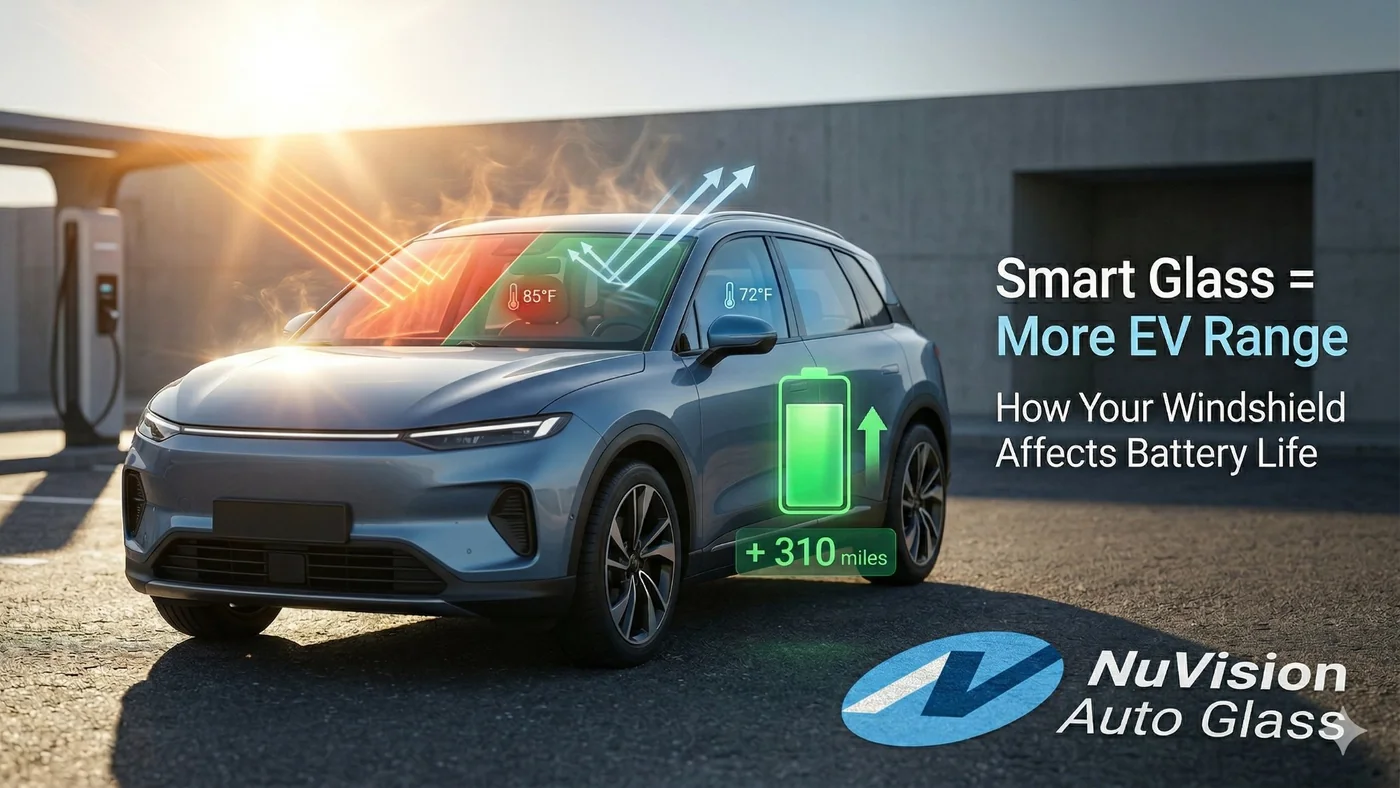
Air conditioning accounts for 10–20% of EV range reduction in hot weather. Infrared-absorbing windshield interlayers reduce cabin heat load by blocking solar radiation before it enters the cabin — lowering interior temperatures by up to 15°F and reducing the AC draw that eats into range.
Why Does Air Conditioning Cost EVs So Much Range?
In a conventional petrol vehicle, the engine generates waste heat continuously. Running the AC requires routing some of that heat through a compressor — the energy cost is real but modest relative to total fuel consumption.
In an EV, there is no waste heat. Every watt used by the climate control system comes directly from the battery pack. The compressor that runs the AC is electric. In a hot Arizona summer, where interior temperatures in a parked vehicle can reach 160°F and the AC needs to bring that down to a comfortable level quickly, the energy draw is significant and sustained.
Studies from the US Department of Energy consistently show that HVAC is the single largest non-drivetrain energy consumer in EVs in hot climates — reducing range by 10–20% at ambient temperatures above 95°F. At 110°F, the impact on certain models is at the higher end of that range.
Anything that reduces the thermal load entering the cabin reduces how hard the AC needs to work — and that efficiency gain goes directly back into driving range.
What Is an Infrared-Absorbing Windshield Interlayer and How Does It Work?
A standard windshield is built from two layers of tempered glass bonded to a polyvinyl butyral (PVB) interlayer under heat and pressure. The PVB layer provides the safety function — holding glass together on impact. In a basic windshield, that’s its only role.
An infrared-absorbing interlayer is a modified PVB formulation that incorporates compounds — typically indium tin oxide nanoparticles or similar materials — specifically engineered to absorb and reflect near-infrared radiation. Near-infrared is the portion of the solar spectrum that doesn’t produce visible light but does produce heat. It accounts for roughly 53% of the total solar energy reaching your windshield.
Standard glass transmits most of that near-infrared energy straight into the cabin. An infrared-absorbing interlayer intercepts it at the glass level — before it becomes heat in the air you’re sitting in. The result is a windshield that looks identical from the driver’s perspective but transmits significantly less thermal energy.
| Glass Type | Near-IR Transmission | Cabin Heat Impact | AC Load Effect |
|---|---|---|---|
| Standard PVB interlayer | ~70–75% transmitted | Full solar heat load enters cabin | AC works at full demand |
| IR-absorbing interlayer | ~30–45% transmitted | Cabin up to 15°F cooler | Reduced AC demand, range preserved |
| Acoustic + IR interlayer | ~30–45% transmitted | Same thermal benefit + noise reduction | Same range benefit + cabin comfort |
The visible light transmission doesn’t change meaningfully — an IR-absorbing windshield looks and drives the same as a standard one. The difference is entirely in the infrared spectrum, invisible to the driver but felt in the cabin temperature and reflected in range figures over time.
Which EVs Use Smart Glass as Standard — and What Happens When It’s Replaced With the Wrong Spec?
Most current EVs from major manufacturers specify IR-absorbing or solar control glass as standard equipment — particularly on models built for hot-climate markets. Tesla specifies acoustic and thermal glass on all Model 3, Model Y, Model S, and Model X windshields. The Rivian R1T and R1S use laminated acoustic glass with solar control properties. Ford Mustang Mach-E, Hyundai Ioniq 6, and Kia EV6 all specify solar-control windshield glass on their standard configurations.
The problem occurs at replacement. When a shop orders aftermarket glass without confirming the original specification, standard PVB interlayer glass is the default. It fits the vehicle correctly, installs without issue, and looks identical. The thermal performance difference is invisible until the driver notices their range is lower in summer than it should be — which most attribute to battery degradation rather than glass spec.
| EV Model | OEM Glass Spec | Risk if Wrong Spec Used |
|---|---|---|
| Tesla Model 3 / Model Y | Acoustic + solar control laminate | Range loss, increased AC draw, Autopilot recalibration required |
| Rivian R1T / R1S | Acoustic laminated glass | Cabin noise increase, thermal benefit loss |
| Ford Mustang Mach-E | Solar control glass | Increased cabin heat load, Co-Pilot360 recalibration required |
| Hyundai Ioniq 6 / Kia EV6 | Solar control laminate | Thermal performance loss in hot climates |
| Chevrolet Equinox EV | Solar control interlayer | Reduced range efficiency in summer |
When booking a windshield replacement for an EV, confirm with the shop that they’re matching the original glass specification — not just the fit. OEM-equivalent glass for EVs is available and typically costs $50–100 more than standard aftermarket. On a vehicle where range efficiency directly affects daily usability, that difference is worth specifying.
How Does This Play Out Differently in Arizona, Florida, and South Carolina?
The thermal management benefit of smart glass scales directly with ambient temperature and solar intensity. The hotter and sunnier the environment, the more significant the AC draw that smart glass reduces — which means the range benefit is not uniform across all climates.
Arizona is where smart glass delivers its highest range benefit. Phoenix receives over 300 days of direct sun per year, and summer ambient temperatures regularly exceed 110°F. An EV parked outside for four hours on a July afternoon in Phoenix accumulates enough radiant heat through a standard windshield to require sustained high-load AC operation for 15–20 minutes after startup. Over a day of short trips with frequent parking cycles, that thermal load represents meaningful cumulative battery draw. Arizona EV owners replacing a windshield with standard glass are making the most costly spec error of the three states.
Florida combines high solar intensity with high humidity. Humidity doesn’t directly affect the infrared transmission of glass, but it increases the comfort temperature threshold — the point at which the AC needs to run hard to make the cabin comfortable. A hotter, more humid starting point for cabin temperature means the AC works harder for longer after each park cycle. The range benefit of IR-absorbing glass in Florida is real, if somewhat less extreme than in Arizona’s dry heat.
South Carolina has a more seasonal dynamic. The thermal benefit of smart glass is significant from May through September but substantially reduced during the state’s mild winters. EV owners in South Carolina still benefit from OEM glass spec on replacement — the summer advantage is real — but the impact is less year-round than in the other two states.
What About Lightweight Laminated Glass — Does Weight Actually Affect EV Range?
Yes, but the effect is smaller than the thermal management benefit and often misunderstood.
Automotive glass manufacturers have been reducing windshield weight through thinner laminate constructions — using 1.6mm glass layers instead of the traditional 2.1mm, with a thinner PVB interlayer. A full windshield weight reduction from 9kg to 6–7kg sounds modest, but in EV engineering, unsprung and rotational mass reductions are amplified in their effect on efficiency. Every kilogram removed from a vehicle improves range by approximately 0.1–0.3% depending on the model and drive cycle.
More significantly, lightweight laminated glass reduces the thermal mass that needs to be cooled. A thinner windshield heats up faster but also releases heat faster — which matters less than the IR-absorbing interlayer in hot-park scenarios but contributes to the overall thermal efficiency of the vehicle’s glass package.
For EV owners, the combination of lightweight construction and IR-absorbing interlayer in OEM-specified glass is a deliberate engineering choice — not a feature that exists independently of the vehicle’s efficiency targets. Specifying the correct replacement glass preserves both benefits simultaneously.
Does EV Windshield Replacement Require ADAS Recalibration?
Every current mainstream EV uses forward-facing cameras mounted on or near the windshield for its driver assistance systems. Tesla’s Autopilot, Ford’s Co-Pilot360, Hyundai’s Highway Driving Assist, and Rivian’s Driver+ all depend on a camera whose bracket is bonded to the windshield glass.
When the glass is replaced — regardless of spec — the camera position shifts at the millimetre scale. That shift is enough to misalign the detection field for lane departure warnings, automatic emergency braking, and adaptive cruise control. A camera that’s 1mm off its calibrated position creates approximately a 6-foot lateral detection error at highway speeds.
Recalibration restores the camera to its manufacturer-specified alignment. For EVs, this is particularly important because most EV buyers are specifically relying on the driver assistance systems their vehicles are marketed around. Replacing the windshield without recalibrating the camera leaves those systems operating on incorrect data with no dashboard warning.
NuVision performs mobile ADAS recalibration as part of the windshield replacement service on all ADAS-equipped vehicles — including EVs. There is no separate appointment. For the technical differences between calibration methods, the static vs. dynamic calibration guide covers the process in detail.
Frequently Asked Questions
Does windshield glass actually affect EV battery range?
Indirectly, yes. The windshield doesn’t draw power directly. But AC is one of the largest non-drivetrain battery consumers in hot weather — 10–20% range reduction at temperatures above 95°F. IR-absorbing windshield interlayers reduce cabin heat load, which reduces AC demand, which reduces battery draw. The effect is meaningful in hot climates.
What is an infrared-absorbing windshield interlayer?
A modified version of the standard PVB bonding layer in laminated glass that incorporates compounds engineered to absorb near-infrared radiation — the portion of sunlight that produces heat without producing visible light. It blocks roughly 30–45% of the solar heat that standard glass transmits, lowering cabin temperatures by up to 15°F.
Does the glass spec matter when replacing an EV windshield?
Yes. Standard aftermarket glass uses a basic PVB interlayer without infrared-absorbing or acoustic properties. Replacing OEM smart glass with standard aftermarket eliminates the thermal benefit entirely. Specify OEM-equivalent glass that matches the original solar control specification when booking a replacement for any EV.
Does smart glass replace window tinting on an EV?
They serve complementary roles. The windshield interlayer handles front solar heat rejection. Side window tinting handles the broader glass area around the passengers. For maximum thermal efficiency in hot climates, both are worth having. The windshield is the largest glass surface and the highest-impact thermal management point.
Does EV windshield replacement require ADAS recalibration?
Yes, on all current mainstream EVs. The camera for Autopilot, Co-Pilot360, Highway Driving Assist, and equivalent systems is bonded to the windshield glass. When the glass is replaced, recalibration is required before those systems operate correctly. See the calibration guide for the full process.
The Windshield Is Part of the EV’s Efficiency System. Treat It That Way.
The Gilbert customer’s range didn’t drop because his battery degraded. It dropped because the wrong windshield was installed. Six months of reduced range in Arizona summer heat — from a $50 difference in glass specification at replacement time.
For EV owners, a windshield replacement isn’t a commodity job. The glass spec, the installation quality, and the ADAS recalibration all affect how the vehicle performs after the appointment. Getting all three right takes the same amount of time as getting any one of them wrong.
If you’re in Arizona, Florida, or South Carolina and need an EV windshield assessed or replaced — book at nuvisionautoglass.com/get-a-quote. OEM-equivalent glass, ADAS recalibration included, mobile service.
Find us on Google Maps:
NuVision Auto Glass — Arizona
NuVision Auto Glass — Florida