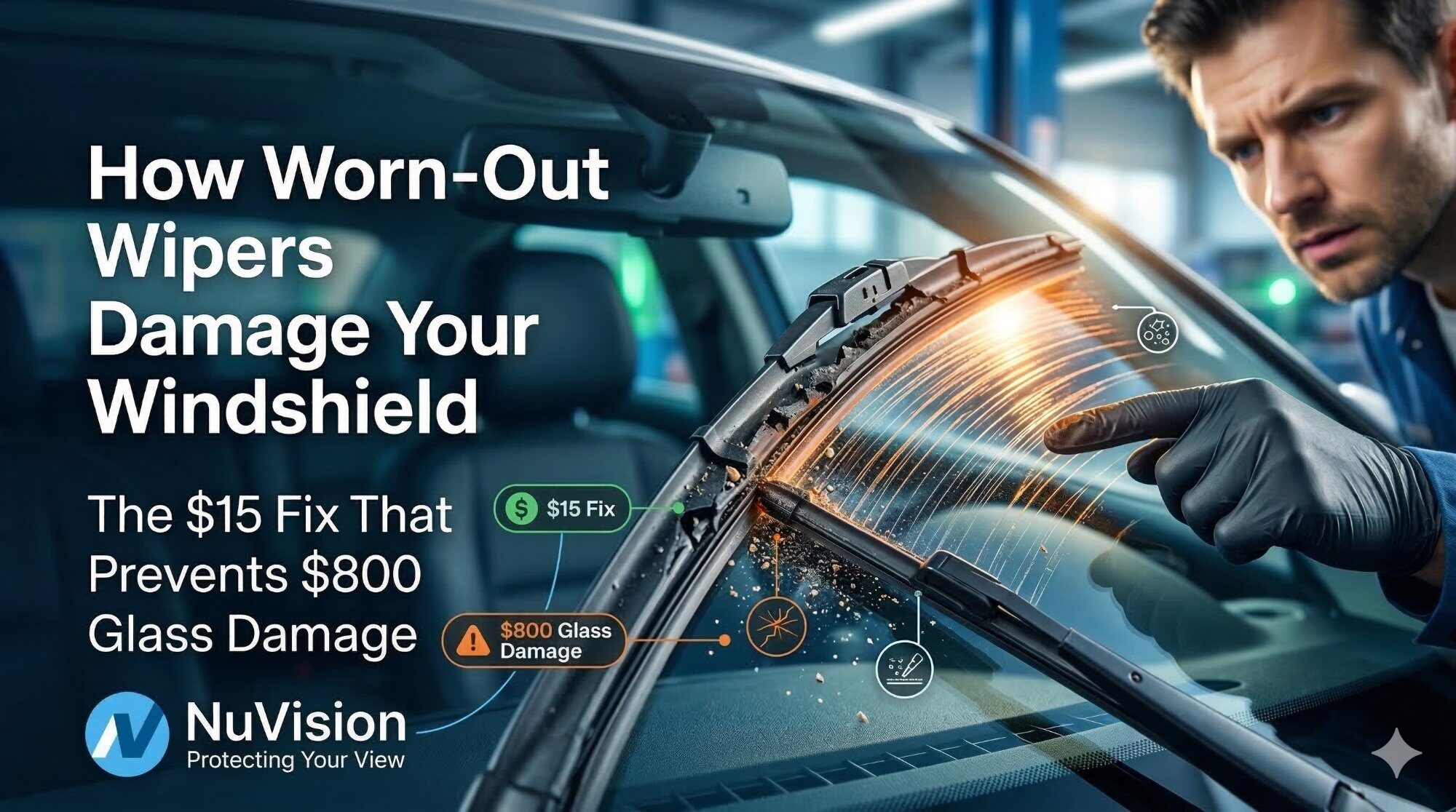

Worn wiper blades cause permanent windshield damage through three mechanisms: exposed metal frame scoring that creates irreversible scratches, hardened rubber that carves microscopic grooves reducing visibility 15 to 25%, and torn blade edges that trap abrasive debris and etch glass over thousands of wiper cycles. Roughly 40% of “mysteriously scratched” windshields trace back to wiper blade degradation that drivers ignored for 9 to 12 months past replacement dates.
The cost gap tells the whole story. A $15 to $30 blade replacement every 3 to 6 months prevents $300 to $800 in windshield replacement costs. Over 5 years, proper wiper maintenance saves roughly $760 compared to neglect.
This guide covers how each damage mechanism works, the warning signs that mean “replace right now,” state-specific degradation patterns for Arizona, Florida, South Carolina, and Colorado, and blade selection by climate.
How Do Worn Wipers Actually Damage Glass?
Three distinct mechanisms. Each creates a different damage type, and all three are permanent once they occur.
| Mechanism | What Happens | Damage Type | Reversible? |
|---|---|---|---|
| Exposed metal frame | Rubber wears thin, metal contacts glass at 15-25 lbs pressure | Deep parallel scratches following wiper arc | No. Replacement required ($300-$800) |
| Hardened rubber | UV and heat harden rubber into fine sandpaper texture | Microscopic grooves that trap dirt, cut visibility 15-25% | Professional polishing only ($150-$300) |
| Torn/split edges | Torn rubber creates uneven pressure, traps sand and grit | Circular or irregular etch patterns | No. Replacement required if deep |
Metal Frame Exposure
A wiper blade is a rubber wiping surface over a metal or composite frame with a spring mechanism that maintains windshield contact. As rubber wears down over 3 to 12 months (faster in extreme climates), it thins enough to expose the metal underneath.
That metal contacts your glass at 15 to 25 pounds of pressure per blade. Every wiper pass creates microscopic scratches. Fine parallel lines following the wiper arc, concentrated in the driver’s sight line where wiper use is heaviest during rain.
You’ll notice them first in direct sunlight or from oncoming headlight glare at night. And once they exist, they’re permanent. Each additional cycle with the same worn blade deepens them further.
Hardened Rubber Degradation
Even before metal exposure, the rubber itself becomes a problem.
| Months | Rubber Condition | Effect on Glass |
|---|---|---|
| 0-3 | Supple, conforms to windshield curvature | Clean wiping, no damage |
| 4-6 | UV and ozone begin hardening | Slight streaking, minimal risk |
| 7-9 | Lost flexibility, incomplete glass contact | Micro-groove formation starting |
| 10+ | Hardened rubber acts like fine sandpaper | Grooves accumulating dirt, visibility dropping 15-25% |
The grooves are too small to see individually but they accumulate. They trap dirt, road film, and contaminants that reduce visibility progressively. Professional glass polishing ($150 to $300) can sometimes improve this but can’t fully reverse it. For the polishing process details, see our guide on how to polish windshield glass.
Torn Edge Pressure and Debris Trapping
When blade rubber tears or splits, it creates uneven contact pressure. Some areas get pressed harder, concentrating force on small glass sections over thousands of cycles.
Worse: torn blades trap dust, sand, and road debris in the gaps. A single grain of sand caught in a torn blade can scratch the entire wiper sweep area in one pass. That’s how “random” scratch patterns appear on windshields that seem otherwise well-maintained.
What Warning Signs Mean “Replace Right Now”?
Don’t wait for complete blade failure. By then, your glass already has damage.
| Warning Sign | What It Means | Urgency |
|---|---|---|
| Streaking | Water left in lines. Rubber hardened or contaminated. | Replace within 1 week |
| Chattering/vibrating | Blade bouncing across glass. Uneven pressure creating etching risk. | Replace within days |
| Skipping | Blade lifts and jumps. High-pressure contact points forming. | Replace immediately |
| Squeaking/squealing | Friction abnormality. Scratch damage likely starting. | Replace within 1-2 weeks |
| Smearing | Spreads water instead of clearing. Rubber edge worn rounded. | Replace within 1 week |
| Visible rubber damage | Cracks, splits, missing chunks, hardening, discoloration. | Replace immediately |
Squeaking and chattering are the most common early warnings drivers ignore. Both indicate the rubber-to-glass interface has degraded to the point where scratch damage is imminent or already occurring. See our guide on stopping windshield wipers from squeaking for troubleshooting.
How Do You Identify Wiper Scratches vs Other Damage?
Wiper-caused scratches have a distinct pattern.
Wiper scratches: Fine parallel lines following the wiper arc. Both sides of the windshield affected similarly. Gradual appearance over weeks or months. Most visible in direct sunlight or headlight glare.
Road debris: Random orientation, single deep marks, no arc pattern.
Improper cleaning: Swirl patterns concentrated in specific spots.
Manufacturing defects: Present since installation, not progressive.
If you’re seeing arc-shaped scratches across your wiper sweep zone, your blades are the cause. Replace them immediately, then have existing scratches assessed. For removal methods ranked by severity, see our guide on removing windshield wiper scratches.
| Scratch Severity | Visibility | Solution | Cost |
|---|---|---|---|
| Minor | Only in direct sunlight | Professional polishing (may work) | $150-$250 |
| Moderate | Normal daylight, night glare | Polishing may improve but not eliminate | $200-$300 |
| Severe | All conditions, dangerous glare | Windshield replacement | $300-$800 |
How Fast Does Each State Destroy Wiper Blades?
Arizona: 3 to 4 Months
The harshest wiper environment in the country. Summer dashboard temperatures reach 160 to 180°F. Blades stored on a 140 to 150°F windshield surface harden and crack in roughly half the national average lifespan.
Year-round UV exposure breaks down rubber at the molecular level, causing fading and surface cracking. Monsoon season (July through September) deposits fine silica particles that embed in blade rubber, creating an abrasive surface that grinds glass with every sweep.
Drivers in Phoenix, Mesa, Scottsdale, and Chandler should replace every 3 to 4 months. Post-monsoon replacement (September/October) clears embedded dust. Premium heat-resistant blades ($20 to $30) are worth it here because economy blades ($8 to $15) degrade too fast to deliver value.
Florida: 4 to 5 Months
A different degradation pattern driven by humidity. High moisture separates rubber layers (delamination), creating an uneven wiping surface that chatters and skips. The blade looks intact but performs poorly.
Mold and mildew grow on blade surfaces, creating sticky residue that smears instead of clears. Coastal drivers in Tampa, Miami, and Jacksonville add salt spray that corrodes metal frame components.
Replace every 4 to 5 months standard. Coastal areas every 3 to 4 months. Post-hurricane season inspection in November. Silicone-based blades ($25 to $35) resist humidity degradation better than standard rubber.
South Carolina: Pre-Winter and Post-Winter
Freeze-thaw cycles crack blade rubber, creating sharp edges that literally cut the glass surface. The most mechanically damaging degradation pattern because the cracks form actual cutting edges.
Frozen blades that get activated tear when the wiper motor tries to move them. Never operate wipers on a frozen windshield. Use a plastic ice scraper ($3 to $6) and let the vehicle defrost gradually.
Drivers in Charleston, Columbia, Greenville, and Myrtle Beach should replace twice: pre-winter (November) with cold-weather rated blades, post-winter (March/April) back to standard. Monthly inspection November through February catches crack development early.
Colorado: Extended Winter Protocol
Colorado drivers in Denver and Colorado Springs follow the same freeze-thaw pattern but across a longer season (November through March). Cold-weather rated blades that stay flexible at sub-zero temperatures are essential.
| State | Replacement Schedule | Blade Recommendation |
|---|---|---|
| Arizona | Every 3-4 months + post-monsoon | Premium heat-resistant ($20-$30) |
| Florida | Every 4-5 months (coastal 3-4) | Silicone-based, corrosion-resistant ($25-$35) |
| South Carolina | Pre-winter (Nov) + post-winter (Mar) | Cold-weather rated ($20-$30) |
| Colorado | Pre-winter (Nov) + post-winter (Apr) | Sub-zero flexible ($22-$35) |
For step-by-step installation instructions and blade type guidance, see our windshield wiper replacement guide.
What Does the 5-Year Cost Comparison Look Like?
| Regular Replacement | Neglected Wipers | |
|---|---|---|
| Blade cost | $25/pair x 10 = $250 | $12/pair x 5 = $60 |
| Scratch damage | $0 | Replacement year 3: $500 |
| Premium increase | $0 | 10% x 3 years: $450 |
| 5-year total | $250 | $1,010 |
The math is clear. Spending $250 on regular blade replacements over 5 years saves $760 compared to the neglect scenario. The neglect cost jumps even higher for ADAS-equipped vehicles where replacement runs $600 to $1,200 and ADAS calibration adds $150 to $400. For full replacement pricing details, see our windshield replacement cost guide.
How Do You Prevent Wiper-Caused Damage?
Replace on Schedule, Not on Failure
Set a phone reminder every 3 to 6 months depending on your climate. Replace on schedule regardless of how the blades look. Rubber degrades internally before visible signs appear. By the time you see cracks, the blade has been damaging your glass for weeks.
If you prefer a performance-based approach: replace at the first sign of streaking, chattering, or skipping. Don’t wait for “complete failure.” Intermediate degradation is when scratch damage happens.
Clean Blades Weekly
Two minutes, once a week. Lift blades away from the windshield, wipe the rubber edge with a damp microfiber cloth. This removes embedded grit that would otherwise scratch glass on the next activation. Monthly, do a deeper clean with rubbing alcohol on a cloth, wiping the entire blade assembly. This extends blade life 20 to 30%.
Also see our tips on preventing windshield scratches for additional protective habits.
Choose the Right Blade for Your Climate
| Tier | Price | Lifespan | Best For |
|---|---|---|---|
| Economy | $8-$15/pair | 3-6 months | Low-mileage, covered parking vehicles |
| Mid-range | $15-$25/pair | 6-9 months | Most drivers (best value) |
| Premium | $25-$40/pair | 9-12 months (6-9 in AZ) | Extreme climates, high-mileage |
Prioritize beam-style design (better windshield conformity on curved glass), graphite-coated rubber (less friction), UV-resistant compounds (Arizona essential), corrosion-resistant frames (Florida coastal), and cold-weather ratings (South Carolina/Colorado winter).
Stop the Habits That Kill Blades
Never run wipers on a dry windshield. Always hit washer fluid first. Dry wiping creates friction damage to both the blade and the glass simultaneously.
Clear ice manually before activating wipers. Forcing wipers through frost or ice tears the blade rubber, creating the sharp edges that score glass.
Keep washer fluid filled. Running blades without fluid lubrication accelerates rubber degradation and increases glass friction.
Use covered parking when possible. Reduces UV exposure (the primary blade degradation cause) and extends blade life 40 to 50%. When covered parking is unavailable, lift blades off the windshield during extended parking to prevent rubber deformation, and use a windshield sunshade to reduce UV and heat exposure.
When Should You Get a Professional Windshield Assessment?
When you suspect scratch damage. Professional UV light inspection reveals invisible scratches, determines whether wiper blades or other sources caused them, assesses whether polishing can help, and determines if replacement is necessary. Whether you drive a Toyota, Honda, Ford, Tesla, or Chevrolet, scratches in the ADAS camera zone are particularly concerning because they can interfere with safety system accuracy.
When blades look fine but perform poorly. Sometimes the issue is windshield contamination or surface damage rather than the blade itself. Professional cleaning may resolve performance issues and prevent unnecessary blade replacement costs.
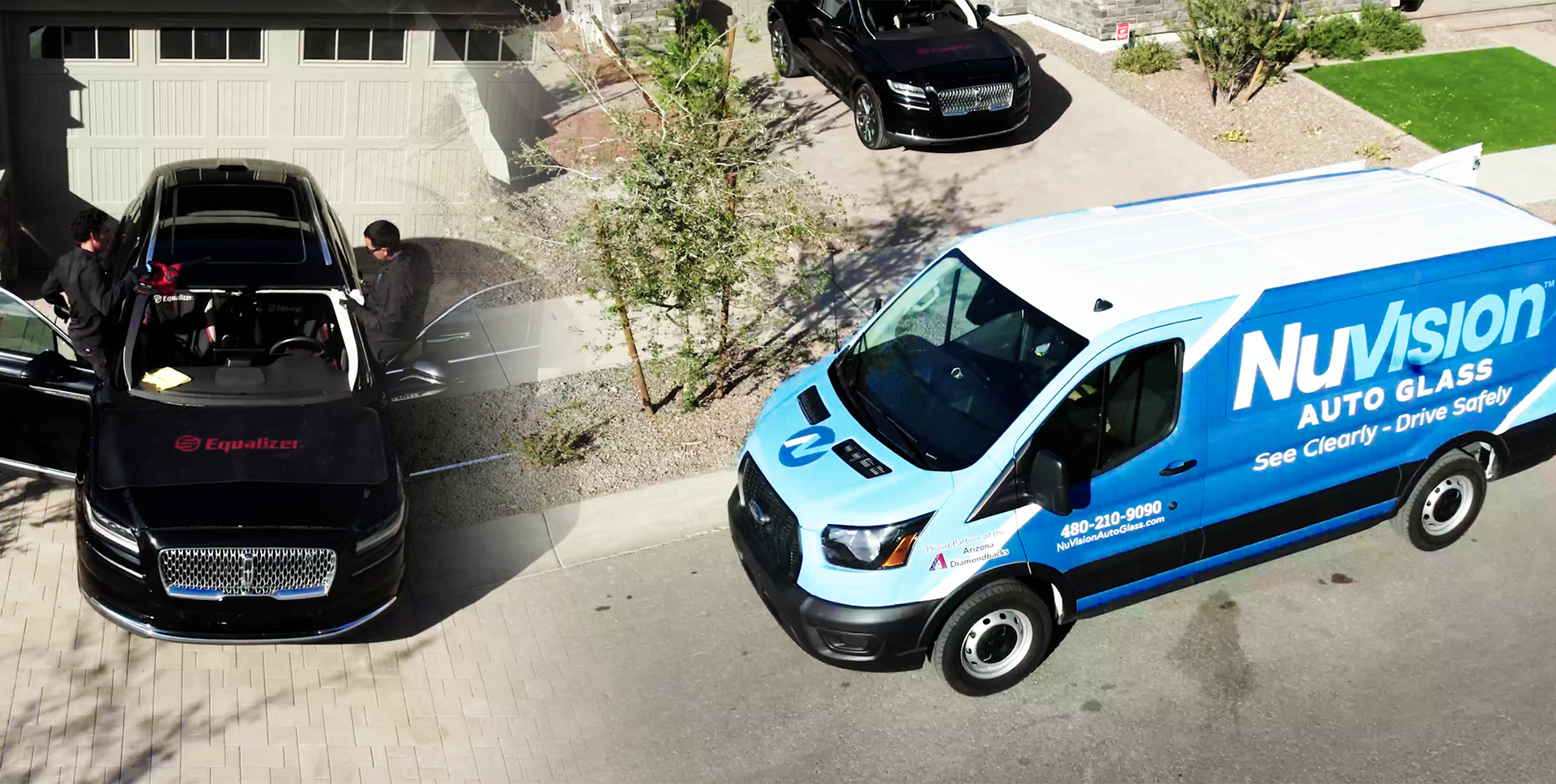
NuVision Auto Glass provides complimentary blade inspection during any windshield service, professional scratch damage assessment using UV light inspection, and quality blade recommendations specific to your climate. Visit our Arizona location or Florida location on Google Maps, or schedule our mobile service.
Frequently Asked Questions
Can I replace just the rubber inserts instead of the entire blade?
Some traditional frame wipers allow insert replacement ($4 to $8), saving money over full blade swaps. However, if the frame is bent or corroded, inserts won’t solve the problem. Beam-style blades (most modern vehicles) require full replacement. In extreme climates like Arizona and coastal Florida, frame degradation typically matches rubber wear, making full replacement the more reliable option.
How do I know if scratches came from wipers or something else?
Wiper scratches show fine parallel lines following the wiper arc, affect both sides of the windshield similarly, and develop gradually. Road debris creates random single scratches. Improper cleaning leaves swirl patterns. If you’re uncertain, professional UV light inspection definitively identifies the source and depth.
Do premium wipers actually last longer in extreme climates?
Yes. Premium blades ($25 to $40) use advanced rubber compounds and UV-resistant materials that withstand Arizona heat 50 to 70% longer than economy blades. In Florida, silicone-based premium blades resist delamination. For South Carolina winters, premium cold-weather blades stay flexible at temperatures that crack economy rubber. Economy blades last 3 to 6 months; premium last 6 to 12 months, making premium genuinely cost-effective in harsh conditions.
How often should I clean my wiper blades?
Weekly: wipe the rubber edge with a damp microfiber cloth to remove embedded grit. Monthly: deeper clean with rubbing alcohol on the entire blade assembly. This takes 2 minutes per session and extends blade life 20 to 30%.
Can wiper scratches be repaired without replacing the windshield?
Minor scratches visible only in direct sunlight may respond to professional glass polishing ($150 to $300). Moderate scratches can sometimes be improved but rarely eliminated. Severe scratches creating visibility obstruction or dangerous night glare require full replacement. The repair vs. replace decision depends on scratch depth, location, and whether it affects the driver’s sight line.
Will my insurance cover windshield damage caused by worn wipers?
Typically no. Wiper-caused scratches fall under wear-and-tear exclusions in most comprehensive policies. Damage from neglected maintenance is generally not a covered peril. This is another reason prevention through timely blade replacement ($15 to $30) matters: the damage it prevents isn’t covered by insurance. For details on what insurance does and doesn’t cover, see our guide on how windshield claims affect your insurance.
What’s the cheapest way to protect my windshield from wiper damage?
Mid-range blades ($15 to $25 per pair) replaced every 6 months cost $40 to $50 per year. Add weekly blade wiping with a microfiber cloth (no additional cost) and always using washer fluid before activating wipers. Total annual investment under $75. That prevents $300 to $800+ in potential windshield damage.
Replace the Blade, Not the Windshield
Worn wiper blades create permanent, irreversible windshield damage through metal scoring, hardened rubber grooving, and abrasive debris trapping. Every warning sign (streaking, chattering, skipping, squeaking) is your windshield asking for a $15 to $30 fix before it needs a $300 to $800 replacement.
Replace on schedule. Replace at the first performance symptom. Clean blades weekly. Choose the right blade for your climate.
Schedule a Free Windshield Assessment →
Already seeing scratch damage from worn wipers? NuVision provides professional UV light assessment, repair recommendations, and same-day replacement with ADAS calibration when needed. Call 1-855-213-0100 or request a quote online.
Same-day mobile service throughout Arizona, Florida, South Carolina, and Colorado.