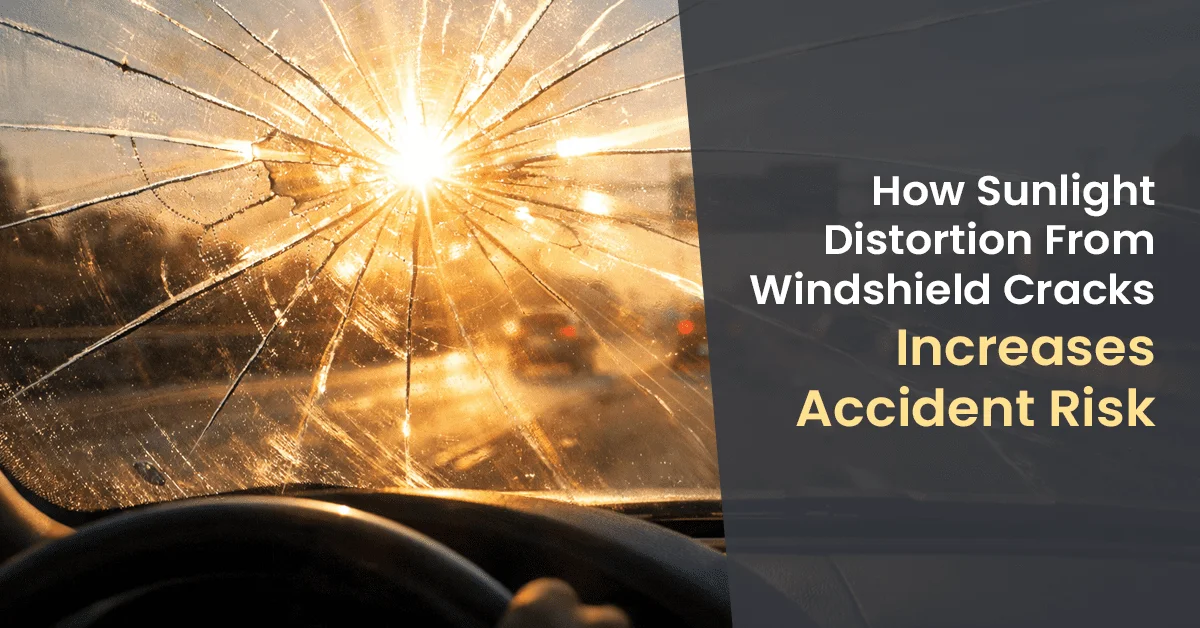

Windshield cracks create sunlight distortion that increases accident risk by 35-47% during peak glare hours, according to NHTSA sun glare crash data from 2015-2022. When sunlight strikes damaged glass at specific angles, cracks act as unintended prisms — bending and scattering light across your visual field in patterns that intact glass never produces. This optical phenomenon transforms manageable sun glare into blinding light obstacles that obscure vehicles, pedestrians, and traffic signals for critical seconds. During these glare events, drivers with cracked windshields effectively operate blind while traveling 88-132 feet per second at highway speeds, creating unavoidable collision scenarios.
For drivers in Arizona, Florida, and South Carolina, sun angle and regional highway orientations create predictably dangerous conditions. Arizona’s east-west I-10 and I-8 face sunrise and sunset glare for extended periods due to desert horizon visibility. Florida’s I-4, I-75, and Turnpike segments align with sun positions during peak traffic hours. South Carolina’s US-17 coastal route and I-26 mountain corridor present sun glare at changing elevations. Understanding how windshield cracks amplify natural sun glare — and when this creates maximum danger — can prevent crashes that statistics show are otherwise inevitable.
How Do Windshield Cracks Bend and Scatter Sunlight?
Intact automotive glass is precision-engineered for minimal optical distortion. The laminated structure — two glass layers bonded to PVB (polyvinyl butyral) plastic — maintains uniform thickness and refractive properties across the entire critical viewing area. FMVSS 205 limits optical distortion to 0.25 diopters across this zone, ensuring light passes through cleanly and bends only at designed entry and exit angles that the human visual system easily compensates for.
Cracks destroy this optical precision. Each crack creates irregular surfaces with constantly changing angles. When sunlight — already intensely bright — strikes these irregular surfaces, basic physics takes over. Refraction causes light to bend at unpredictable angles as it passes through new air-to-glass interfaces created by the crack. Scattering sends dozens of light rays reaching your eyes from unexpected directions instead of the single controlled beam that intact glass transmits. Internal reflection bounces light off crack surfaces rather than passing it through, creating bright spots and flares within the windshield itself. And certain crack geometries actually focus light similar to magnifying glasses, intensifying already-bright sunlight into concentrated beams.
The Society of Automotive Engineers published research quantifying this effect: windshield cracks increase light scattering by 300-500% compared to intact glass. When the sun is positioned at 5-15 degrees above the horizon — the most dangerous glare zone occurring during sunrise and sunset — this scattering creates complete visual obstruction lasting 2-8 seconds per glare event.
Different crack patterns produce different optical dangers:
| Crack Type | Sunlight Distortion Pattern | Peak Danger Period |
| Vertical crack | Linear starburst bisecting view | Sunrise/sunset on east-west roads |
| Horizontal crack | Wide horizontal flare | Low sun angles, any orientation |
| Star break (radiating) | 360-degree bloom obscuring large area | Any sun exposure, particularly intense |
| Multiple intersecting cracks | Chaotic scattered light across entire windshield | Continuous distortion in any sunlight |
| Edge crack with propagation | Asymmetric glare growing toward sight line | Progressive worsening during drive |
Understanding this physics matters because it explains why no driving technique, sun visor adjustment, or sunglasses fully compensates for cracked-windshield glare. The distortion originates inside the glass itself — between you and every external light source — and no accessory addresses light that’s already scattered before it reaches your eyes.
How Many Crashes Does Sun Glare Actually Cause?
NHTSA crash data from 2015-2022 documents approximately 3,000 crashes annually where sun glare was explicitly reported as a contributing factor. However, these represent only cases where officers or drivers specifically cited glare — the actual number is likely 6,000-9,000 annually, as many drivers don’t report glare as a factor in rear-end collisions they attribute to “following too closely.”
Sun glare crashes have distinct characteristics that separate them from general collision patterns. Time concentration is severe: 78% occur during the sunrise window (6-9 AM) and sunset window (4-7 PM). Road alignment matters enormously — 82% occur on roads aligned within 30 degrees of east-west. The crash type breakdown reveals why these are so dangerous: 69% are rear-end collisions, 18% are intersection signal violations, and 13% are pedestrian or bicycle strikes. Injury rates run 23% higher than general crashes because delayed reaction times mean higher impact speeds.
The critical finding for drivers with windshield damage: studies examining windshield condition in sun glare crashes found that vehicles with pre-existing damage were overrepresented by 35-47%. If 15% of vehicles on the road have windshield damage, they account for 20-22% of sun glare crashes — nearly 50% overrepresentation. This isn’t coincidental. Damaged windshields transform manageable glare into total visibility loss. While all drivers face sun glare challenges, those with cracked windshields enter situations where normal glare becomes complete blindness.
Why Is Arizona’s Sun Glare Risk the Most Severe in the US?
Arizona presents the most severe sun glare environment in the continental United States. With 300+ days of sunshine, minimal atmospheric moisture, and high altitude (Phoenix at 1,000+ feet, Flagstaff at 7,000 feet), sunlight intensity exceeds most other locations by 15-25%.
I-10 corridor (Phoenix to Tucson): This 116-mile stretch runs nearly perfectly east-west. Morning commuters traveling east face direct sunrise from roughly 6:00-8:30 AM. Evening commuters face sunset glare from 5:00-7:30 PM. The desert landscape provides no natural shading — you face unobstructed sun for extended periods. Arizona Department of Transportation (ADOT) identified a 300% increase in crash rates on I-10 during peak sun glare times compared to mid-day. The report specifically noted that driver complaints about temporary blindness correlated with sun angles between 5-12 degrees above the horizon — exactly the range where windshield cracks create maximum distortion.
I-17 (Phoenix to Flagstaff): While primarily north-south, the highway’s winding mountain path creates periodic east-west segments where sun glare becomes dangerous. The elevation gain from 1,000 to 7,000 feet means thinner atmosphere and even more intense sunlight. Drivers report white-out conditions where sun reflecting off rock faces combines with windshield damage to create total visibility loss.
US-93 toward Las Vegas: Northwest orientation means afternoon sun angles align with travel direction. Summer heat creates additional distortion from heat waves rising off pavement. Combined with windshield cracks, some drivers report being unable to see the vehicle directly ahead during peak glare periods.
Tucson and the broader Phoenix metro grid road system — running north-south and east-west — means commuters inevitably face sun glare daily. What starts as a small chip from highway debris creates twice-daily exposure to elevated crash risk during peak traffic periods. Arizona’s thermal cycling can propagate that chip into a sight-line crack within days.
How Does Florida’s Humidity Amplify Windshield Glare?
Florida’s sun glare challenges differ from Arizona’s but create equally dangerous conditions. High humidity, frequent rain, and coastal haze filter sunlight — but they also create additional refraction when combined with windshield damage. Moisture in the air acts as an additional refractive medium, meaning sunlight doesn’t just scatter through the crack — it scatters again through water vapor, multiplying the optical distortion effect.
I-4 (Tampa to Orlando): This congested corridor runs roughly east-west for much of its 132-mile length. Morning and evening rush hours coincide with sun glare periods. Florida Highway Patrol crash reports identify I-4 as the state’s highest-risk corridor for sun glare crashes, with particular concentration near the Tampa and Orlando metro areas where traffic density is highest.
I-95 coastal corridor: Running north-south, I-95 generally avoids direct sun glare. However, elevated sections and causeways crossing waterways create situations where sun reflection off water combines with overhead sun to produce multi-directional glare. Windshield cracks scatter both direct and reflected light simultaneously, creating visual chaos that no single visor angle can block.
Florida Turnpike and I-75: Both highways have significant east-west segments. The Turnpike from Miami to Orlando and I-75 through Tampa experience sun glare during commute hours. Florida’s year-round tourism means heavy traffic during sun glare periods occurs daily, not just during traditional rush hours.
Florida’s afternoon thunderstorms create a unique complication. Post-storm driving toward setting sun means windshields covered in water spots and residual film. Combined with existing cracks, the distortion becomes overwhelming. Florida Highway Patrol reports show a 40% spike in rear-end collisions during the 30-60 minutes post-storm as sun emerges from clouds at low angles. For drivers with windshield damage, this post-storm glare is the highest-risk window in Florida driving.
What Makes South Carolina’s Terrain Create Unpredictable Glare?
South Carolina’s geography — mountains, piedmont, and coastal plain — creates varied sun glare challenges based on elevation and landscape that differ from the sustained exposure in Arizona or humidity-amplified conditions in Florida.
I-26 mountain corridor (Columbia to Asheville): This highway climbs from 200 feet elevation near Columbia to 2,000+ feet approaching the North Carolina line. Changing elevations mean sun angle varies throughout the drive. Mountain horizons cause sun to appear and disappear unpredictably around curves, giving zero time to adjust. South Carolina Highway Patrol has identified several I-26 segments as “sun glare crash clusters” where accidents concentrate during specific seasons when sun angle aligns with road curves. With windshield damage, these surprise glare events become crash-inevitable situations.
US-17 coastal route: This north-south highway generally avoids direct sun glare, but proximity to marshes and waterways creates extensive sun reflection. Morning and evening low sun reflects off water surfaces, approaching vehicles from side angles that windshield cracks scatter across the entire field of view. Lowcountry drivers near Charleston, Beaufort, and Hilton Head frequently report this reflected glare as more problematic than direct overhead sun.
I-85 through Upstate (Greenville-Spartanburg): This southwest-northeast alignment creates sun glare during specific seasons when solar paths align with highway direction. The piedmont region’s rolling terrain means sun appears and disappears behind hills, creating intermittent glare bursts rather than sustained exposure. These sudden transitions from shade to intense glare are particularly dangerous — drivers don’t have time to deploy sun visors or adjust eye adaptation before glare hits.
How Long Does Sun Glare Blindness Last at Highway Speeds?
When sun glare through cracked windshields creates complete visual obstruction, the blindness lasts 2-8 seconds depending on sun intensity and windshield damage severity. Research by Virginia Tech Transportation Institute using driver eye tracking during sun glare events confirmed these durations — and the travel distances during blindness are what make this lethal.
At 60 mph, you travel 176 feet in two seconds — more than half a football field. At 70 mph, 205 feet. At 80 mph, 234 feet. During these 2-8 seconds of blindness, you’re traveling with zero forward visibility. If the vehicle ahead brakes, you won’t know until your vision clears — by which point impact may be unavoidable.
Rear-end collisions dominate sun glare crash statistics for exactly this reason. Drivers approach stopped or slowing traffic, sun glare creates temporary blindness through the cracked windshield, vision clears after traveling 175-200 feet, and impact occurs before braking can prevent it. The crack isn’t directly blamed in the crash report — officers cite “sun glare” or “following too close” — but the crack transformed survivable sun glare into crash-causing blindness.
Consider a real-world scenario: 6:45 AM in Phoenix, traveling east on I-10. Traffic ahead slows for construction. Sun sits 8 degrees above the eastern horizon, directly in your path. Your windshield has a 4-inch vertical crack from a rock chip last month. As you crest a slight rise, direct sun hits the crack — instant white-out with nothing visible but brilliant scattered light. Two seconds later, vision partially returns. Traffic ahead has stopped. You slam brakes. At 65 mph, you traveled 190 feet during those 2 seconds. The stopped vehicles are 50 feet ahead. Impact is unavoidable. This scenario plays out hundreds of times annually across Arizona, Florida, and South Carolina.
How Does Sun Glare Cause Intersection Crashes?
While rear-end collisions dominate sun glare crash volume, intersection violations create far more severe outcomes. When sun glare combined with windshield damage obscures traffic signals or cross-traffic vehicles, T-bone collisions result — statistically 3-4 times more likely to cause serious injuries or fatalities than rear-end impacts.
Red light violations: Traffic signals positioned with sun directly behind them become invisible when viewed through cracked windshields. The bright LED signal light scatters through the crack, creating an amorphous glow rather than a distinct red, yellow, or green indication. Drivers proceed through intersections unaware the signal shows red. NHTSA data shows sun glare contributes to 8-12% of red light violation crashes. Insurance Institute for Highway Safety analysis found windshield damage present in 23% of sun-glare-related intersection crashes — nearly double the general population rate.
Left turns across oncoming traffic: Judging approaching vehicle speed and distance requires clear visibility. When sun glare combined with windshield cracks obscures oncoming traffic, drivers make turns into vehicles they literally cannot see. These crashes typically occur at combined impact speeds of 60-80 mph, resulting in severe injuries.
Pedestrian and bicycle strikes: The most tragic sun glare crashes involve vulnerable road users who become completely invisible when intense sun combines with windshield damage. School zones create particular concern — drop-off and pick-up times (7:30-8:30 AM, 2:30-3:30 PM) coincide with potential sun glare hours in certain seasons. Windshield-damaged vehicles approaching school zones during these times operate with severely compromised ability to see children. Florida and South Carolina, with abundant signalized intersections on state highways, see higher rates of sun-glare intersection crashes than Arizona’s grade-separated metro interchanges.
Why Don’t Sun Visors and Sunglasses Fix the Problem?
Sun visors protect against overhead sun but provide minimal help against the 5-15 degree low-angle glare where windshield cracks create maximum distortion. When sun sits in this dangerous zone, it approaches below sun visor coverage. Drivers face a lose-lose choice: deploy the visor and block forward vision entirely, or leave it up and face unmitigated glare through damaged glass.
With damaged windshields, the problem compounds further. Scattered light from cracks doesn’t just come from the sun’s actual position — it radiates across the entire crack pattern. A sun visor blocks direct sunlight from above but does nothing to prevent the scattered light refracting through the crack into your eyes from below the visor, from the sides, and from angles no visor design accounts for.
Sunglasses help somewhat. Polarized lenses reduce reflected glare from horizontal surfaces (water, pavement) and decrease glare intensity by 20-30%. But sunglasses reduce overall light transmission by 60-80%, making it difficult to see darker areas of the road, vehicles in shadow, and pedestrians wearing dark clothing. During transitional glare periods — when sun moves behind clouds then emerges — constant adjustment of sunglasses becomes its own distraction.
The only effective solution to low-angle sun glare through damaged windshields is eliminating the damage itself. No visor, sunglasses, or driving technique compensates for optical distortion originating inside the glass between you and every external light source. A professional windshield repair restores 80-90% of original optical clarity for chips under 1 inch. For larger cracks, full windshield replacement with quality OEM-equivalent glass meeting FMVSS 205 optical standards eliminates the distortion entirely.
How Quickly Does Glare Distortion Worsen From a Small Chip?
Windshield damage worsens over time, and glare distortion intensifies proportionally. What might be tolerable glare from a small chip in week one becomes intolerable blindness from a propagated crack in week three. Arizona’s extreme thermal cycling accelerates this progression dramatically.
Progression timeline (Arizona summer): Day 1, a quarter-size chip creates a minor starburst visible only in direct sun. By days 3-5, thermal stress propagates the chip into a 2-3 inch crack, and the starburst becomes a linear glare band. By days 7-10, the crack reaches 6+ inches, and sun glare creates 3-5 seconds of blindness during morning and evening commutes. By day 14 and beyond, multiple propagating cracks create unmanageable scattered light during any sun exposure — not just sunrise and sunset.
Florida and South Carolina see similar but slightly slower progression due to less extreme thermal cycling. Florida’s humidity can accelerate internal delamination around the chip, creating additional light-scattering surfaces even before the crack propagates visually. South Carolina’s winter temperature swings (freezing nights to 50-60°F days) create their own propagation pattern, particularly in the mountain and piedmont regions.
The key point: accepting minor sun glare from a chip today means accepting much worse glare from a crack next week. By the time glare becomes intolerable, you’ve already driven through weeks of progressively elevated crash risk. Early auto glass repair when damage is still a chip — not yet a crack — costs less, takes 30 minutes, and eliminates the escalating danger entirely.
When Are Sun Glare Risks Highest by Season?
Sun glare risk varies by season due to changing solar paths, and understanding when your commute routes face maximum danger allows proactive planning — or ideally, proactive windshield repair before seasonal high-risk periods arrive.
Arizona seasonal patterns: Summer brings sun rising northeast and setting northwest, meaning I-10 commuters face glare for shorter duration but at maximum intensity. Winter brings a lower sun arc rising southeast and setting southwest, creating longer glare exposure with more sustained visual obstruction. Spring and fall equinoxes produce maximum danger — sun rises due east, sets due west, creating perfect alignment with I-10, I-8, and the Phoenix metro grid street system. Arizona drivers with windshield damage face the highest risk during March-April and September-October equinox periods.
Florida seasonal patterns: Summer’s higher sun angle means less intense low-angle glare, but afternoon thunderstorms create the post-storm glare events that spike rear-end collisions by 40%. Winter brings lower sun angles creating longer morning and evening glare periods on I-4 and east-west roads. Fall and winter are Florida’s peak risk window — sun angle aligns with the I-4 corridor during 4:30-6:00 PM traffic.
South Carolina seasonal patterns: Summer’s high sun minimizes sustained glare but creates brief intense events at sunrise and sunset. Winter brings extended glare periods that are particularly problematic in the I-26 mountain corridor where low sun combines with winding roads. Spring and fall produce maximum glare alignment with I-85 and US-17 segments, creating the most dangerous conditions for Upstate and Lowcountry drivers.
How Does Windshield Damage Affect Insurance Liability in Sun Glare Crashes?
When crashes occur during sun glare conditions, insurance investigation focuses on whether the driver took reasonable precautions. Visible windshield damage becomes evidence of failure to maintain safe vehicle equipment — and this directly affects claim outcomes and liability determination.
Rear-end collision scenario: You claim sun glare prevented seeing stopped traffic on I-10. Investigation reveals an 8-inch windshield crack. The insurance adjuster argues that maintaining a damaged windshield constitutes negligence — you knew it impaired visibility but continued driving. Your claim is reduced by 25-50% under comparative negligence in Arizona, Florida, or South Carolina.
Intersection T-bone scenario: You turned left, claiming you didn’t see the oncoming vehicle due to sun glare. The police report notes windshield damage. The opposing party’s attorney argues your failure to repair the windshield caused the crash. Civil court may assign significant liability despite sun glare being an environmental factor.
Pedestrian strike scenario: You struck a pedestrian in a crosswalk during sunrise glare. Windshield damage in the critical viewing area is documented. An injury claim against you strengthens substantially because evidence shows inadequate visibility maintenance.
The protective action is straightforward: repair windshield damage promptly and keep documentation. Comprehensive auto insurance covers windshield repair and replacement — often at zero deductible under full glass coverage, which is standard in approximately 85% of Arizona policies. Filing a glass claim doesn’t typically increase premiums — comprehensive claims are classified as not-at-fault. Utilizing this coverage protects both immediate safety and future liability exposure. You can verify NuVision’s service quality and customer reviews on our verified Google Business Profile before scheduling.
What Should You Do During a Sun Glare Event With a Damaged Windshield?
If you encounter blinding sun glare through a damaged windshield while driving, these immediate actions reduce crash probability:
Reduce speed immediately. Slow to a speed where your stopping distance matches your limited visibility. If you can only see 100 feet ahead, you need to be traveling slowly enough to stop in that distance.
Increase following distance. Allow 5-6 seconds of gap rather than the standard 3 seconds. This gives you additional reaction time when vision returns after a glare burst.
Activate hazard lights. Warning following drivers that you’re moving slower than traffic flow prevents rear-end collisions from vehicles behind you who may have better visibility.
Exit at the next opportunity. If glare makes driving genuinely unsafe, don’t continue hoping it improves. Exit the highway, pull into a parking lot, and wait for the sun to move above the critical 5-15 degree glare angle — typically 15-30 minutes after initial exposure.
Never stop on the highway. Unless absolutely unavoidable, don’t stop on the shoulder. Moving slowly is safer than sitting stationary where approaching drivers — also dealing with sun glare — may not see you.
Once you reach your destination, schedule immediate mobile windshield service. The glare you experienced represents ongoing crash risk every time you drive during sun hours. NuVision’s mobile technicians come to your location — home, office, or wherever is convenient — so you don’t need to drive with the damaged windshield to reach a shop.
Frequently Asked Questions
Do polarized sunglasses eliminate sun glare through windshield cracks?
No. Polarized lenses reduce reflected glare from horizontal surfaces like water and pavement but don’t eliminate refraction through windshield cracks. They may reduce glare intensity by 20-30% but cannot solve distortion originating inside the glass itself. The scattered light pattern from a crack radiates in multiple directions that polarization doesn’t filter.
Can I tint my windshield to reduce sun glare from cracks?
Not legally below the AS-1 line (4-6 inches from the top edge). Arizona, Florida, and South Carolina all prohibit aftermarket windshield tinting in the critical viewing area below this line. Factory tint bands above the AS-1 line help with overhead sun but don’t address crack-related glare at low sun angles where the danger is highest.
Is sun glare worse through newer vehicles’ larger windshields?
Modern steeply-raked windshields actually reduce some sun glare angles by reflecting more overhead light away from the driver. However, any crack negates this design benefit. Glass area doesn’t significantly affect glare severity from cracks — it’s the crack itself creating the optical distortion regardless of windshield size.
Should I avoid east-west routes during sunrise and sunset if my windshield is cracked?
Yes. Until the damage is repaired, planning alternate routes running north-south eliminates the most dangerous direct-sun alignment. Alternatively, delay travel until sun rises above the 15-degree glare angle (typically after 9:00 AM) or wait until after sunset. This is a temporary safety measure — professional repair eliminates the need to alter driving patterns.
Will my insurance cover a crash I claim was caused by sun glare with a cracked windshield?
Sun glare is a recognized contributing factor in crash investigations. However, if windshield damage is discovered, insurers may argue you contributed to the crash by failing to maintain safe equipment. This comparative negligence can reduce payouts by 25-50%. Proactively repairing windshield damage under your comprehensive coverage eliminates this liability exposure.
How does sun glare through windshield cracks affect ADAS camera systems?
Forward-facing ADAS cameras mounted behind the windshield rely on optical clarity even more stringently than human vision. Sun glare scattered through cracks can trigger phantom braking events, disable lane departure warning, and cause automatic emergency braking to malfunction. The camera receives the same chaotic scattered light your eyes do — but lacks the human ability to partially compensate. Vehicles with ADAS systems face both human visibility risk and electronic system malfunction simultaneously.
Does the type of glass affect sun glare distortion from cracks?
Yes. OEM-equivalent glass from certified manufacturers maintains tighter optical tolerances than economy glass, meaning even when damaged, the baseline distortion is lower. Economy glass with inferior lamination may exhibit worse distortion from equivalent crack damage. If your windshield needs replacement, choosing quality glass matters for ongoing optical performance.
How long does it take for a chip to become dangerous for sun glare?
In Arizona summer conditions, a chip can propagate into a glare-causing crack within 3-5 days due to thermal cycling. Florida and South Carolina progression is typically 7-14 days. By the time you notice significant sun glare worsening, you’ve already been driving through days of progressively elevated risk. Addressing chips immediately through repair — not waiting for them to become cracks requiring replacement — is both safer and less expensive.
Sun glare through windshield cracks increases accident risk by 35-47% during peak glare hours — a statistic representing hundreds of preventable crashes annually across Arizona, Florida, and South Carolina alone. The physics of light refraction through damaged glass transforms manageable sun glare into complete visual obstruction lasting 2-8 seconds, during which you travel 175-235 feet completely blind at highway speeds. Arizona’s 300+ sunny days and east-west highway network, Florida’s humidity-amplified distortion and post-storm glare events, and South Carolina’s unpredictable terrain-driven glare bursts all create environments where windshield damage becomes sun glare crash inevitability rather than mere risk.
If you have windshield damage and drive during sunrise or sunset hours — which describes most commuters — you’re operating with severely elevated crash probability during these periods. Insurance covers repair or replacement with minimal out-of-pocket cost, often zero in Arizona. Understanding your deductible takes one phone call. NuVision Auto Glass provides same-day service, mobile installation, and direct insurance billing throughout Arizona, Florida, and South Carolina. Before you book, ask the right questions and check our reviews on our Google Business Profile.
The next sunrise or sunset glare event will happen tomorrow. The physics of light refraction doesn’t care about convenience or cost — cracks will scatter sunlight whether or not you’ve addressed them.
Get a Free Quote — Same-Day Mobile Service, Direct Insurance Billing →
NuVision Auto Glass serves drivers across Arizona, Florida, and South Carolina with windshield replacement, Toyota and all-make auto glass repair, and ADAS recalibration. Your windshield is a structural safety component — all technicians are AGSC certified, and all work is backed by a written lifetime warranty.