Top 10 Auto Glass Repair Features to Compare Across Local Shops
Choosing an auto glass shop based on price alone is how drivers end up with economy glass, skipped ADAS calibration, and a “lifetime warranty” that covers nothing. Ten features separate shops that protect your safety from those that cut corners — and most drivers never check more than two of them before booking.
The auto glass replacement market generates over $5 billion annually in the U.S., with more than 12,000 shops competing for your business. Industry data from 2024-2025 shows that shops with 4.0+ star ratings see 26% higher click-through rates, 80% of customers who used mobile auto glass services report high satisfaction, and 93% of consumers read online reviews before purchasing. But ratings and convenience don’t tell you whether a shop uses AGSC-certified technicians, owns ADAS calibration equipment, stocks FMVSS 205-compliant glass, or applies urethane adhesives with documented minimum drive-away times.
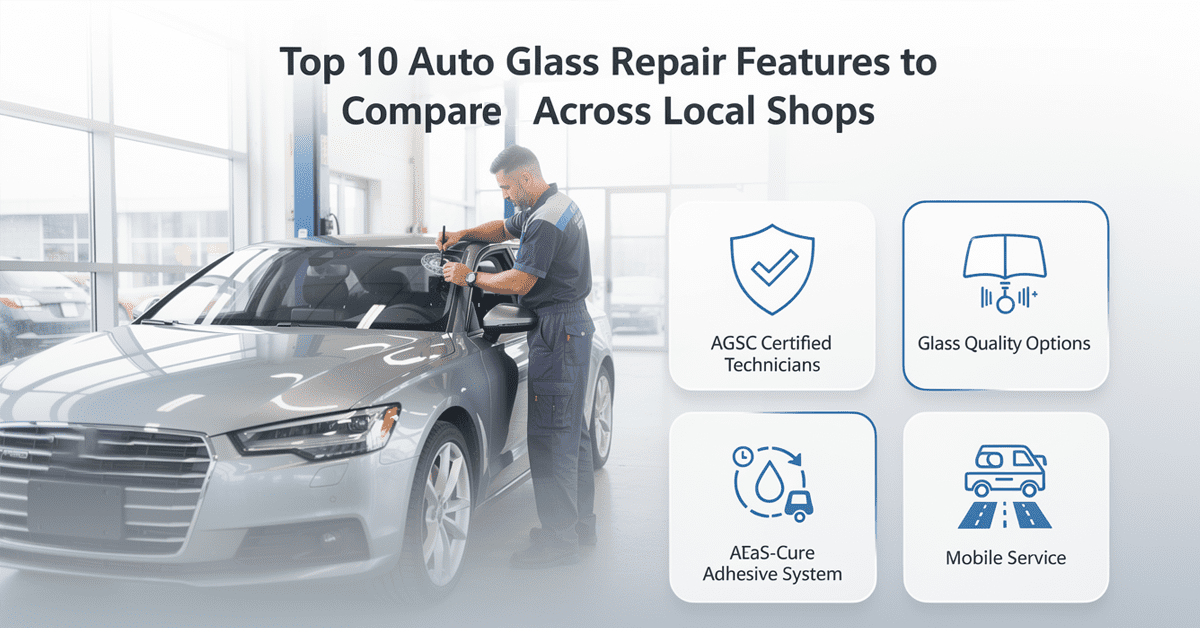
These 10 features do. Here’s what each one means, why it matters, and how to verify it before you commit.
Feature 1: Are the Technicians AGSC Certified?
The Auto Glass Safety Council (AGSC) runs the only nationally recognized certification for auto glass technicians. It’s a 70-question exam covering OSHA safety regulations, FMVSS 208 and 212 compliance (the federal standards for occupant protection and windshield retention), ADAS technology identification, and the AGRSS Standard for proper installation procedures. The Master Technician level requires 3+ years of industry experience plus advanced competencies in custom glass cutting, electrical troubleshooting, and leak diagnosis.
Before the AGSC established this standard, the industry had no consensus on proper installation methods. Windshields ejected during rollovers because installers didn’t understand proper urethane application. The AGRSS Standard was created specifically to prevent these failures, and the number of certified technicians recently surpassed 3,000 nationally — but tens of thousands of uncertified installers still operate alongside them.
AGSC Registered Member Companies undergo independent third-party audits verifying compliance with the ANSI/AGSC/AGRSS Standard. This audit adds accountability beyond individual technician certification — it means the company’s processes, not just its people, meet safety requirements.
How to verify: Ask “Are your technicians AGSC certified?” specifically. “Our guys are experienced” or “we’re factory trained” isn’t the same credential. Check the AGSC website at safewindshields.org to confirm Registered Member Company status. Insurance companies increasingly require AGSC certification for approved providers — if a shop is in your insurer’s network, they likely meet this standard, but confirm directly.
NuVision standard: Every NuVision technician across Arizona, Florida, and South Carolina holds AGSC certification. It’s a hiring requirement, not an optional credential.
Feature 2: What Glass Quality Tier Does the Shop Stock?
Three distinct quality tiers exist in the auto glass market, and the tier a shop defaults to determines both your optical clarity and your safety margin.
OEM (Original Equipment Manufacturer) glass comes from your vehicle manufacturer’s designated supplier — identical to the factory windshield in thickness, curvature, acoustic properties, and optical quality. It costs 30-50% more than OEM-equivalent. For luxury vehicles, lease returns, and vehicles with heads-up displays, OEM is the appropriate choice. Knowing how to verify if your replacement windshield is genuine OEM protects you from shops that charge OEM prices for lesser glass.
OEM-equivalent (aftermarket premium) glass meets FMVSS 205 and 212 certification, frequently comes from the same factories producing OEM glass under different branding, and is manufactured by names like Pilkington, Saint-Gobain, AGC, and Guardian. This tier handles 90% of replacements at the optimal balance of quality and value. Read more about what defines an OEM windshield and how equivalent glass compares.
Economy/budget glass meets minimum legal requirements but can exhibit optical distortion, waviness, thinner lamination, and inconsistent curvature. For ADAS-equipped vehicles, economy glass creates a measurable problem: camera sensors calibrated to specific optical properties produce unreliable readings through substandard glass. Some automakers refuse to calibrate ADAS systems on vehicles with glass that doesn’t meet their optical specifications.
FMVSS 205 requires minimum 70% visible light transmittance and no more than 0.25 diopter distortion across the critical viewing area. Economy glass may technically meet these numbers off the production line, but degradation under UV exposure and thermal stress can push it below compliance faster than quality glass.
How to verify: Ask for the specific glass manufacturer name before your appointment. Any shop that can’t tell you the brand going into your vehicle is likely using whatever is cheapest from their distributor that week. Every installed windshield must carry visible DOT markings — check them after installation to confirm the glass matches what was quoted.
NuVision standard: We exclusively install OEM-equivalent glass from certified manufacturers meeting FMVSS 205 and 212. We don’t stock economy glass. OEM is available on request for any make and model with the price difference quoted upfront.
Feature 3: Does the Shop Perform ADAS Calibration In-House?
This feature has become the most consequential differentiator in the auto glass industry. Over 80% of new vehicles sold in 2025 have at least one ADAS feature, and 95%+ of 2024-2026 models require ADAS recalibration after windshield replacement. Forward Collision Warning and Automatic Emergency Braking alone reached 94% market penetration in 2023 model-year vehicles.
The forward-facing camera behind your windshield controls automatic emergency braking, lane departure warning, adaptive cruise control, and forward collision warning. The AAA Foundation for Traffic Safety found that properly functioning ADAS could prevent 2.7 million crashes, 1.1 million injuries, and 9,500 deaths annually. A camera misaligned by a fraction of an inch aims significantly off-target at highway distances — and these cameras cannot self-recalibrate after glass replacement.
Proper recalibration requires specialized equipment costing $15,000-$30,000, manufacturer-specific software with annual licensing fees, and 1-2 hours of additional technician time. The process involves two methods: static calibration (performed in a controlled environment using precisely positioned targets) and dynamic calibration (performed on-road using a scan tool while driving at specific speeds). Many vehicles require both.
How to verify: Ask “Do you calibrate in-house or subcontract?” Shops that subcontract send you to a dealership — adding $200-$400 and a second appointment with no oversight of whether calibration actually happens. The most dangerous response: a shop that doesn’t mention calibration at all and returns your keys without it.
NuVision standard: All ADAS calibration is performed in-house — static, dynamic, or both — following manufacturer-specified procedures for your exact vehicle. Calibration cost is included in the total quote, never a surprise add-on.
Feature 4: What Adhesive System and Cure Time Does the Shop Use?
This is the feature most drivers never think to ask about — and it directly determines whether your windshield stays bonded in a collision. Your windshield provides up to 45% of your vehicle’s structural rigidity during a rollover and serves as the backstop for passenger-side airbag deployment. The urethane adhesive holding it in place must reach FMVSS 212 retention strength before you drive.
The AGRSS Standard uses the term “minimum drive-away time” (MDAT) — the minimum period after installation before the adhesive achieves enough strength to pass federal crash test requirements. According to I-CAR, fast-cure urethanes allow MDAT as short as 30-60 minutes, while conventional moisture-cured products require 2-8 hours or longer. Full structural cure typically takes 24-48 hours at moderate temperatures and can extend to 72 hours in cold, wet conditions.
Here’s the cost reality: urethanes with 30-60 minute MDAT cost significantly more than those with 4-6 hour cure times. Industry sources note that most companies use adhesives in the 4-6 hour range to cut costs. Premium shops invest in fast-cure products because customers need their vehicles back — but the safety calculation matters more than convenience. A shop using cheap adhesive with a 6-hour MDAT that tells you to “drive carefully” after 45 minutes has compromised your crash protection.
Environmental factors affect cure time dramatically: Arizona’s summer heat (110°F+) accelerates curing, potentially reducing MDAT below rated times. But Florida’s humidity, while accelerating moisture-cured urethanes, can also complicate outdoor mobile installations during rain. South Carolina’s winter temperatures can extend cure times beyond the product’s rated specifications.
How to verify: Ask “What’s the minimum drive-away time for the adhesive you use?” A good shop answers immediately with a specific time. If they can’t answer, they likely don’t know or don’t track it — neither is acceptable. Also ask whether the MDAT changes based on current weather conditions at your service time.
NuVision standard: We use premium fast-cure urethane adhesives with documented MDAT. Technicians communicate the specific drive-away time based on current conditions — not a generic estimate. We won’t release your vehicle before the adhesive reaches FMVSS 212 retention strength.
Feature 5: Does the Shop Offer True Mobile Service?
Surveys show 80% of customers who use mobile auto glass service report high satisfaction, citing time savings and personalized attention. But “mobile service” varies enormously between providers — from fully equipped service vehicles matching shop-quality capabilities to a technician in a sedan with a glass rack and basic tools.
True mobile service means the technician’s vehicle carries the same glass inventory, adhesives, primers, moldings, and ADAS calibration equipment available at the shop’s fixed location. The work quality should be identical regardless of service location. Key considerations that separate real mobile capability from marketing claims:
ADAS calibration capability: Static calibration requires a level surface and 30+ feet of clear space in front of the vehicle. Mobile ADAS calibration is possible but location-dependent — a technician arriving at your office parking lot may not have adequate space or surface conditions. Ask whether mobile calibration is available or whether you’ll need a separate shop visit.
Weather limitations: Glass adhesives cure based on temperature and humidity. Rain, extreme cold, or extreme heat can affect cure quality for outdoor installations. Reputable mobile providers will reschedule rather than install in conditions that compromise adhesive performance.
Service area coverage: Mobile adds drive time to the technician’s schedule. Shops charging for mobile service ($50-$100 typical) are at least transparent about the cost. Shops advertising “free mobile” may build the cost into glass markup or reduce time on the installation to maintain margins.
How to verify: Ask “Does your mobile unit carry ADAS calibration equipment?” and “Under what weather conditions would you reschedule?” A shop that reschedules when conditions compromise quality demonstrates higher standards than one that installs regardless.
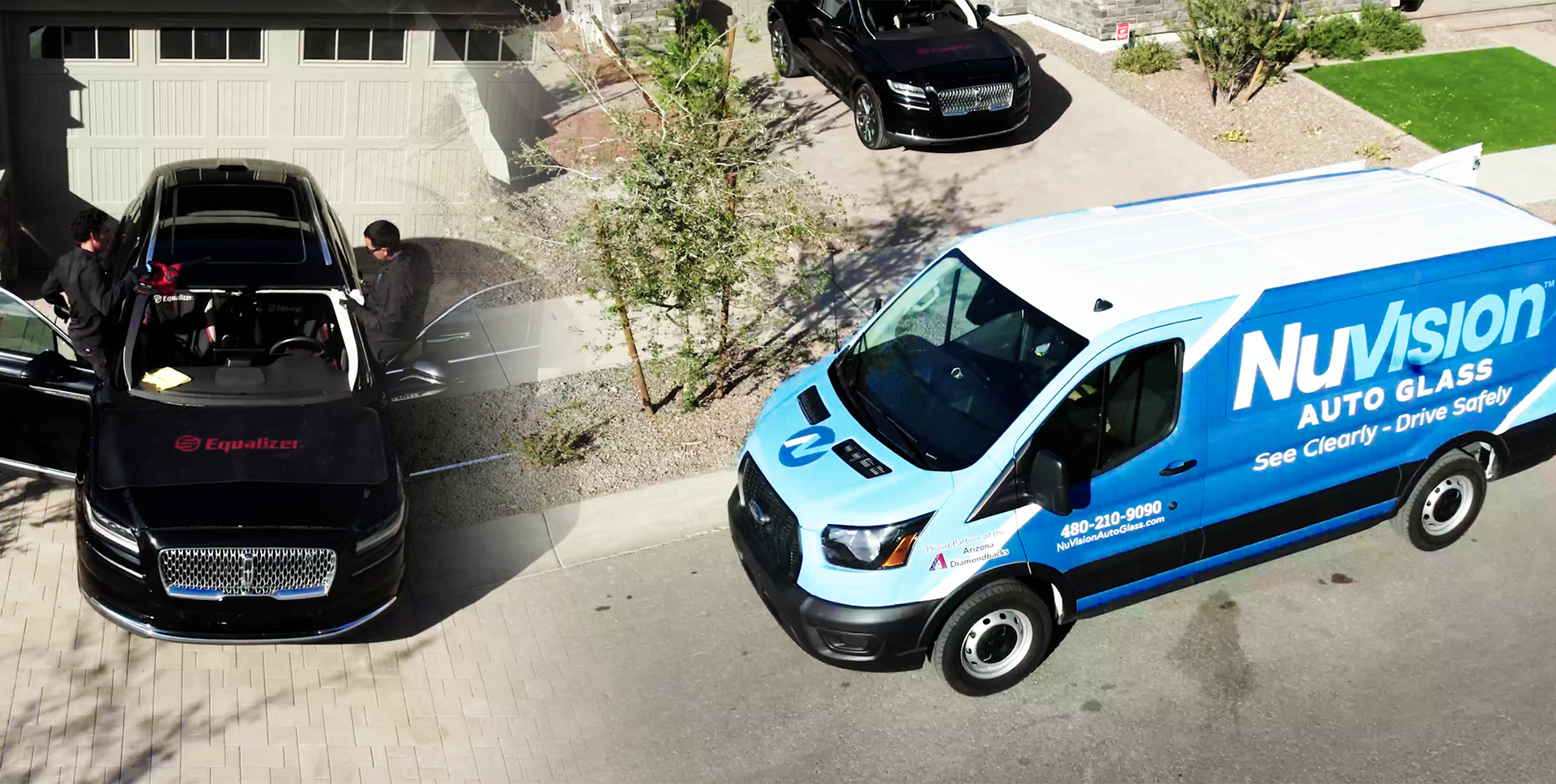
NuVision standard: Mobile service is included at no additional charge across all service areas in Arizona, Florida, and South Carolina. Our mobile units carry full glass inventory, premium adhesives, and ADAS calibration equipment. We reschedule mobile appointments when weather conditions would compromise cure quality — your safety isn’t worth the convenience of keeping a schedule.
Feature 6: How Transparent Is the Pricing Structure?
A complete windshield replacement cost includes five components, and every quote should itemize all of them: glass ($150-$600 depending on vehicle and quality tier), labor ($50-$150), materials ($25-$75 for urethane, primer, and moldings), mobile service ($0-$100), and ADAS recalibration ($150-$400 when required). A shop quoting $250 that excludes calibration has given you a partial number — the actual cost for an ADAS-equipped vehicle runs $500-$750.
Regional pricing varies across NuVision’s service areas. Phoenix runs at the low end of national pricing due to market competition, while South Florida runs 15-20% higher. Tucson typically adds 10-15% over Phoenix pricing. These differences are normal market dynamics, not price gouging — but you should expect consistent transparency regardless of location.
Insurance processing adds another comparison dimension. Shops that handle insurance claims directly save you time and usually reduce out-of-pocket costs. Understanding your deductible structure and whether you carry full glass coverage vs. standard determines whether insurance or cash is the better approach for your situation.
How to verify: Ask “Is this the total out-the-door price including ADAS calibration, mobile service, and materials?” If the answer requires qualifiers — “if applicable,” “that depends,” “starting at” — you don’t have a real quote. Also ask whether payment is collected before or after service. Reputable shops charge at completion, not before.
NuVision standard: Every quote is the total out-the-door price — glass, labor, materials, mobile service, and ADAS calibration included. Itemized breakdown provided before you commit. We also help you compare insurance vs. cash pricing so you make the most economical decision.
Feature 7: What Does the Warranty Actually Cover?
Every auto glass shop advertises “lifetime warranty.” The word has become meaningless without examining the document. Industry experts point out that a robust 90-day warranty can be more valuable than a lifetime warranty filled with exclusions that deny every claim.
What a strong warranty covers: defects in materials and workmanship, water leaks caused by installation error, wind noise from improper sealing, stress cracks resulting from installation (not subsequent impacts), loose or failing moldings, and ADAS recalibration if safety systems malfunction after service. Duration should be for as long as you own or lease the vehicle, provided in writing, and honored at multiple locations if the company operates in more than one market.
Red flags in warranty fine print: A 30-day reporting requirement that voids coverage if you don’t discover a slow leak within a month. Single-location-only coverage that evaporates if you move. Warranty voided if any other shop touches your glass afterward — locking you into one provider permanently. And the most common gap: no mention of ADAS calibration coverage whatsoever.
National chains offer geographic warranty advantages. Safelite’s lifetime warranty is honored across all 50 states. Caliber Auto Glass explicitly includes ADAS calibration in their limited lifetime warranty. Independent shops vary widely — some offer stronger local coverage than chains, while others provide verbal promises with no documentation.
How to verify: Ask “Can I have the warranty terms in writing before I book?” Read the exclusions, not just the coverage summary. If a shop can’t produce written warranty documentation on request, the warranty doesn’t functionally exist.
NuVision standard: Lifetime workmanship warranty covering materials, installation defects, water leaks, wind noise, stress cracks from installation, and ADAS recalibration — in writing, provided at service completion, honored at all NuVision locations across Arizona, Florida, and South Carolina.
Feature 8: How Does the Shop Handle Insurance Claims?
Insurance processing capability reveals operational maturity. Approximately 85% of U.S. drivers carry comprehensive coverage that typically includes windshield damage. A shop that handles the entire claims process — from verification to filing to direct billing — reduces your involvement to providing insurance information and signing authorization.
The comparison points that matter:
Direct insurance billing: Does the shop bill your insurer directly, or do you pay upfront and file for reimbursement? Direct billing eliminates out-of-pocket expense in most cases and is standard practice at established shops.
Claims expertise: Does the shop know whether your policy includes full glass coverage (often zero deductible) vs. standard comprehensive (deductible applies)? Can they advise whether filing a claim makes financial sense for your situation? A shop that recommends filing a $350 claim against a $500 deductible is either ignorant or dishonest.
Insurer network status: Shops in your insurer’s preferred network often provide expedited approval and pre-negotiated pricing. Out-of-network shops can still bill insurance but may involve longer approval times or balance billing.
State-specific knowledge: Florida’s SB 1002 reformed auto glass insurance practices — shops offering cashback incentives or assignment of benefits are operating outside the law. Arizona allows cashback incentives (currently up to $375 with NuVision). South Carolina follows standard comprehensive claim procedures. A shop’s knowledge of these state-level differences indicates operational sophistication.
How to verify: Ask “Do you bill my insurance directly?” and “Can you tell me whether filing a claim makes sense for my specific policy?” The second question tests their claims expertise.
NuVision standard: We handle direct insurance billing with all major carriers, verify your coverage details before quoting, and advise whether insurance or cash pricing benefits you more. We won’t recommend filing a claim when your deductible exceeds the service cost.
Feature 9: What Is the Shop’s Response Time and Scheduling Flexibility?
Response time matters because windshield damage worsens rapidly. Arizona’s thermal cycling can propagate a chip into a crack within days. Florida’s humidity penetrates chip damage and accelerates internal degradation. What’s a small chip today can become a major safety hazard requiring full replacement instead of a $50 repair.
The comparison framework for scheduling:
Same-day availability: Can the shop schedule windshield repair or replacement within the same business day? Top-performing shops maintain 60%+ repeat and referral business partly because rapid response builds loyalty. Same-day mobile service is the highest standard — it means the shop has adequate inventory, technician staffing, and route flexibility to handle urgent requests.
Scheduling windows: Shops offering 2-hour scheduling windows (rather than “sometime between 8 and 5”) demonstrate better fleet management and respect for your time. Some providers offer evening and weekend appointments — valuable for drivers who can’t take time off work.
Communication quality: 68% of Gen Z and Millennial customers prefer digital channels throughout the claims process, according to J.D. Power. A shop offering text updates, online scheduling, and digital payment reflects operational modernity. But communication quality goes beyond channels — does the shop proactively notify you of delays, confirm appointments, and follow up after service?
Emergency response: Shattered side glass, rear window blowouts, and catastrophic windshield failures require immediate response. Ask whether the shop offers emergency scheduling and what the typical response time is for urgent calls.
How to verify: Call during business hours with a specific vehicle and service request. Time how long it takes to get a real appointment (not “we’ll call you back”). The experience of getting a quote and appointment mirrors the experience of getting the actual service.
NuVision standard: Same-day service available across Tampa, Phoenix, and all primary service areas. Online scheduling, text confirmations, and proactive communication throughout the service process.
Feature 10: What Do Verified Reviews Actually Say?
Online reviews are easy to manufacture, but patterns within reviews reveal operational truth. Businesses with 4.0+ star ratings see 26% higher click-through rates, and 93% of consumers read reviews before purchasing — but the aggregate number matters less than what customers specifically describe.
Signals of a quality operation:
- ADAS calibration mentions: Customers describing calibration as a standard part of service — explained, performed, and documented — indicates the shop treats ADAS as routine procedure, not an afterthought or surprise upsell
- Technician names: Reviews naming specific technicians suggest a stable workforce with consistent quality. High turnover is endemic in auto glass and correlates directly with inconsistent work
- Warranty claim stories: Reviews describing successful warranty claims are the strongest trust signal available. It proves the shop honors its written commitments when tested
- Issue resolution: Every shop gets complaints. Professional, specific responses that resolve the problem demonstrate accountability. Generic copy-paste replies indicate a marketing operation, not a service culture
- Recency: Reviews from the past 6 months reflect current operations. A shop with excellent 2021 reviews but silence since may have changed ownership, lost key technicians, or shifted operational priorities
Business verification beyond reviews: Confirm an active Google Business Profile with verified address and current photos. Verify the shop has a physical location in your service area (not just a P.O. box). Ask about general liability and auto damage insurance coverage — any shop working on your vehicle should carry it. For auto glass work on Honda and other popular makes, confirming that the shop regularly services your vehicle brand matters — familiarity with model-specific clips, trim, and ADAS mounting reduces error risk.
How to verify: Read the 3-star and 4-star reviews, not the 5-star and 1-star reviews. The middle ratings contain the most honest operational feedback — good enough to acknowledge quality but specific enough to mention what could improve.
NuVision standard: Our verified Google Business Profile shows real customer reviews across every service area. We respond to every review — positive and negative — because accountability is baseline, not marketing.
Side-by-Side Feature Comparison: Shop Types
Here’s how these 10 features typically compare across different shop categories. This table reflects industry-wide patterns based on publicly available data, warranty terms, and common customer experiences — individual shops may vary.
| Feature | NuVision Auto Glass | National Chains | Typical Independents |
| 1. AGSC Certification | All technicians; required for hire | Often required; varies by location | Rarely verified; experience-based claims |
| 2. Glass Quality | OEM-equivalent standard; OEM on request | OEM-equivalent standard; economy in some markets | Varies widely; economy common for competitive pricing |
| 3. ADAS Calibration | In-house; static + dynamic; included in quote | In-house at most locations; some subcontract | Subcontracted to dealership or skipped |
| 4. Adhesive Standard | Fast-cure urethane; documented MDAT | Generally fast-cure; varies by franchise | 4-6 hour cure common to reduce costs |
| 5. Mobile Service | Free; full equipment including ADAS | Available; may charge $50-$100; ADAS varies | Limited or no mobile; basic equipment |
| 6. Pricing Transparency | Total out-the-door; itemized; no hidden fees | Generally transparent; add-ons possible | Highly variable; calibration often excluded |
| 7. Warranty | Lifetime written; ADAS included; multi-state | Lifetime; national coverage; ADAS varies | 90 days to lifetime; single-location; ADAS rare |
| 8. Insurance Handling | Direct billing all carriers; claims advisory | Direct billing; network preferred status | Some direct billing; many require upfront payment |
| 9. Response Time | Same-day available; digital scheduling | Same-day at most locations; online booking | 1-3 days typical; phone scheduling |
| 10. Reviews & Verification | Verified Google Business; responds to all | National profiles; local quality varies | Excellent to nonexistent; no standard |
National chains bring scale advantages — nationwide warranty, standardized processes, and established insurer relationships. Quality independent shops offer competitive pricing, personalized attention, and direct accountability. NuVision combines regional scale with local accountability: AGSC-certified technicians, in-house ADAS calibration, transparent pricing, and multi-state warranty coverage without corporate overhead driving up costs. For a deeper dive into the specific questions to ask any auto glass shop before booking, we’ve published a companion guide with red flags and documentation checklists.
How to Use This Checklist
You don’t need to interrogate every shop on all 10 features. The first three — AGSC certification, glass quality tier, and ADAS calibration capability — eliminate the majority of corner-cutting operations. If a shop can’t clearly answer those three, the remaining seven become irrelevant.
For drivers comparing two or three shops that pass the initial screen, features 4-7 (adhesive quality, mobile service, pricing transparency, and warranty terms) differentiate on value. Features 8-10 (insurance handling, response time, and review verification) confirm operational maturity and customer experience.
The cheapest quote only means something when all 10 features are equivalent. A $250 quote that excludes ADAS calibration, uses economy glass, and provides a verbal-only warranty isn’t comparable to a $650 quote that includes OEM-equivalent glass, in-house calibration, premium adhesive, mobile service, and a written lifetime warranty. The first quote is incomplete. The second quote is transparent.
Frequently Asked Questions
What is the most important feature to compare between auto glass shops?
ADAS recalibration capability. With 95%+ of 2024-2026 vehicles requiring it, a shop that can’t calibrate in-house either skips the procedure or sends you elsewhere. Skipping calibration leaves your automatic emergency braking, lane departure warning, and forward collision warning non-functional or unreliable.
How do I know if an auto glass shop uses quality glass?
Ask for the glass manufacturer name before your appointment. Reputable shops use OEM-equivalent glass from Pilkington, Saint-Gobain, AGC, or Guardian that meets FMVSS 205 and 212. If the shop can’t name the manufacturer, they’re using whatever is cheapest from their distributor. After installation, verify the DOT markings on the glass match what was quoted.
What should a complete windshield replacement quote include?
Five components: glass (specifying quality tier), labor, materials (urethane, primer, moldings), mobile service fee if applicable, and ADAS recalibration if your vehicle requires it. The total should be the out-the-door price with no additional charges at service time. Typical totals: $200-$350 for non-ADAS sedans, $500-$750 for ADAS-equipped vehicles, $800-$1,200 for luxury ADAS vehicles.
How long should I wait to drive after windshield replacement?
Minimum drive-away time depends on the adhesive used and current weather conditions. Fast-cure urethanes allow 30-60 minutes. Conventional products require 2-8 hours. Full structural cure takes 24-48 hours. Your shop should communicate the specific MDAT based on the product used and conditions at your service time. Driving before the adhesive reaches FMVSS 212 retention strength compromises your crash protection.
Is mobile windshield replacement as good as in-shop service?
Yes, when the mobile unit carries equivalent equipment — same glass inventory, adhesives, and ADAS calibration tools. Weather conditions can affect mobile installations. Reputable providers reschedule when rain, extreme temperatures, or humidity would compromise adhesive cure quality. Ask whether mobile ADAS calibration is available or requires a follow-up shop visit.
Should I choose a national chain or a local auto glass shop?
Both can deliver excellent results — what matters is how they score across these 10 features. National chains offer broader warranty coverage and standardized processes. Quality regional providers like NuVision often provide more competitive pricing, personalized service, and direct accountability. The worst choice is any shop — chain or independent — that can’t answer the first three questions clearly.
Does filing an auto glass insurance claim raise my premium?
Glass claims are classified as comprehensive, not collision, and typically don’t increase premiums. However, the Insurance Research Council found that drivers filing two or more auto glass claims within three years experienced an average 15% premium increase. One claim within a three-year period almost never affects rates. Your shop should be able to advise whether filing makes financial sense based on your specific deductible and claims history.
What does AGSC certification actually require?
AGSC certification requires passing a 70-question exam covering OSHA safety regulations, FMVSS 208 and 212 compliance, ADAS technology identification, all types of auto glass replacement, and the AGRSS installation standard. The Master Technician certification adds 3+ years of industry experience plus advanced competencies. Certification is valid for 3 years and requires renewal. Over 3,000 technicians hold the credential nationally.
Every feature in this list exists to answer one question: will this shop protect my safety, my wallet, and my time? The shops that score well across all 10 don’t need to compete on price alone — their value is self-evident.
NuVision Auto Glass checks every box across Arizona, Florida, and South Carolina: AGSC-certified technicians, OEM-equivalent glass, in-house ADAS calibration, fast-cure adhesives, free mobile service, transparent pricing, written lifetime warranty, direct insurance billing, same-day availability, and verified customer reviews on our Google Business Profile.
Get a Free Quote — All 10 Features Included, Itemized, No Surprises →