Parking Habits That Reduce Windshield Damage Risk
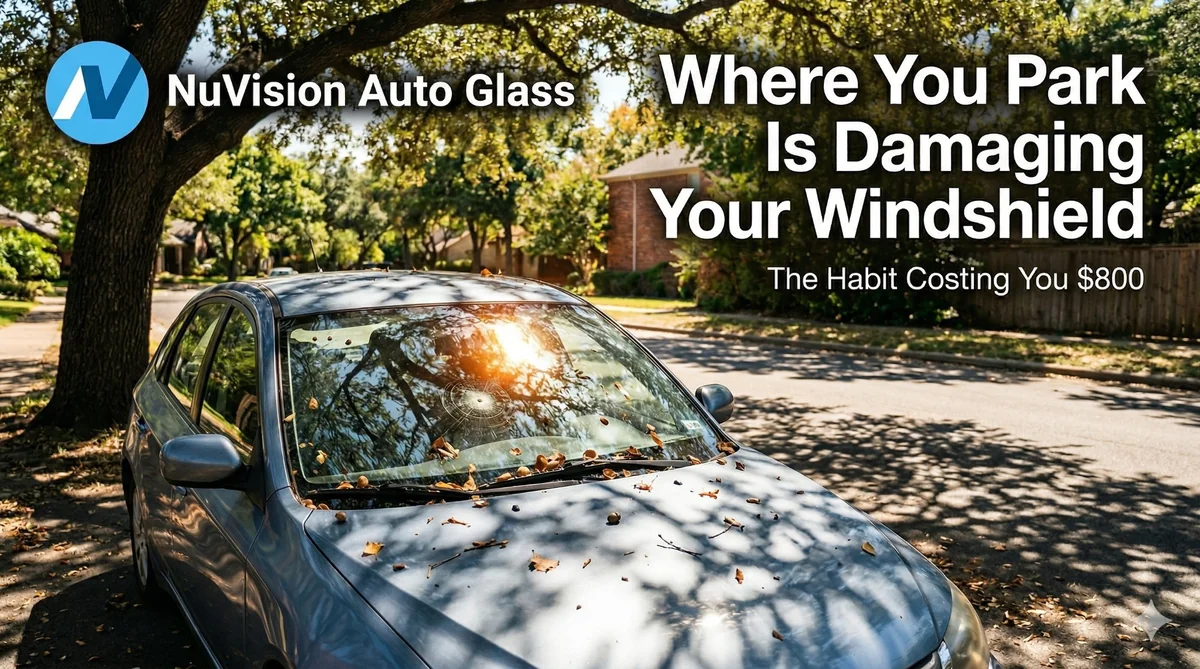
A customer in Gilbert came in last spring after his second windshield replacement in three years. Same car, same neighborhood, no highway incidents. We asked him where he parked at work. He said the surface lot by the east entrance — full sun, closest to the door, under a large oak tree.
We counted four separate damage sources in that one answer: UV exposure, thermal stress, falling debris from the oak, and acorns in the fall. He’d been paying for proximity. His windshield was paying the price.
Where you park is one of the highest-leverage decisions you make for your windshield’s lifespan — and most drivers never think about it at all.
The short answer
Strategic parking reduces windshield damage risk by 50–70%. Covered parking alone extends glass life from 7–10 years to 12–15+ years — a $300–800 replacement savings that justifies most covered parking premiums on its own.
How Much Does Covered Parking Actually Change Things?
More than most people expect. The damage mechanisms that covered parking eliminates aren’t dramatic — they’re slow, cumulative, and invisible until they aren’t. UV radiation degrades urethane seal adhesive over years. Daily heat cycles expand and contract glass around any existing stress point. Bird droppings left for days etch the surface. Falling debris creates chips that become cracks.
Covered parking stops all of them simultaneously. That’s why the lifespan difference is as large as it is.
| Covered Parking Type | Protection Level | Typical Cost | Best For |
|---|---|---|---|
| Private home garage | Maximum | $0 (already owned) | Homeowners — always use it |
| Covered parking structure | Excellent | $50–150/month | Urban workers, apartments |
| Carport | Good | $0–50/month | Suburban homes |
| Open-sided parking garage | Moderate | $25–75/month | City commuters |
| Windshield sunshade only | Minimal (UV only) | $15–30 one-time | When no covered option exists |
The cost math on covered parking is straightforward. A $500 windshield replacement avoided every five years is $100/year in annualized savings. A $25/month covered spot costs $300/year. The gap closes quickly when you factor in interior preservation, reduced AC wear, and paint protection — all of which covered parking provides simultaneously.
At $50/month for a covered spot, the windshield savings alone nearly break even. Everything else is upside.
What Overhead Hazards Are Actually Worth Avoiding?
Trees are the most consistent source of falling-object windshield damage we encounter — responsible for roughly 25% of chips from above. The risk varies significantly by species, season, and weather conditions.
Tree Risk by Type
| Tree Type | Risk Level | Main Hazard | Worst Season |
|---|---|---|---|
| Oak | High | Heavy acorns + large falling branches | September–November |
| Pine | High | Sap etching + falling cones + branch weight | Year-round / Winter ice loading |
| Palm | High | Dropping fronds (heavy, fast) | Florida hurricane season |
| Maple / Ash / Elm | Moderate | Smaller debris, manageable branches | Storm events |
| Low ornamental shrubs | Low | Minimal overhead risk | N/A |
The safe distance rule is 10 feet minimum from the trunk, 15 feet ideally. During Arizona monsoon season (July–September), dust devils and sudden wind gusts break dead branches without warning — any tree proximity becomes a gamble. In Florida during hurricane season, any tree becomes a projectile risk. Move the vehicle to a garage during tropical watches.
Power lines and poles account for 5–8% of overhead damage. The risks aren’t just from the lines themselves — ice accumulation in South Carolina causes line drops, and pole-mounted transformers add overhead weight risk that most drivers never consider. Maintain 15 feet from power poles and never park directly under active lines.
Construction zones deserve a separate note. Scaffolding, tools, and demolition debris account for 10–15% of chips in urban areas. Twenty-five feet minimum distance from any active site — and if there’s fencing or barriers, treat it as a hard signal to find alternate parking, even if it’s inconvenient.
Why Do End Spots Protect Your Windshield?
End spots reduce adjacent-vehicle damage by 40%. The reason is simple: one neighboring vehicle instead of two means half the door-ding exposure and half the shopping cart collision risk. Over years of daily parking, that adds up to a measurable difference in both minor and major damage incidents.
The selection criteria matter though. Not all end spots are equal.
- Choose driver-side end spots. Your door opening is fully controlled, and the passenger side is protected by a curb, wall, or building rather than open space.
- Avoid cart corral ends if carts are stored on your vehicle side. An overflowing corral with wind is its own damage source.
- Prefer wall or building ends over open-field ends. You get wind protection in addition to the side protection.
- Accept the longer walk. The end spot is typically 30–100 extra feet from the entrance. That tradeoff is worth it every time.
For workplace parking, the same logic applies with an additional variable: duration. An end spot that protects your car for 8 hours daily has significantly more impact than a weekend shopping trip. If your workplace has a covered end spot available, that’s the combination worth paying for.
Does Which Direction You Park Actually Matter?
In Arizona, yes — more than most drivers realize. North-facing parking minimizes direct sun exposure to the windshield and reduces interior temperature by 10–15°F compared to south-facing. It also reduces thermal shock when you blast the AC after getting in, which is one of the most consistent crack-triggering scenarios we see with existing chips.
In Florida and South Carolina, shade duration matters more than compass direction. Position the vehicle to maximize time in building shadows or tree shade — with the important caveat that tree shade is only beneficial if the overhead hazard risk is low. A shaded spot under a healthy ornamental tree in a well-maintained lot is fine. A shaded spot under a pine tree near the coast during hurricane season is not.
| State | Ideal Direction / Position | Why | Seasonal Exception |
|---|---|---|---|
| Arizona | Face north | Minimizes direct sun on glass, reduces interior temp 10–15°F | Monsoon season: avoid all trees regardless of direction |
| Florida | Maximize shade duration | UV and heat second only to AZ, shade extends glass life | Hurricane watch: garage only, avoid all outdoor trees |
| South Carolina | South-facing in winter | Captures sun warmth, aids natural defrosting, reduces ice scraper use | Hail warnings (March–May): covered parking immediately |
What Distance From Foot Traffic Should You Maintain?
Six feet minimum from main pedestrian walkways. It sounds specific, but the damage patterns support it. Shopping cart collisions, accidental door swings from crowded access paths, and vandalism are all significantly more likely within that radius.
Building entrances follow the same logic. The closest parking spots aren’t just high foot-traffic — they’re high-turnover. More cars moving in and out of adjacent spots means more backing maneuvers, more door openings, and more opportunity for incidental contact. Parking four to eight rows back finds the balance between convenience and reduced exposure.
For shopping centers, the cart corral strategy is worth knowing: two to three spots away is the optimal distance. Close enough to return your cart without abandoning it in the lot. Far enough that a rolling cart from a full corral or a careless user doesn’t reach your vehicle. Never park directly adjacent — wind and inattention push carts into neighboring cars more often than drivers realize.
How Does This Play Out Differently Across Arizona, Florida, and South Carolina?
Each state has a distinct primary threat, and the parking priorities reflect that.
Arizona: Covered parking is the highest priority of any market we serve. UV radiation and 110°F+ heat are the primary windshield threats — not road debris, not hail. In Gilbert, Mesa, Chandler, and Phoenix, a vehicle parked in full sun every workday is experiencing thermal cycles that accelerate glass deterioration and chip expansion far faster than a garaged vehicle. A windshield sunshade is the minimum viable protection when covered parking isn’t available. It’s a $15–30 investment that meaningfully extends glass life in an environment where it would otherwise degrade in 7–8 years instead of 12+.
Monsoon season (July–September) adds a layer: garage during dust storm warnings, and avoid tree parking entirely. Dust devils and sudden gust fronts break dead branches without the usual warning signs a sustained storm provides.
Florida: Coastal drivers face the combination of salt spray and hurricane debris. Both are manageable with covered parking — and during hurricane watches, a garage isn’t optional, it’s the only sensible choice. Inland Florida has a slightly lower urgency, but UV and heat are still second-highest nationally after Arizona. Year-round shade-seeking is worth the habit.
South Carolina: Hail season (March–May) is the acute risk, and it’s the period when covered parking pays for itself most visibly. A single hail event that catches your car outdoors can mean a full windshield replacement at $300–800. Freeze-thaw cycles through November–March make the winter the secondary priority — ice scraping and temperature cycling both stress glass with existing chips. The covered parking calculus here is most compelling between October and May.
What Does Strategic Parking Actually Cost vs. What It Prevents?
| Strategy | Annual Cost | Damage Reduction | Annual Value |
|---|---|---|---|
| Covered parking ($25/month) | $300 | UV, debris, hail, thermal cycles | $125–167/year (replacement savings) |
| Covered parking ($75/month) | $900 | All of above + interior preservation | $245/year (glass + interior savings) |
| Windshield sunshade ($20) | $20 one-time | UV only (no debris, thermal still applies) | Partial — extends seal life |
| Strategic free parking (end spots, hazard avoidance) | $0 | 30–40% damage reduction | $150–320/year in prevented damage |
The last row is the most underrated. Strategic free parking — end spots, 10 feet from trees, 15 feet from power lines, north-facing in Arizona — costs nothing except 30–60 seconds of attention per parking event. The $150–320 in annual damage prevention is real money for a habit that requires no ongoing spend.
For vehicles with ADAS systems, the calculus is even stronger. A replacement that requires camera recalibration costs $300–600 more than a standard swap. Parking habits that extend glass life by three to five years are worth considerably more on modern vehicles than on older ones.
What About Long-Term and Airport Parking?
Long-duration parking is where covered options provide the most concentrated value. A week-long trip with your car in an uncovered surface lot exposes it to every weather event that passes through — and you have no ability to respond. A $50–100 covered parking upgrade for that week is the most straightforward insurance available.
If uncovered long-term parking is the only option, choose end rows for easier vehicle location, avoid areas with poor lighting (vandalism risk), and use landmarks like light poles to remember your spot — but don’t park under them. The landmark is useful. The pole is a hazard.
For apartment and complex parking, a covered or assigned spot is worth the $20–50/month premium over visitor parking. Visitor areas have the highest vehicle turnover and the lowest care from unfamiliar drivers. Your car sitting in visitor parking for weeks is accumulating risk from every driver who parks beside it.
Frequently Asked Questions
How much does parking location actually affect windshield life?
Significantly. Vehicles in covered garages consistently need windshield replacement every 12–14 years versus 7–9 years for exposed parking. Strategic parking alone reduces damage risk by 50–70% without changing anything about how you drive.
Is it worth paying for covered parking just for windshield protection?
At $25–50/month, covered parking nearly pays for itself in windshield savings alone — $60–160 annually in avoided replacement costs. Add interior preservation, reduced AC wear, and paint protection, and the value is clear at most price points.
What trees are most dangerous to park under?
Oak (heavy acorns, large branches), pine (sap and cones), and palm (dropping fronds) carry the highest risk. Maintain at least 10 feet from the trunk. During storm warnings, move away from all trees regardless of species.
Why is end-spot parking better for windshields?
One adjacent vehicle instead of two cuts door ding and shopping cart collision risk by 40%. Choose the driver-side end, where your door is controlled and the passenger side is protected by a wall or curb rather than open space.
Does parking direction affect windshield damage in Arizona?
Yes. North-facing reduces direct sun exposure and interior temperature by 10–15°F versus south-facing. It also reduces the thermal shock of blasting AC after getting in — one of the most consistent crack triggers we see with existing chips in Phoenix and Gilbert.
When should I move my car to covered parking immediately?
During any hail warning (South Carolina March–May), hurricane watch (Florida), or dust storm or monsoon warning (Arizona). Even paying for emergency covered parking during a hail event is cheaper than a $300–800 glass replacement.
The Habit Takes 30 Seconds. The Savings Last for Years.
Most windshield damage we see isn’t unavoidable. It’s the result of parking under the same oak tree every day for three years, or leaving a car in full Arizona sun for eight hours while a chip slowly expands in the heat, or pulling into the first open spot in a busy lot and collecting a cart strike by Thursday.
None of these are dramatic events. They’re just habits — and habits can change.
End spots, covered parking when available, 10 feet from trees, north-facing in Arizona, garage during hail warnings. That’s the full list. Thirty seconds of attention per parking event and a willingness to walk an extra row.
If you already have damage that’s been sitting for a few weeks, a chip repair costs $50–90 and takes 30–45 minutes. Waiting until it spreads costs $300–800 and takes longer. Get a free quote here — we come to you anywhere in Arizona, Florida, or South Carolina.
You can also find us and read customer reviews on Google Maps:
📍 NuVision Auto Glass — Arizona
📍 NuVision Auto Glass — Florida