HUD Windshield Compatibility: Why the Wrong Replacement Glass Causes Ghosting?
HUD windshield compatibility is something most drivers only discover matters after it’s too late. A customer in Scottsdale came to us last February after her Mazda CX-90’s Head-Up Display developed a ghost image — a faint, offset duplicate of the speed readout floating just above the correct number. The car had a new windshield installed six weeks earlier. The shop had used standard glass.
The HUD itself was fine. The projector was working exactly as designed. The problem was that the new glass didn’t have the optical construction required to handle a HUD projection correctly.
The ghost was permanent. The only fix was another replacement — this time with the right glass.
A standard windshield installed on a HUD-equipped vehicle produces ghosting — a double image — that no calibration, software update, or film can fix. The only solution is replacing the glass with a HUD-compatible windshield that includes the correct wedge-shaped interlayer. The glass spec isn’t optional. It’s structural.
What Is Ghosting and Why Does It Happen on HUD Vehicles?
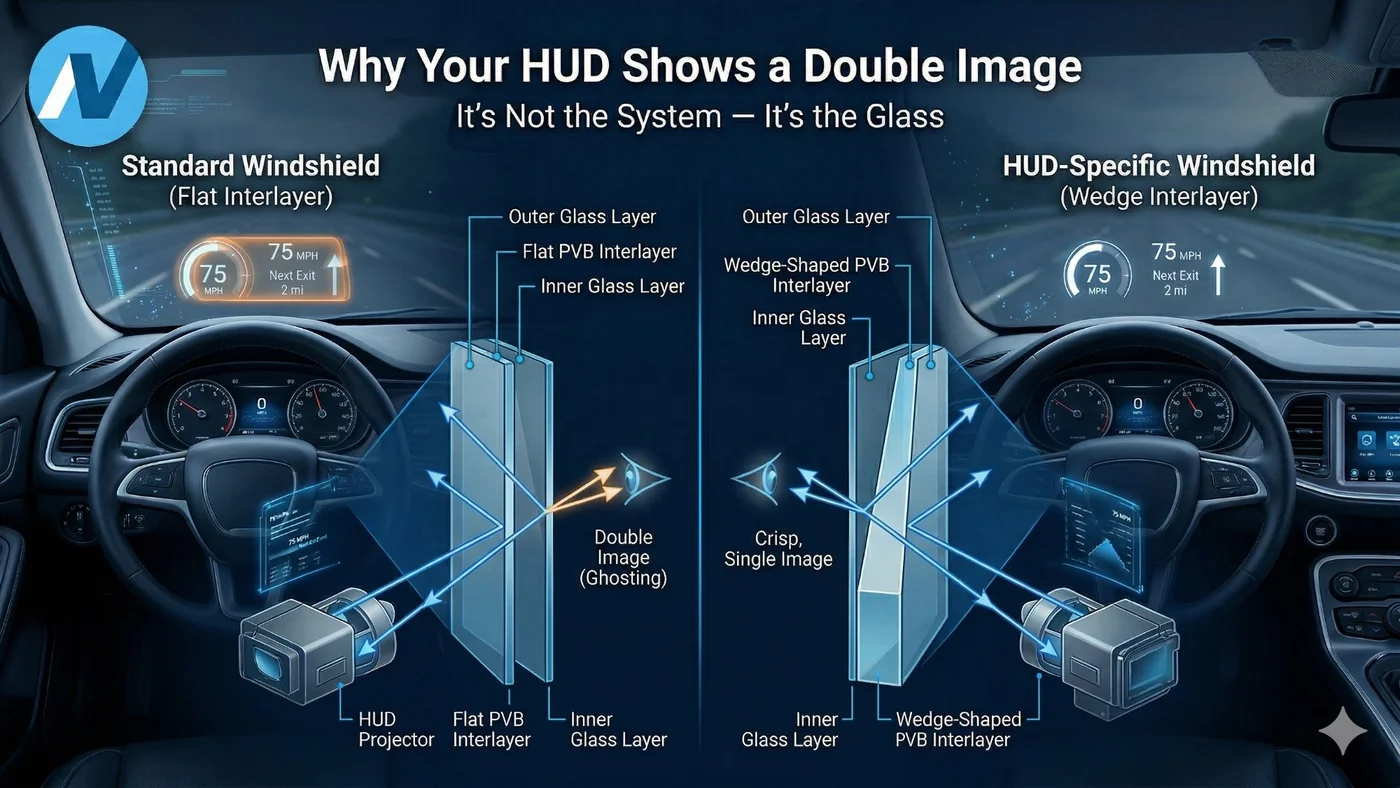
A windshield is a laminated sandwich — two glass layers bonded to a PVB (polyvinyl butyral) interlayer. When a HUD projector fires an image toward the windshield, that image reflects off the glass surface toward the driver’s eyes. The problem: light doesn’t reflect off just one surface. It reflects off the inner glass surface and the outer glass surface — producing two separate reflected images.
On standard glass with a flat, parallel interlayer, those two reflections are slightly offset. At normal distances and angles, you see both — a sharp primary image and a faint, displaced secondary image sitting just above or below it. That secondary image is the ghost.
HUD-compatible windshields eliminate this with a wedge-shaped PVB interlayer. Instead of running parallel, the interlayer is slightly thicker at the bottom than the top — angled at a fraction of a degree. That wedge angle causes both glass surfaces to tilt relative to each other by precisely the amount needed to make the two reflections converge at the same point in the driver’s line of sight. One image. No ghost.
The wedge angle is calculated specifically for each vehicle’s HUD projector position, angle, and driver eye-box. It varies by make and model. This is why HUD-compatible glass has a VIN-specific part number — the wedge geometry isn’t universal.
| Glass Type | Interlayer | HUD Result | Fix for Ghosting |
|---|---|---|---|
| Standard windshield | Flat parallel PVB | Ghost image — two offset reflections | Not fixable — replace with HUD spec |
| HUD-compatible windshield | Wedge-shaped PVB | Single sharp image — reflections converge | N/A — correct by design |
| Combiner HUD vehicle (flip-up screen) | Standard flat PVB | N/A — image projects on combiner, not glass | Standard replacement fine |
Which Vehicles Have Windshield-Projected HUDs That Require Specialist Glass?
More than 30 manufacturers now offer factory HUDs. Not all of them project onto the windshield — some use a separate combiner screen. The ones that project directly onto the glass require HUD-compatible replacement.
Luxury segment. BMW, Mercedes-Benz, Audi, Lexus, and Jaguar have used windshield-projected HUDs as standard or optional features across their ranges for over a decade. The BMW 5 Series, Mercedes C-Class, and Audi A6 all specify wedge-interlayer glass. Augmented Reality HUDs on the BMW iX and Mercedes EQS project across a significantly larger windshield area, with even tighter optical tolerances.
Mid-range expanding rapidly. Mazda’s CX-90, CX-5, and Mazda6, Chevrolet’s Corvette and Silverado, Toyota’s RAV4 and Camry (HUD-optioned variants), Hyundai’s IONIQ 6 and Tucson, Genesis GV80, and Volvo’s XC range all use windshield-projected HUDs. HUDs are now offered across more than 30 manufacturers globally as of 2025, with mid-range adoption accelerating as production costs fall.
How to confirm your vehicle. Open the owner’s manual and search for “Head-Up Display.” If it describes the image appearing on the windshield (not on a pop-up screen), HUD-compatible glass is required for replacement. Alternatively, confirm by VIN with the shop before booking — a qualified technician should be able to confirm the correct part number in under two minutes.
What Else Makes a HUD Windshield Different From Standard Glass?
The wedge interlayer is the most critical difference but not the only one. HUD windshields often incorporate several additional specifications that affect both the display performance and the replacement process.
Anti-reflective coating in the projection zone. The lower portion of the windshield — where the HUD image is projected — is often treated with a specific coating that optimises contrast and reduces ambient light interference. This makes the displayed image readable in bright sunlight conditions. Standard glass without this coating produces a dimmer, lower-contrast display at the same projector brightness.
Precise glass thickness consistency. Even minor thickness variations across the projection zone cause distortion. HUD glass is manufactured and inspected to tighter tolerances than standard automotive glass. Low-cost aftermarket glass that meets the dimensional specification for fit may not meet the optical consistency requirement for a clear HUD display.
Compatibility with other embedded features. Many HUD vehicles also have acoustic interlayers for noise reduction, solar control layers for UV and heat management, or embedded antenna elements. A correct HUD replacement needs to match all of these specifications — not just the wedge angle. Installing HUD-compatible glass that lacks the acoustic layer, for example, restores the display but increases cabin noise.
HUD alignment after replacement. After installation, the HUD projector position needs to be verified and aligned. Even correctly-specced glass installed at a fractionally different angle can shift where the image sits in the driver’s field of view. A HUD alignment confirms the image height and horizontal position are correct for the driver’s eye-box range.
What Happens to ADAS Systems on HUD-Equipped Vehicles at Replacement?
Most vehicles with factory-installed windshield HUDs were built after 2016 — which means most of them also have ADAS cameras mounted to or near the windshield. The two systems are independent, but both are affected by glass replacement and both require post-replacement work.
The ADAS camera bracket bonds to the windshield glass. When the glass changes, the camera position shifts at the millimetre scale. A 1mm displacement creates approximately a 6-foot lateral detection error at highway range — with no dashboard warning. ADAS recalibration corrects that shift and must be completed before lane departure warning, automatic emergency braking, and adaptive cruise control function correctly.
This means a complete HUD windshield replacement on a modern vehicle typically involves three distinct steps: installation of the correct HUD-compatible glass, HUD alignment, and ADAS recalibration. A shop that completes only the installation has left two critical post-replacement steps undone.
For the full breakdown of ADAS calibration methods by vehicle — including which vehicles require static, dynamic, or both — see the calibration guide.
Does This Matter More in Arizona, Florida, or South Carolina?
The HUD specification issue is universal — it applies everywhere. But the driving conditions that expose a ghost image most prominently differ by state.
Arizona. Bright sun is the amplifier. Ghosting is most visible when ambient light competes with the HUD projection — which in Phoenix, from May through September, is most of the day. A ghost image that might be barely noticeable on an overcast morning in South Carolina becomes a constant distraction on a clear Arizona afternoon. Arizona drivers with HUDs who notice any display issue after a replacement should have the glass spec confirmed immediately — the conditions here make a misspecified windshield significantly harder to tolerate than in a cooler, cloudier climate.
Florida. High UV and humidity accelerate degradation of anti-reflective coatings if the wrong glass is installed. Florida’s climate is also hard on the adhesive bond for the HUD projector housing — a correctly installed HUD windshield with proper cure time is particularly important here, where temperature and humidity variations can stress a bond that wasn’t given adequate time to fully set.
South Carolina. The winter variable is most relevant: freeze-thaw cycles stress glass bonds, and any chip or crack in the HUD projection zone that goes unrepaired will distort the display well before it becomes a structural concern. A chip repair in the projection area, when possible, is worth doing promptly — not just for structural reasons, but because even a small repaired chip leaves a minor optical artifact that can be visible in the HUD display zone.
Frequently Asked Questions
Why does my HUD show a double image after windshield replacement?
The replacement glass used standard flat-interlayer construction instead of the wedge-shaped PVB interlayer required for HUD vehicles. Standard glass produces two offset reflections from the HUD projector — a primary image and a ghost. The wedge interlayer angles the glass surfaces so both reflections converge at one point, eliminating the ghost. No calibration or software fix corrects this — only replacing the glass with the correct HUD spec resolves it.
Does every car with a HUD need a special windshield?
Only vehicles where the HUD projects directly onto the windshield glass. Vehicles with a combiner HUD — a flip-up screen above the dashboard — don’t use the windshield as the display surface and don’t need specialist glass. Confirm by VIN with the shop before booking. If the owner’s manual describes the image appearing on the windshield, HUD-compatible glass is required.
Can HUD ghosting be fixed without replacing the windshield again?
No. Ghosting from an incorrect windshield is a physical property of the glass — the flat interlayer producing two separate reflection points. No calibration, film, or software update corrects it. The glass must be replaced with the correct HUD specification. This is why confirming the spec before the first replacement saves significantly more than the cost difference between standard and HUD glass.
How much more does a HUD windshield cost?
HUD-compatible glass typically costs $400–$1,600 compared to $150–$400 for standard glass on the same vehicle. Most comprehensive policies cover OEM or OEM-equivalent HUD glass when it was factory-fitted — confirm with your insurer before booking, and specifically ask whether the claim covers HUD-spec glass. Some policies default to standard replacement unless the HUD spec is explicitly requested.
Does HUD windshield replacement require ADAS recalibration?
Yes, on any HUD vehicle with ADAS cameras mounted to the windshield — most vehicles with factory HUDs built after 2016. Both the HUD alignment and ADAS recalibration are required after replacement. A shop that returns the vehicle after installation only, without completing both steps, has left the display and safety systems in an uncalibrated state. Ask for written confirmation that both were completed before you drive away.
The Glass Spec Is Not a Detail. It’s the Whole Job.
The Scottsdale customer paid for two windshield replacements. The first one used standard glass. The second — with the correct HUD spec, HUD alignment, and ADAS recalibration — cost more but left the vehicle the way it left the factory.
The cost difference between standard and HUD-compatible glass is real. The cost of getting it wrong — a second replacement, another round of adhesive curing, another day without the vehicle — is higher. Confirming the spec before the appointment takes two minutes and a VIN.
If you’re in Arizona, Florida, or South Carolina and your vehicle has a Head-Up Display, book at nuvisionautoglass.com/get-a-quote and tell us your VIN. We’ll confirm the correct glass specification, HUD alignment requirement, and whether ADAS recalibration applies — before the job starts, not after.
Find us on Google Maps:
NuVision Auto Glass — Arizona
NuVision Auto Glass — Florida