
We get this search question regularly — usually from drivers who moved to the US from the UK, Australia, or South Africa and aren’t sure whether “windscreen repair” and “windshield repair” are the same service, the same part, or something different entirely.
They’re the same thing. Completely. The glass is identical, the construction is identical, the repair and replacement process is identical. The only thing that differs is the word used to describe it — and that depends entirely on where you learned to drive.
Windshield = American and Canadian English.
Windscreen = British, Australian, South African, and New Zealand English.
Same part. Same glass. Same repair process. Different word.
Why Do Americans Say Windshield and Everyone Else Says Windscreen?
Both terms emerged in the early 20th century as mass automobile production began in the United States and Europe simultaneously. Early cars were open-topped — drivers sat fully exposed to wind, rain, and road debris. When manufacturers added a front glass panel, they needed a name for it.
American English went with shield — a word emphasising protection and barrier. The glass shielded occupants from harm. British English went with screen — a word with roots dating to the Middle Ages describing a surface that filters or blocks. The glass screened out the elements.
Neither choice was coordinated. The automotive industries on each side of the Atlantic simply built their own vocabulary independently, and regional usage became entrenched over the following decades. By the time global communication made these differences obvious, both terms were too established to displace.
The result: two words in active use today for the same piece of glass, dividing the English-speaking world cleanly along geographic lines.
| Term | Where It’s Used | Word Root |
|---|---|---|
| Windshield | United States, Canada | Shield — barrier against harm |
| Windscreen | UK, Australia, South Africa, New Zealand, Ireland | Screen — filtering or blocking surface |
One exception worth noting: the aviation and motorcycle industries internationally tend to use windscreen regardless of country — including in the United States. A fighter pilot’s windscreen and a motorcycle’s windscreen are the standard terms on both sides of the Atlantic. The automotive split is specifically a car and truck distinction.
What Is a Windshield Actually Made Of?
Whatever you call it, the glass itself is the same everywhere — and understanding what it is helps explain why it behaves differently from every other piece of glass on your vehicle.
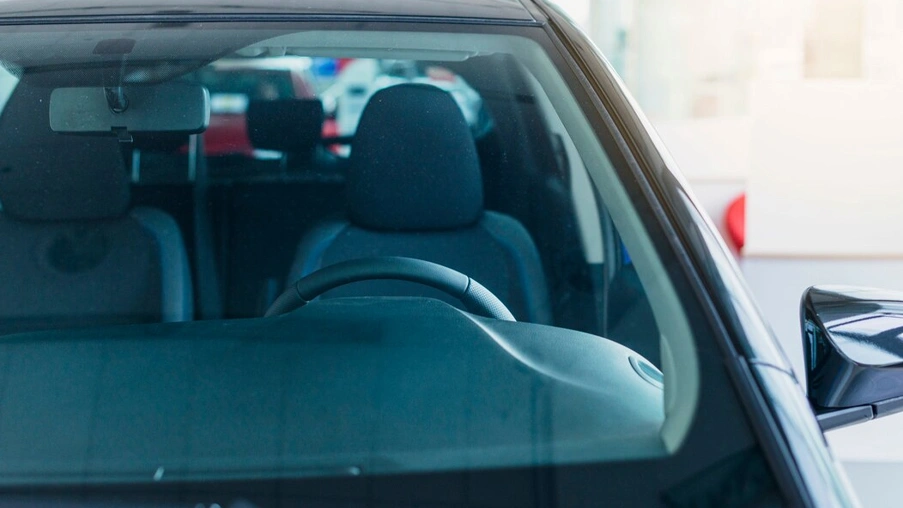
A windshield is made of laminated safety glass: two layers of tempered glass with a polyvinyl butyral (PVB) interlayer bonded between them under heat and pressure. The PVB layer is what makes a windshield behave differently from a side window when it breaks.
Side and rear windows are made of tempered glass only — a single layer that’s heat-treated to be significantly stronger than standard glass. When it breaks, it shatters into thousands of small, relatively blunt pieces designed not to cause lacerations. That’s why a side window breaks completely when it goes.
A windshield doesn’t shatter on impact. The PVB interlayer holds broken pieces together, maintaining the glass as a structural surface even when cracked. This is intentional — a windshield that stayed in one piece after an impact was critical for protecting occupants from ejection and for keeping the roof structure intact in a rollover.
| Glass Type | Construction | On Break | Used On |
|---|---|---|---|
| Laminated | Two glass layers + PVB interlayer | Holds together, cracks but doesn’t shatter | Windshield / windscreen |
| Tempered | Single heat-treated layer | Shatters into small blunt pieces | Side and rear windows |
What Role Does a Modern Windshield Play Beyond Blocking Wind?
The glass panel that early automotive engineers were naming in the 1900s had one job: keep the wind and rain off the driver. Modern windshields do considerably more than that — and this is where the terminology gap becomes practically relevant for anyone moving between countries and dealing with auto glass services.
Structural support. The windshield contributes roughly 30% of a vehicle’s roof crush resistance in a rollover. It’s bonded to the frame with structural urethane adhesive, not just set in a rubber gasket. A windshield that’s cracked along the edge, or one that was improperly installed, reduces this structural contribution — which is why edge cracks are treated as a priority repair regardless of size.
Airbag deployment. The passenger-side airbag in most vehicles deploys upward and uses the windshield as a backstop — the airbag inflates against the glass to direct toward the occupant. A windshield that separates from the frame on impact won’t provide that backstop. This is another reason why proper installation bonding matters as much as the glass itself.
ADAS integration. Most vehicles manufactured after 2016 have cameras and sensors mounted to or near the windshield. Lane departure warning, automatic emergency braking, forward collision warning, and adaptive cruise control all depend on a forward-facing camera with a clear, correctly positioned view. When a windshield is replaced, these systems require recalibration — even a few millimetres of positional shift is enough to misalign their field of view.
UV and acoustic filtering. Most modern windshields include a UV-blocking layer in the PVB interlayer. Some include an acoustic interlayer that reduces road and wind noise in the cabin. These aren’t universal — they’re features of specific vehicle models — but they’re worth confirming when booking a replacement, because not all aftermarket glass includes them.
Does It Matter Which Term You Use When Searching for Repair Services?
Not for the service itself — the repair or replacement process is identical regardless of what you call the glass. It matters slightly for search results if you’re in the US and searching “windscreen repair near me” — you may surface UK-based content or less locally relevant results.
In the United States, the service is universally listed as windshield repair or windshield replacement. If you’ve relocated from outside North America and you’re searching for a local shop, switching to “windshield” will return more geographically relevant results and pricing.
One practical note: if you’re an international driver in Arizona, Florida, or South Carolina and you’re dealing with a chip or crack — the chip vs. pit assessment and repair vs. replacement criteria are the same regardless of terminology. A chip under 1 inch not in your sightline is repairable here under the same conditions it would be repairable anywhere.
How Does Windshield Damage Differ Across Arizona, Florida, and South Carolina?
The glass is the same everywhere. The conditions that damage it are not.
Arizona drivers deal with two distinct threats: monsoon-season dust storms that carry fine sand at high velocity across exposed glass, and extreme heat that accelerates chip-to-crack progression to as little as 7–14 days. A chip that would stay stable for a month in a mild climate can crack fully in under two weeks in Phoenix summer. The 48-hour repair window is not a guideline here — it’s a hard practical limit.
Florida drivers contend with hurricane debris, high-velocity highway gravel on I-95 and I-75, and the combination of salt air and UV that accelerates seal degradation. Florida also has one of the most driver-friendly insurance environments for glass claims — zero-deductible comprehensive coverage is widely available, making chip and crack repair effectively free for most insured drivers.
South Carolina drivers face a specific winter risk that the other two states largely don’t: freeze-thaw cycling. Water from rain or washing enters a chip, freezes overnight, expands, and physically forces the stress fractures wider. A chip that was stable in October can crack by December without any additional impact. Pre-winter chip repair is the single highest-impact maintenance action for South Carolina drivers.
Frequently Asked Questions
Is there any difference between a windshield and a windscreen?
No. They refer to the same piece of glass. Windshield is the North American term. Windscreen is used in the UK, Australia, South Africa, New Zealand, and most other English-speaking countries. The construction, composition, and repair process are identical.
Why do Americans say windshield and British people say windscreen?
The automotive industries in the US and UK developed independently in the early 20th century and chose different words to describe the same part — shield in American English, screen in British English. Both became regionally entrenched before global communication made the discrepancy obvious.
What is a windshield made of?
Laminated safety glass — two layers of tempered glass bonded to a polyvinyl butyral (PVB) interlayer. The PVB layer holds broken pieces together on impact rather than allowing the glass to shatter. Side and rear windows use single-layer tempered glass, which is why they behave differently when broken.
Can a windshield be repaired or does it always need replacement?
Chips under 1 inch outside the driver’s direct sightline are repairable in about 90% of cases — 30–45 minutes, often $0 with insurance. Cracks over 6 inches, edge damage, or sightline damage typically requires full replacement. The sooner a chip is addressed, the more likely repair is viable.
Does windshield replacement require ADAS recalibration?
On most vehicles manufactured after 2016 — yes. Cameras and sensors mounted near the windshield need to be recalibrated after the glass is replaced. Even a small positional shift affects lane departure warning, automatic emergency braking, and adaptive cruise control accuracy. A shop that replaces the glass without mentioning recalibration is leaving a safety system potentially misaligned.
Same Glass. Two Names. One Standard for Repair.
Whether you grew up calling it a windshield or a windscreen, the glass in front of you is built the same way, damaged by the same things, and repaired by the same process. The word is a regional convention. The laminated construction, the structural bonding, the ADAS integration — none of that changes with the terminology.
If you’re in Arizona, Florida, or South Carolina and you’ve got a chip, crack, or a windshield that needs assessment — book at nuvisionautoglass.com/get-a-quote. Mobile service, same-day availability, free inspection.
Find us on Google Maps:
NuVision Auto Glass — Arizona
NuVision Auto Glass — Florida