The 6-Foot Danger Zone: What a 1mm ADAS Misalignment Does at Highway Speed.
A customer in Gilbert brought his 2022 Honda CR-V in for a windshield replacement last September. The glass had taken a rock on I-10. The job was straightforward new glass, properly bonded, done in 90 minutes.
Two weeks later he was back. His automatic emergency braking had fired on the highway with nothing in front of him. Then it happened again. The system was throwing false triggers because the shop that installed his windshield hadn’t performed ADAS recalibration after the replacement. The camera was off by less than 2mm.
At 65 mph, 2mm of camera misalignment produced a lateral detection error of over 12 feet. The system was reading the lane edge as a collision threat.
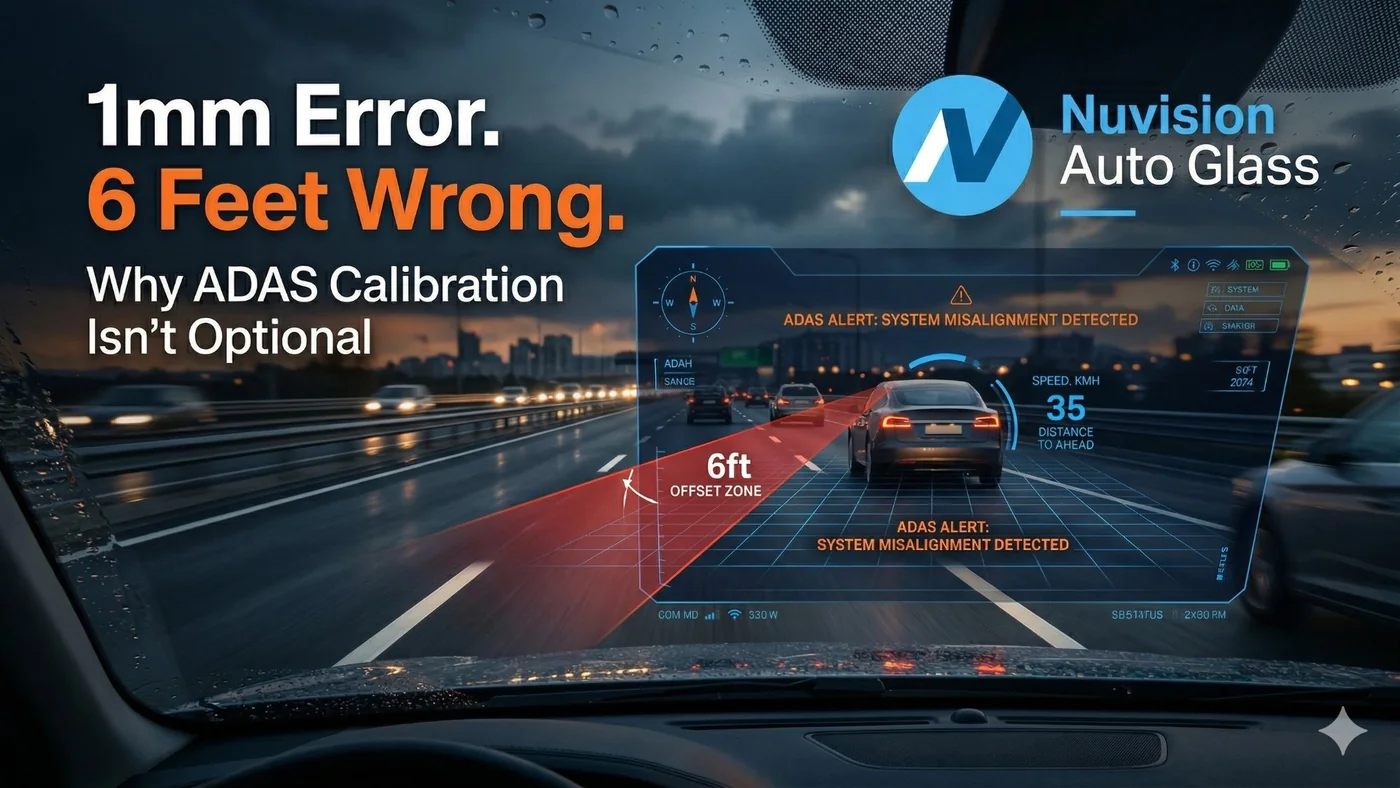
A windshield-mounted ADAS camera misaligned by just 1mm creates a 6-foot lateral object detection error at 65 mph. No dashboard warning appears. The system continues operating on incorrect data.
How Does 1mm of Camera Misalignment Produce 6 Feet of Detection Error?
The math is angular projection the same geometry that makes a small wrist movement produce a large arc at the end of a long stick.
A forward-facing ADAS camera mounted behind the rearview mirror is looking at objects that are anywhere from 30 to 500+ feet down the road, depending on the system. At highway speeds, automatic emergency braking needs to detect obstacles at 200–300 feet to give the system enough time to react. Lane departure systems monitor lane markings at 100–150 feet ahead.
When the camera is displaced by 1mm from its calibrated position, that displacement creates an angular error. At 1mm of offset and a 200-foot detection range, the angular error translates to approximately 6 feet of lateral position inaccuracy. The camera thinks it is looking at a point 6 feet to the left or right of where it is actually pointed.
At 2mm of displacement the amount in the Gilbert customer’s case that error doubles to 12 feet. At highway speeds, 12 feet is the difference between detecting an obstacle in your lane and detecting clear road.
| Camera Misalignment | Detection Error at 150 ft | Detection Error at 200 ft | Real-World Impact |
|---|---|---|---|
| 0.5mm | ~3 ft | ~4 ft | Lane departure triggers on straight roads |
| 1mm | ~5 ft | ~6 ft | AEB may not detect vehicles in your lane |
| 2mm | ~10 ft | ~12 ft | System reads adjacent lane as primary lane |
| 5mm+ | ~25 ft | ~33 ft | System unreliable — false triggers and missed detections |
These are lateral errors how far left or right the camera thinks it is looking versus where it is actually pointed. For forward distance detection (stopping distance calculation), misalignment creates a separate angular error that affects how far ahead the system believes an obstacle is. Both types of error operate simultaneously when the camera is off-position.
Why Doesn’t a Warning Light Appear When the Camera Is Misaligned?
This is the part that catches most drivers off guard. The camera sends continuous data to the vehicle’s safety systems. Those systems process the data and respond accordingly. Nothing in that chain checks whether the camera is pointed in the right direction it only checks whether the camera is functioning and sending data.
A misaligned camera is functioning perfectly. It is sending accurate data about what it can see. The problem is that what it can see has shifted by a few millimetres from where the engineers designed it to look. The safety systems have no way to know this. They respond to the data they receive as though it is correct.
This produces two failure modes, both dangerous:
False positives. The camera detects something at the edge of its misaligned field of view a lane marking, a guardrail, a vehicle in an adjacent lane — and the system interprets it as a threat in the primary lane. Automatic emergency braking fires. Lane departure warning triggers on a straight road. Adaptive cruise control decelerates without a vehicle in front. This is what happened to the customer in Gilbert.
False negatives. The camera’s misaligned field of view shifts the detection zone away from the actual lane center. A vehicle braking hard in front of you sits at the edge of or outside the camera’s effective detection zone. The automatic emergency braking system doesn’t register it as a threat until later or at all. The driver has been trusting a system that is not monitoring what they think it is monitoring.
False negatives are the silent failure. False positives, while alarming, at least alert the driver that something is wrong. False negatives operate invisibly until the situation they were meant to prevent occurs.
What Causes ADAS Camera Misalignment After a Windshield Replacement?
The camera bracket is bonded to the windshield glass itself not to the vehicle frame. When the original windshield is removed and a new one is installed, the camera bracket moves with the old glass or is transferred to the new one. Either way, the position of the bracket relative to the new glass and the vehicle frame is never exactly identical to the original.
The variance doesn’t need to be visible to matter. Manufacturing tolerances, adhesive bead thickness, glass curvature variation between the original and replacement, and the physical process of removing and reinstalling the bracket all introduce positional error at the millimetre scale. On a system calibrated to fractions of a degree, millimetre-scale displacement is significant.
Three specific scenarios where the misalignment is greatest:
Rushed installations. Windshield adhesive requires 60–90 minutes to cure enough to drive safely, and 24–72 hours to reach full bond strength. A camera bracket re-mounted before the adhesive has set can shift slightly as it cures. The final resting position of the bracket and therefore the camera may differ from where it was placed.
OEM glass replaced with aftermarket. Aftermarket glass is manufactured to fit a range of vehicles rather than to exact OEM specifications. Minor differences in glass curvature or thickness affect how the bracket seats. For most standard vehicles the difference is negligible. For vehicles with precise ADAS camera positioning requirements, even a small variance matters.
No recalibration performed. The most common cause and the most preventable. A shop that replaces the glass and returns the car without recalibrating the camera has skipped the step that corrects for every source of positional variance in the installation. Whatever misalignment exists after the job is done becomes the misalignment the driver lives with.
Which ADAS Systems Are Affected by Camera Misalignment?
Every safety system that depends on the forward-facing windshield camera is affected which, on most post-2016 vehicles, is most of them.
Automatic Emergency Braking (AEB). The highest-stakes system. AEB relies on the camera to detect vehicles and obstacles in the primary lane at the distances required to calculate a stopping response. A detection error of 6 feet at 200-foot range means the system may register an obstacle as outside the lane — or inside the lane when it isn’t. At 65 mph, reaction distance is measured in fractions of a second.
Lane Departure Warning and Lane Keeping Assist. These systems track lane markings. A lateral detection error shifts where the system believes the lane center is. You can be centred in your lane while the system reads you as drifting. Or drifting while it reads you as centred.
Adaptive Cruise Control. The camera contributes to tracking the vehicle ahead for following distance maintenance. A misaligned camera may lose the tracked vehicle at curves or register a vehicle in an adjacent lane as the lead vehicle, causing unexpected deceleration or acceleration.
Forward Collision Warning. Operates on the same camera data as AEB. Misalignment produces both false warnings (alerting when no threat exists) and missed warnings (not alerting when a threat does exist).
| ADAS System | Effect of 1mm Misalignment | Failure Mode |
|---|---|---|
| Auto Emergency Braking | ~6 ft detection shift at 200 ft range | Missed obstacle or false brake activation |
| Lane Departure Warning | Lane centre reads ~6 ft off actual | False alerts on straight roads |
| Adaptive Cruise Control | Lead vehicle tracking degraded | Unexpected speed changes |
| Forward Collision Warning | Alert threshold shifted off-lane | Missed warnings or false alarms |
| Lane Keeping Assist | Steering corrections based on wrong lane centre | Steering input when not needed |
What Does ADAS Recalibration Actually Do and How Long Does It Take?
Recalibration resets the camera’s reference frame to manufacturer specifications. It doesn’t move the camera physically it tells the vehicle’s safety systems exactly where the camera is pointing so they can compensate for any positional variance in the installation.
There are two methods, and which one applies depends on the vehicle manufacturer’s requirements. Some vehicles require one, some require both.
Static calibration is performed with the vehicle stationary. Calibration targets precisely measured patterns placed at specific distances and angles in front of the camera give the system fixed reference points to recalculate its field of view against. It requires a flat surface, controlled lighting, and enough space to set the targets at the required distances. Static calibration takes 45–90 minutes. For a full explanation of the process, see the static vs. dynamic calibration guide.
Dynamic calibration is performed while driving at specified speeds on roads with clear, visible lane markings. The camera recalibrates against real-world reference data as the vehicle moves. It requires 20–40 minutes of driving under the right conditions. Some manufacturers require dynamic calibration to follow static calibration as a verification step.
NuVision performs mobile ADAS calibration our technicians come to your location with portable calibration equipment rather than requiring you to bring the vehicle to a shop. After any windshield replacement we perform, recalibration is part of the service on ADAS-equipped vehicles.
Is ADAS Camera Misalignment a Bigger Risk in Arizona, Florida, or South Carolina?
The misalignment risk from a windshield replacement is consistent across all three states it’s a function of the installation process, not the climate. Where the states differ is in the driving conditions that make a misaligned system more dangerous.
Arizona. Highway speeds on I-10 and I-17 are where misaligned AEB is most dangerous and where Arizona drivers spend the most time. The state also has a high rate of windshield chip damage from monsoon-season debris, meaning more replacements and more opportunities for the recalibration step to be skipped. We also see a specific issue with Arizona heat: thermal expansion of the windshield frame can shift a bracket that was correctly positioned in a cool shop, creating a small additional misalignment that shows up at operating temperature.
Florida. Construction zones on I-95 and I-75 produce frequent debris impacts and frequent replacements. Florida’s zero-deductible insurance environment means drivers replace windshields more often than in most states, which increases the cumulative risk of encountering a shop that skips recalibration. Florida’s highway network also includes significant night driving, where a misaligned lane departure system is harder to catch through normal driving awareness.
South Carolina. The state’s mix of interstate freight corridors (I-95, I-26, I-85) and two-lane state highways means drivers regularly transition between high-speed environments where ADAS is active and lower-speed roads. A misaligned system that produces intermittent false triggers is particularly disorienting on roads where drivers are already managing more complex traffic situations.
Frequently Asked Questions
Does a windshield replacement always require ADAS recalibration?
On any vehicle with a forward-facing camera mounted to or near the windshield most vehicles made after 2016 yes. The new glass sits at a marginally different position than the original, which shifts the camera’s field of view. Recalibration corrects for that shift. Check your owner’s manual under the windshield section — if it mentions a camera behind the rearview mirror, recalibration is required after replacement.
Will a warning light appear if my ADAS camera is misaligned?
Not necessarily. A misaligned camera continues to function and send data. The vehicle’s safety systems process that data as correct. A warning light only appears if the camera loses signal or detects a physical obstruction — not if its field of view has shifted. This is why post-replacement recalibration matters even when the car seems to be driving normally.
What is the difference between static and dynamic ADAS calibration?
Static calibration is performed with the vehicle stationary using calibration targets at precise distances. Dynamic calibration requires a 20–40 minute drive at specified speeds on roads with clear lane markings. Which method applies depends on the vehicle manufacturer. Some require both. See the full static vs. dynamic calibration guide for the complete breakdown.
How long does ADAS recalibration take?
Static calibration takes 45–90 minutes. Dynamic calibration takes 20–40 minutes of driving. Some vehicles require both. NuVision performs mobile calibration technicians come to your location with portable equipment, so you don’t need to leave the car at a shop for a separate appointment.
Can I drive before ADAS recalibration after a windshield replacement?
Physically, yes. But your ADAS systems are operating on misaligned data until recalibration is done. For short, low-speed trips this is a lower risk. For highway driving where AEB and lane departure systems are active the detection errors described in this article apply from the moment you leave the shop. Recalibration should happen before any highway driving post-replacement.
The Camera Is 1mm Off. Your Safety System Is 6 Feet Off. No Warning Light Appears.
The Gilbert customer with the false-triggering AEB was lucky the system told him something was wrong. The more dangerous scenario is the one that stays silent: a camera that’s off just enough to miss the obstacle it was designed to detect, on a highway, at speed.
Recalibration after a windshield replacement isn’t an upsell. It’s the correction for a known positional variance that occurs in every replacement, on every vehicle, every time. Skipping it means trusting a safety system that is no longer pointed where the engineers designed it to look.
If you’ve had a windshield replaced and aren’t certain recalibration was performed or if your ADAS systems are behaving erratically — book a free assessment at nuvisionautoglass.com/get-a-quote. Mobile service, same-day availability across Arizona, Florida, and South Carolina.
Find us on Google Maps:
NuVision Auto Glass — Arizona
NuVision Auto Glass — Florida