10 Warning Signs that Show Your Windshield Is No Longer Road-Safe.
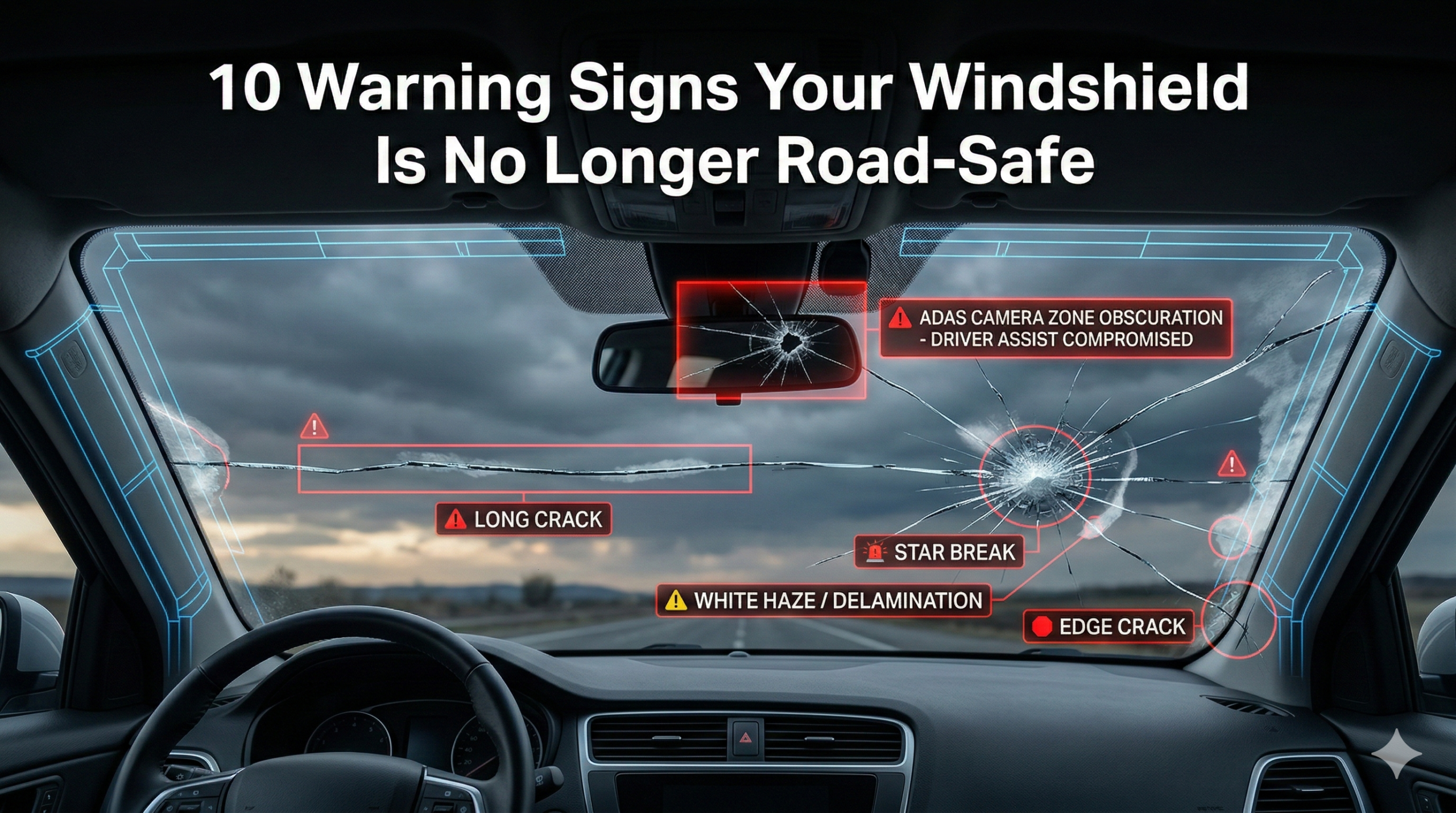
Your windshield is not a passive sheet of glass. It provides up to 45% of your vehicle’s structural rigidity during a rollover. It serves as the deployment backstop for your passenger-side airbag.
On vehicles built after 2020, it also houses the forward-facing camera that controls automatic emergency braking, lane departure warning, and adaptive cruise control.
Federal Motor Vehicle Safety Standard (FMVSS) 212 requires a windshield to retain at least 75% of its perimeter bond during a 30 mph barrier crash. FMVSS 216 mandates the roof sustain no more than 5 inches of displacement when 1.5 times the vehicle’s weight is applied to the A-pillar.
Your windshield is integral to meeting both standards. When that glass is compromised, every federal safety rating your vehicle earned at the factory becomes unreliable.
Understanding why your windshield is a structural safety component is the first step toward recognizing when it is no longer safe to drive behind.
What you will gain from this guide:
- Identify danger before it’s too late — the 10 specific warning signs that mean your windshield needs replacement, not repair
- Understand the engineering behind each sign — FMVSS standards, PVB interlayer failure mechanics, and ADAS camera tolerances explained in plain language
- Know your exact repair-versus-replacement thresholds — AGSC and NWRA guidelines, plus the tighter standards required for ADAS-equipped vehicles
- Protect yourself legally — state-by-state requirements for Arizona, Florida, and South Carolina, including fines, enforcement patterns, and zero-deductible insurance benefits
- Compare all 10 thresholds at a glance — a single comparison table with repairable limits, replacement triggers, and ADAS considerations side by side
- Inspect your own windshield in 5 minutes — a step-by-step self-check method using only daylight and a flashlight
- Choose the right replacement provider — three non-negotiable requirements that separate FMVSS-compliant shops from those that just advertise compliance
A small chip picked up on a US highway might be repairable in 20 minutes. The same chip in the wrong location, at the wrong size, or combined with other damage might mean your windshield has crossed from road-safe to structurally compromised.
What Are the Warning Signs That a Windshield Crack Has Become Too Dangerous to Drive With?
Not all windshield damage is created equal. The difference between a repairable chip and a replacement-level crack comes down to four variables: size, location, pattern, and progression rate.
The Auto Glass Safety Council (AGSC) and the National Windshield Repair Association (NWRA) both publish repair-versus-replace guidelines. These thresholds have tightened significantly as ADAS-equipped vehicles have become the majority on the road.
Repair is generally appropriate for single chips smaller than a quarter, bullseye or star breaks under one inch, and cracks shorter than three inches that have not reached the windshield edge.
Anything beyond those parameters or anything within the ADAS camera zone or the driver’s direct sight line shifts the recommendation toward full windshield replacement.
Warning Sign 1: How Do Cracks Longer Than Six Inches Compromise Windshield Safety?
A crack exceeding six inches has crossed the threshold where resin injection can reliably restore structural integrity. At this length, the crack has typically propagated through most of the outer glass layer.
It may have also begun compromising the polyvinyl butyral (PVB) interlayer that bonds the two glass sheets together. That PVB interlayer prevents your windshield from shattering into fragments during impact and holds the glass in place to meet FMVSS 212 retention requirements.
A six-inch crack creates a stress concentration line across a significant portion of the windshield surface. Temperature changes, road vibrations, and cabin pressure differentials cause the crack to flex. Each flex cycle weakens the surrounding glass further.
In Arizona, where surface temperatures regularly exceed 140°F during summer, thermal expansion can propagate a six-inch crack to a full edge-to-edge fracture within days. The repair window for long cracks is measured in hours, not weeks.
Warning Sign 2: Why Are Edge Cracks Within Two Inches of the Windshield Perimeter a Structural Emergency?
The perimeter of your windshield is where the glass bonds to the vehicle frame through urethane adhesive. This bond is what FMVSS 212 tests when a vehicle is crashed into a concrete barrier at 30 mph.
The standard requires 75% perimeter retention. Some manufacturers require 100%.
Edge cracks directly compromise this bond zone. When a crack reaches within two inches of the edge, the urethane can no longer distribute crash forces evenly across the glass. Force concentrates at the crack terminus, dramatically increasing the probability of windshield ejection during a collision.
Edge cracks also propagate faster than center cracks. The glass near the perimeter is under pre-existing stress from the installation process. The curvature of the windshield creates tension at the edges that accelerates crack growth.
An edge crack that appears stable today can reach the frame bond by tomorrow particularly during rapid temperature swings common in South Carolina, where coastal variability causes expansion and contraction cycles throughout a single day.
Warning Sign 3: What Makes Spider Web and Star Break Patterns Indicate Immediate Replacement?
Spider web patterns occur when multiple cracks radiate outward from a single impact point. Unlike a linear crack, a spider web creates intersecting stress lines that weaken the glass in multiple directions simultaneously.
Pressure applied anywhere on the windshield affects all connected crack lines at once. This makes the entire panel structurally unpredictable.
Star breaks follow a similar radiating pattern but with shorter legs. When a star break exceeds one inch in overall diameter, the resin injection process cannot fill all legs uniformly. Some fracture paths remain structurally unrestored.
The critical concern with both patterns is light refraction. Each crack leg bends and scatters incoming light differently, creating multiple glare points that impair visibility.
This effect intensifies during night driving when oncoming headlights pass through damaged glass. What appears manageable during daylight becomes a constellation of glare bursts after dark.
Warning Sign 4: How Does Damage in the Driver’s Direct Line of Sight Create Unsafe Driving Conditions?
Federal regulations define the critical viewing area as the zone extending upward from steering wheel height, excluding a two-inch border at the top and one-inch borders on each side. Any damage within this zone exceeding three-quarters of an inch violates federal standards.
Even successfully repaired damage within the sight line can leave residual optical distortion. Repair resin does not achieve the same optical clarity as undamaged laminated glass.
The refractive index difference between cured resin and original glass is small but measurable. It becomes noticeable when sunlight strikes the repair at low angles.
Sunlight distortion from windshield cracks is a documented contributor to delayed hazard recognition. In Arizona, where I-10 and I-17 corridors face notorious sunrise and sunset glare, even minor optical imperfections create meaningful safety degradation.
In Florida, afternoon thunderstorms create rapidly shifting light conditions where distortion becomes especially dangerous. For sight line damage, replacement eliminates a risk that repair can only reduce.
Warning Sign 5: Why Does Damage Near the ADAS Camera Zone Require Windshield Replacement Rather Than Repair?
Over 95% of vehicles manufactured between 2024 and 2026 have a forward-facing camera behind the windshield, typically centered behind the rearview mirror. This camera controls automatic emergency braking, forward collision warning, lane departure warning, and adaptive cruise control.
ADAS cameras operate at optical distortion thresholds below 0.1 diopter significantly tighter than the 0.25 diopter federal standard for human visibility. Even a successfully repaired chip near the camera zone can leave optical artifacts the camera detects even when the human eye does not.
A misalignment of just 3 to 5 millimeters in camera aim translates to a targeting error of 7 feet at 200 feet of distance. Windshield repair affects ADAS functionality at thresholds most drivers never consider.
Any chip, crack, or discoloration within six inches of the camera housing should be evaluated for replacement. Replacement must be followed by proper ADAS recalibration using manufacturer-specified procedures.
Warning Sign 6: What Does White Haze or Cloudy Discoloration Along the Windshield Edges Mean?
White haze or milky discoloration near the edges of your windshield indicates PVB interlayer delamination. Your windshield consists of two layers of glass bonded to a polyvinyl butyral plastic interlayer.
When moisture penetrates between the glass and the PVB layer, the adhesive bond weakens and the layers begin separating. This appears as cloudy, milky patches that typically start at the edges and progress inward.
Delamination is irreversible. Once the PVB bond fails, that section has lost its laminated safety function.
The PVB interlayer holds glass fragments together during impact, preventing them from becoming projectiles. It also gives the windshield flexibility to absorb crash energy without shattering. A delaminated windshield may look intact but will behave like unlaminated glass during a collision.
Delamination also disrupts ADAS camera function because the optical properties change in affected areas.
In Tampa and other high-humidity Florida markets, moisture intrusion accelerates delamination significantly. If you see white haze at any edge, replacement is the only safe response. No repair procedure can rebond separated PVB interlayer.
Warning Sign 7: How Does Windshield Pitting From Road Debris Erosion Affect Driving Safety?
Windshield pitting is the gradual erosion of the outer glass surface caused by thousands of impacts from sand, dust, salt, and small gravel particles over time. Unlike a sudden rock chip, pitting accumulates invisibly.
A pitted windshield scatters incoming light across hundreds of microscopic surface imperfections. During daylight, the effect may be barely noticeable.
When oncoming headlights or low-angle sunlight strikes pitted glass, the entire windshield can appear to glow. This dramatically reduces contrast between road hazards and their background.
This is why some drivers report feeling more fatigued during night driving without realizing their windshield is the cause.
Pitting is particularly aggressive in Arizona. I-10 between Phoenix and Tucson is notorious for rock chip frequency, and airborne sand during dust storms accelerates surface erosion. Phoenix drivers on I-17 or Loop 101 may accumulate enough pitting to degrade night visibility within two to three years.
Pitting cannot be repaired. When headlight glare becomes noticeably worse than when the windshield was new, it is time for an assessment of whether repair or replacement is the appropriate response.
Warning Sign 8: What Do Water Leaks or Wind Noise After a Previous Repair Indicate About Windshield Integrity?
Water leaking around the windshield or increased wind noise at highway speeds following a previous repair indicates a compromised seal. The urethane adhesive bond is not merely waterproofing it is the structural connection that enables the windshield to function as a load-bearing safety component.
When water penetrates that bond, the urethane has failed in at least one section. A seal failure means the windshield can no longer meet FMVSS 212 retention requirements in the compromised area.
During a collision, the windshield may partially or fully eject at the failure point, allowing occupant ejection and eliminating the airbag deployment backstop.
Water intrusion also introduces moisture between the glass and vehicle body, accelerating corrosion of the metal frame the urethane bonds to.
Wind noise is an early indicator. Before visible leaks appear, air penetration through a failing seal creates whistling or rushing sounds that increase with vehicle speed. If you notice new wind noise after auto glass service, the installation needs professional evaluation.
A failing seal requires complete removal, frame preparation, and reinstallation with fresh urethane. It cannot be patched.
Warning Sign 9: When Do Multiple Chips or Cracks Across the Windshield Mean Replacement Is Unavoidable?
A single repairable chip reduces windshield integrity by a small, measurable amount. Two chips reduce it further. Three or more chips, even if each individually falls within repair parameters, create a cumulative structural deficit that repair cannot fully address.
Each repair fills the damaged area with resin that restores optical clarity and prevents crack propagation. But repaired areas do not recover 100% of the original glass strength.
A windshield with four repaired chips has four points of reduced strength distributed across its surface. During a collision, crash forces follow the path of least resistance concentrating at repaired areas.
If multiple repaired points align along a force vector, the windshield may fail along that line even though each individual repair was structurally adequate in isolation.
The NWRA recommends replacement when three or more damage points exist, when repairs cluster within the driver’s critical viewing area, or when damage compromises more than 20% of the windshield surface.
Understanding when a small chip becomes a major safety hazard requires evaluating each damage point as part of the windshield’s total damage load not in isolation.
Warning Sign 10: Why Does a Crack That Keeps Growing Signal That Your Windshield Has Already Failed?
A crack that visibly lengthens over days or weeks is not just damaged glass. It is glass that is actively failing. Crack propagation indicates the stress state within the windshield exceeds the glass’s ability to contain it.
Temperature cycling is the primary driver. When glass heats, it expands. When it cools, it contracts. At the crack tip, these forces concentrate at a molecular level, pushing the fracture forward with each cycle.
Arizona’s extreme diurnal temperature swings, where surface temperatures can vary by 60+ degrees between dawn and afternoon, create aggressive propagation environments.
Charleston and coastal South Carolina present a different challenge. Temperature variability combines with humidity that penetrates crack surfaces, weakening the glass through chemical interaction with the PVB interlayer.
A growing crack means the windshield’s stress balance has already tipped past stability. Delaying replacement risks the crack reaching an edge, at which point the entire windshield’s FMVSS 212 retention capability is compromised.
How Do Warning Sign Thresholds Differ Between Repair and Replacement?
The following table summarizes the key thresholds separating repairable damage from replacement-level damage. These reflect AGSC guidelines, NWRA recommendations, and the tighter standards ADAS-equipped vehicles require.
For a deeper evaluation of what separates quality providers, see our guide to the 10 auto glass repair features to compare across local shops.
| Warning Sign | Repairable Threshold | Replacement Required | ADAS Vehicle Consideration |
| Crack length | Under 3 inches, not at edge | Over 6 inches or reaching edge | Any crack within 6 inches of camera housing |
| Edge crack proximity | No edge cracks repairable | Any crack within 2 inches of perimeter | Edge cracks compromise both retention and calibration mounting |
| Spider web or star break | Star break under 1 inch diameter | Spider web any size; star break over 1 inch | Any radiating pattern near camera zone requires replacement |
| Driver sight line damage | Single chip under 3/4 inch (may leave residual distortion) | Any damage creating visible optical distortion | Tighter threshold due to combined driver and camera visibility needs |
| ADAS camera zone damage | Not recommended even for small chips | Any damage within 6 inches of camera housing | Camera requires sub-0.1 diopter clarity; repair cannot guarantee this |
| PVB delamination | Not repairable | Any visible white haze, cloudy patches, or edge discoloration | Delamination disrupts camera optical path regardless of location |
| Surface pitting | Not repairable | When headlight glare noticeably worsens versus new glass | Pitting scatters light through camera lens, degrading image processing |
| Water leaks or wind noise | May indicate seal issue, not glass issue | Reinstallation required if urethane bond has failed | Seal failure may shift camera position, requiring recalibration |
| Multiple damage points | 1 to 2 chips outside sight line and camera zone | 3 or more damage points on a single windshield | Lower threshold; cumulative optical degradation affects camera |
| Active crack growth | Not repairable once propagation begins | Any crack that visibly lengthens over time | Growing crack approaching camera zone requires urgent replacement |
What Are the Legal Consequences of Driving With a Damaged Windshield in Arizona, Florida, and South Carolina?
Each of NuVision’s service states has distinct enforcement approaches. Understanding the legal landscape helps you act on warning signs before they become citations.
Arizona. ARS 28-957.01 requires windshields to be in good condition and free of cracks that obstruct the driver’s view. Chips or cracks larger than three-quarters of an inch in the driver’s line of sight must be repaired.
Arizona does not have mandatory safety inspections, so enforcement relies on traffic stops. Highway patrol on I-10, I-17, and US-93 actively enforces equipment violations, and fines can reach $150.
Arizona’s ARS 20-263 protects drivers: filing a no-fault windshield replacement claim will not raise insurance rates. For a complete enforcement breakdown, see our guide to cracked windshield laws across states.
Florida. Statute 316.610 mandates windshields be in good condition with safety glazing providing adequate vision. Florida does not specify exact crack measurements — compliance depends on officer discretion.
Critically, Florida’s cracked windshield law works with the state’s zero-deductible glass replacement benefit. If you carry comprehensive insurance, your insurer must cover replacement with no out-of-pocket deductible. There is virtually no financial barrier to replacing a damaged windshield in Florida.
South Carolina. Cracks larger than one-half inch in the driver’s view are prohibited. Some counties offer voluntary inspection programs where significant damage results in a failed inspection.
South Carolina also offers zero-deductible replacement for comprehensive policyholders. Highway Patrol focuses on I-95, I-26, I-85, and I-77.
How Does Insurance Coverage Work When Your Windshield Needs Replacement?
Understanding your insurance options is essential for acting promptly rather than delaying due to cost. Auto insurance does cover windshield replacement under comprehensive policies.
Florida and South Carolina offer zero-deductible glass replacement for comprehensive policyholders. Arizona covers replacement subject to your deductible, plus rebates up to $375 via virtual Visa cards for insurance-paid replacements.
The distinction between full glass coverage and standard comprehensive coverage matters significantly. Full glass eliminates the deductible entirely. Standard comprehensive applies your deductible, which may range from $100 to $1,000.
Understanding windshield replacement cost without insurance helps you evaluate whether cash payment is more economical than a claim against a high deductible. Knowing how to file a claim ensures the process moves quickly before damage worsens.
What Should You Look for in an Auto Glass Provider When Replacement Is Needed?
Once you identify warning signs, the quality of that replacement determines whether your windshield returns to full safety function or simply looks intact while remaining structurally compromised.
The six questions to ask any auto glass shop before you book provide a starting framework. The 8 reasons drivers consider NuVision explain why verifiable capabilities matter more than advertising claims.
Three non-negotiable requirements separate safe replacement from risky replacement:
- First, technician certification. AGSC-certified technicians pass a 70-question exam covering FMVSS 208, 212, and 216 compliance, OSHA regulations, and the AGRSS installation standard.
- Second, glass quality. OEM and OEM-equivalent windshields from Pilkington, Saint-Gobain, AGC, and Guardian meet FMVSS 205 optical clarity and impact resistance standards. Economy glass may exhibit distortion that interferes with ADAS cameras.
- Third, in-house ADAS calibration. Equipment costs $15,000 to $30,000. Shops without it either skip calibration, subcontract to a dealership at $200–$400 extra, or tell you it is unnecessary.
NuVision requires AGSC certification for every technician, uses OEM-equivalent glass exclusively with OEM on request, and performs all ADAS calibration in-house across Miami, Tampa, Phoenix, Charleston, and every other service location.
Mobile auto glass repair units carry the same equipment, adhesives, and calibration tools as fixed locations with no mobile service surcharge.
How Can You Inspect Your Own Windshield for These 10 Warning Signs?
A thorough self-inspection takes five minutes. You need only natural daylight and a flashlight for edge inspection.
- Step 1: Check the driver’s sight line. Sit in the driver’s seat with the engine off. Look at straight lines like building edges or power lines through different areas of the glass. Wavy or bent lines indicate surface damage or delamination.
- Step 2: Examine the edges. Walk around the vehicle. Check windshield edges for white haze or milky discoloration this indicates PVB delamination.
- Step 3: Test for pitting. Hold a flashlight at a low angle against the glass. Light will scatter across pitted areas, making them visible against undamaged sections.
- Step 4: Track existing damage. Mark existing chips with a small piece of tape at the crack tip. If the crack extends past the tape within days, propagation has begun.
- Step 5: Listen while driving. On your next highway drive, listen for new wind noise. Watch for water intrusion during rain.
If your inspection reveals any warning signs, the next step is professional evaluation. NuVision provides same-day windshield replacement across Arizona, Florida, and South Carolina with AGSC-certified technicians, OEM-equivalent glass, in-house ADAS calibration, and a lifetime warranty.
Drivers across all three states consistently rate NuVision’s professionalism, speed, insurance handling, and communication among the highest in the industry as reflected in verified customer reviews and ratings on Google Maps.
What Is the Bottom Line on Windshield Safety for Arizona, Florida, and South Carolina Drivers?
Your windshield is the only safety component you look through every time you drive. It is also the only structural component exposed to constant assault from road debris, temperature extremes, UV radiation, and humidity.
The 10 warning signs in this guide represent the points where that assault has overwhelmed the glass’s ability to protect you.
Cracks longer than six inches, edge cracks within two inches of the perimeter, spider web patterns, sight line damage, ADAS camera zone damage, PVB delamination, surface pitting, seal failure, multiple damage points, and active crack growth each independently indicate replacement is the safe course of action.
When two or more warning signs are present simultaneously, the urgency increases substantially.
Do not let cost concerns delay a safety decision. Arizona offers rebates up to $375. Florida and South Carolina offer zero-deductible replacement for comprehensive policyholders.
NuVision provides transparent quotes including glass, labor, materials, mobile service, and ADAS calibration in a single total with no hidden fees. Read what thousands of drivers have experienced with NuVision’s verified Google reviews, then get a quote for your specific vehicle.