OEM vs Aftermarket Windshield Glass: How Insurance Companies Decide
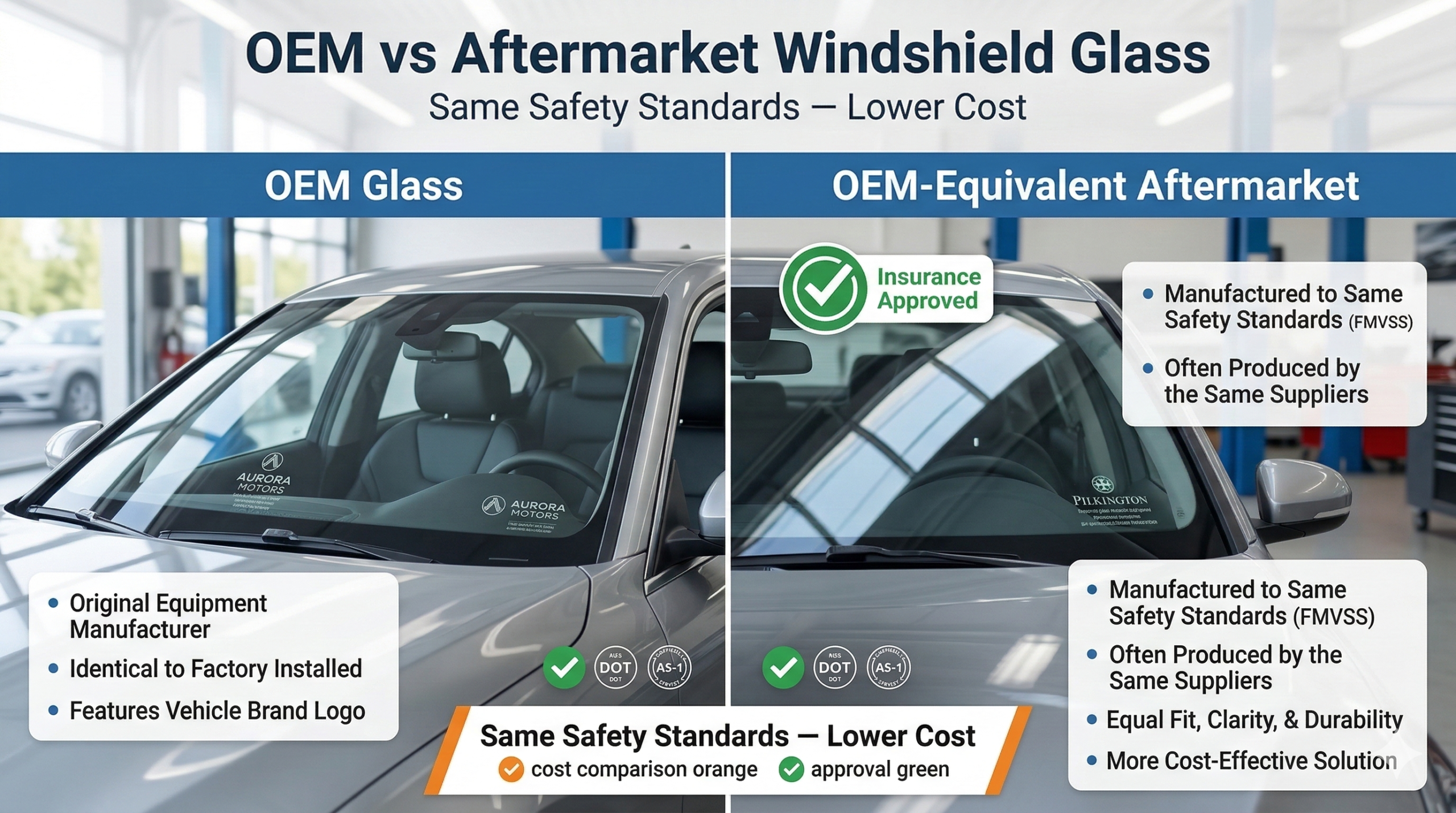
Insurance companies typically authorize OEM-equivalent aftermarket windshield glass rather than original equipment manufacturer (OEM) glass for windshield replacements because both meet Federal Motor Vehicle Safety Standard (FMVSS) 212 specifications while aftermarket costs 20-40% less. OEM glass comes from vehicle manufacturers’ contracted suppliers and matches factory specifications exactly, while OEM-equivalent aftermarket is manufactured to identical standards but branded differently—often from the same factories. Economy aftermarket glass, which insurers generally avoid, cuts costs by 30-50% but may have optical quality issues. Understanding how insurers determine glass quality ensures you receive safe, compliant windshields whether in Arizona, Florida, or South Carolina.
The distinction matters because glass quality affects safety, ADAS system performance, optical clarity, and long-term durability. This article examines OEM vs. aftermarket differences, insurance authorization processes, and how to verify quality regardless of which type your insurer approves.
OEM Glass Specifications
Original Equipment Manufacturer (OEM) glass characteristics:
Source: Manufactured by suppliers under contract with vehicle manufacturers (Toyota, Ford, Honda, etc.)
Branding: Bears vehicle manufacturer logo and part numbers
Specifications: Exact match to factory-installed windshield thickness, curvature, tint, features
Quality control: Subject to automaker quality standards and inspections
Cost: Premium pricing; 30-50% higher than OEM-equivalent aftermarket
Warranty: Typically covered under vehicle manufacturer warranty programs
OEM glass suppliers include:
- Pilkington (supplies Toyota, Honda, Nissan)
- Saint-Gobain Sekurit (supplies GM, Ford)
- AGC Automotive (supplies multiple manufacturers)
- Fuyao Glass (supplies numerous brands)
Key insight: OEM designation doesn’t mean better quality—it means branded by vehicle manufacturer. The same factory often produces both OEM and OEM-equivalent glass on identical production lines.
OEM-Equivalent Aftermarket Glass
OEM-equivalent aftermarket specifications:
Source: Same manufacturers producing OEM glass (Pilkington, Saint-Gobain, AGC, Guardian)
Manufacturing: Identical production processes, materials, quality standards as OEM
Compliance: Meets or exceeds FMVSS 212 federal safety standards
Difference from OEM: Different branding; lacks vehicle manufacturer logo
Cost: 20-40% less than OEM due to eliminated licensing/branding fees
Quality: Functionally identical to OEM in safety, durability, optical clarity
Federal Motor Vehicle Safety Standard (FMVSS) 212 requirements:
- Minimum light transmission (70% visible light)
- Maximum optical distortion (0.25 diopter)
- Impact resistance standards
- Penetration resistance specifications
- Retention system requirements (urethane adhesive strength)
Both OEM and OEM-equivalent must meet these standards—making them functionally equivalent for safety purposes.
Why OEM-equivalent costs less:
No licensing fees: Aftermarket doesn’t pay vehicle manufacturer for branding rights
Direct distribution: Sells to glass shops without manufacturer middleman markup
Competition: Multiple suppliers compete, driving prices down
Volume production: Produces for multiple vehicle makes/models, achieving economies of scale
Economy Aftermarket Glass
Budget/economy glass characteristics:
Source: Lower-cost manufacturers (often overseas)
Compliance: May meet minimum FMVSS 212 standards but at lower quality thresholds
Cost: 30-50% less than OEM-equivalent
Quality concerns:
- Optical distortion near upper limits (0.20-0.25 diopter vs. 0.10-0.15 for OEM-equivalent)
- Thinner glass in some cases (reduced durability)
- Inconsistent tinting (may not match factory specifications)
- Waviness or visual imperfections
- Lower impact resistance within acceptable ranges
Insurance stance: Most major insurers avoid authorizing economy glass due to quality concerns and potential liability if substandard glass contributes to accidents.
How Insurance Companies Determine Glass Type
Authorization process:
Step 1: Claim filed – Customer or shop reports windshield damage
Step 2: Glass shop quote – Shop provides estimate specifying glass type and cost
Step 3: Insurer review – Claims adjuster evaluates quote against approved pricing
Step 4: Authorization – Insurer approves OEM-equivalent glass (standard) or negotiates alternative
Standard insurer practices:
OEM-equivalent default: 85-90% of claims authorized with OEM-equivalent glass
OEM authorization: Rare; typically only for:
- Lease vehicles with OEM replacement requirements
- Very new vehicles (under 6 months old)
- Specific manufacturer partnerships
- Customer willingness to pay OEM upgrade differential
Economy glass: Generally not authorized by major insurers due to quality/liability concerns
State-specific patterns:
Arizona: Insurers comfortable authorizing OEM-equivalent given high claim volumes and established shop relationships
Florida: Post-SB 1002 reforms increased focus on quality; OEM-equivalent standard
South Carolina: Traditional market; OEM-equivalent widely accepted
OEM-Equivalent Quality Verification
How to ensure quality when insurer authorizes OEM-equivalent:
Check manufacturer: Reputable brands include Pilkington, Saint-Gobain, AGC, Guardian, Fuyao
Verify FMVSS 212 compliance: Glass should have DOT markings indicating federal standard compliance
Confirm warranty: Lifetime workmanship warranties indicate shop confidence in glass quality
Review shop certifications: Auto Glass Safety Council or National Glass Association certifications
NuVision Auto Glass quality standards:
We use only OEM-equivalent glass from major manufacturers:
- Pilkington, Saint-Gobain, AGC are primary suppliers
- All glass meets or exceeds FMVSS 212 specifications
- DOT markings on every windshield
- Lifetime workmanship warranty standard
- Never use economy glass regardless of insurer pressure
Quality comparison: OEM vs. OEM-Equivalent vs. Economy
| Attribute | OEM | OEM-Equivalent | Economy |
| FMVSS 212 Compliance | Yes | Yes | Usually (minimum) |
| Optical Clarity | Excellent (0.10-0.15 diopter) | Excellent (0.10-0.15 diopter) | Acceptable (0.20-0.25 diopter) |
| Durability | High | High | Moderate |
| Manufacturing | Top-tier facilities | Same top-tier facilities | Lower-tier facilities |
| Cost | Highest ($400-800) | Moderate ($250-500) | Lowest ($150-300) |
| Insurer Acceptance | Rare authorization | Standard authorization | Rarely authorized |
Customer Rights and Upgrade Options
You have the right to:
Choose your glass shop: Arizona, Florida, South Carolina all allow customer choice of repair facility
Request OEM glass: You can specify OEM glass preference, though insurer may not cover full cost
Refuse substandard glass: If shop installs quality below acceptable standards, you can reject and demand replacement
Verify glass quality before installation: Request to see glass packaging, DOT markings, manufacturer documentation
OEM upgrade process:
If insurer authorizes OEM-equivalent but you want OEM:
- Request OEM glass from shop
- Shop provides quote showing both OEM and OEM-equivalent pricing
- Insurer covers OEM-equivalent amount ($300-500 typical)
- Customer pays difference ($100-300 typical upgrade cost)
- Shop installs OEM glass
When OEM upgrade makes sense:
Lease vehicles: Lease agreements may require OEM parts
Luxury vehicles: Match existing OEM specifications for resale value
Very new vehicles: Maintain all-OEM parts for first years of ownership
Personal preference: Willingness to pay premium for exact OEM match
When OEM-equivalent is sensible:
Owned vehicles: No lease requirement for OEM parts
Most replacements: OEM-equivalent provides identical safety/quality at lower cost
Older vehicles: Diminishing returns on OEM premium for 5+ year old vehicles
Cost-consciousness: $100-300 savings better allocated elsewhere
ADAS Recalibration and Glass Quality
Advanced Driver Assistance Systems require optical precision:
Camera tolerance: ADAS cameras need distortion under 0.10 diopter (stricter than human vision 0.25 diopter FMVSS standard)
Both OEM and OEM-equivalent meet ADAS requirements: Top manufacturers produce glass with 0.08-0.12 diopter distortion
Economy glass risk: May approach 0.25 diopter limit, potentially affecting ADAS performance
For ADAS-equipped vehicles (68% of current fleet):
Insist on quality glass: OEM or OEM-equivalent only; never accept economy glass
Verify manufacturer reputation: Pilkington, Saint-Gobain, AGC all produce ADAS-compatible glass
Confirm recalibration included: $150-400 additional cost; mandatory for proper system function
Test systems post-installation: Verify lane departure, forward collision, adaptive cruise all function correctly
Regional Market Practices
Arizona glass market:
High OEM-equivalent acceptance: Established market with reputable suppliers
Shop standards: Most major shops (including NuVision) use only quality OEM-equivalent
Insurer partnerships: Long-term relationships ensure quality control
Customer education: Competitive market means shops differentiate on quality, not just price
Florida post-reform market:
SB 1002 impact: Reduced fraud created focus on legitimate quality over inflated pricing
OEM-equivalent standard: Insurers and shops align on quality glass at fair pricing
Direct billing: Customer-insurer direct relationship ensures quality transparency
South Carolina traditional market:
Standard insurance practices: OEM-equivalent widely accepted
Regional variation: Upstate manufacturing presence (BMW, Volvo, Mercedes) creates quality awareness
Shop certification importance: Verify shop credentials ensure quality glass selection
Disputing Insurer Glass Quality Decisions
If insurer authorizes glass you believe is substandard:
Step 1: Request documentation of glass type, manufacturer, FMVSS 212 compliance
Step 2: Verify glass meets federal standards (DOT markings, compliance certification)
Step 3: If economy glass authorized, challenge decision:
- Cite safety concerns with substandard glass
- Reference FMVSS 212 compliance requirements
- Request supervisor review of authorization
Step 4: File complaint with state insurance commissioner if insurer persists with substandard authorization
State insurance departments:
Arizona: Department of Insurance and Financial Institutions
Florida: Department of Financial Services, Division of Consumer Services
South Carolina: Department of Insurance
Most disputes resolve quickly when customers question glass quality—insurers prefer authorizing OEM-equivalent over regulatory complaints.
Conclusion: OEM-Equivalent Provides Optimal Value
Insurance companies authorize OEM-equivalent aftermarket glass because it meets identical safety standards as OEM while costing 20-40% less. Both come from the same top-tier manufacturers (Pilkington, Saint-Gobain, AGC) using identical processes. The only meaningful difference is branding—OEM bears vehicle manufacturer logos while OEM-equivalent doesn’t. For Arizona, Florida, and South Carolina drivers, OEM-equivalent glass provides optimal balance of quality, safety, and cost-effectiveness.
Key takeaways:
- OEM and OEM-equivalent meet identical FMVSS 212 safety standards
- Same manufacturers produce both types on same production lines
- OEM-equivalent costs 20-40% less due to eliminated branding/licensing fees
- Insurers authorize OEM-equivalent 85-90% of claims
- Economy glass should be avoided due to quality concerns
- Customer can upgrade to OEM by paying differential
NuVision Auto Glass exclusively uses OEM-equivalent glass from reputable manufacturers, never economy grade. We ensure every windshield meets or exceeds federal standards, includes proper DOT markings, and comes with lifetime workmanship warranty. Whether your insurance authorizes OEM or OEM-equivalent, you’ll receive quality glass that provides proper safety, optical clarity, and ADAS compatibility.