How Road Debris Causes Windshield Damage (And How to Stop It)?
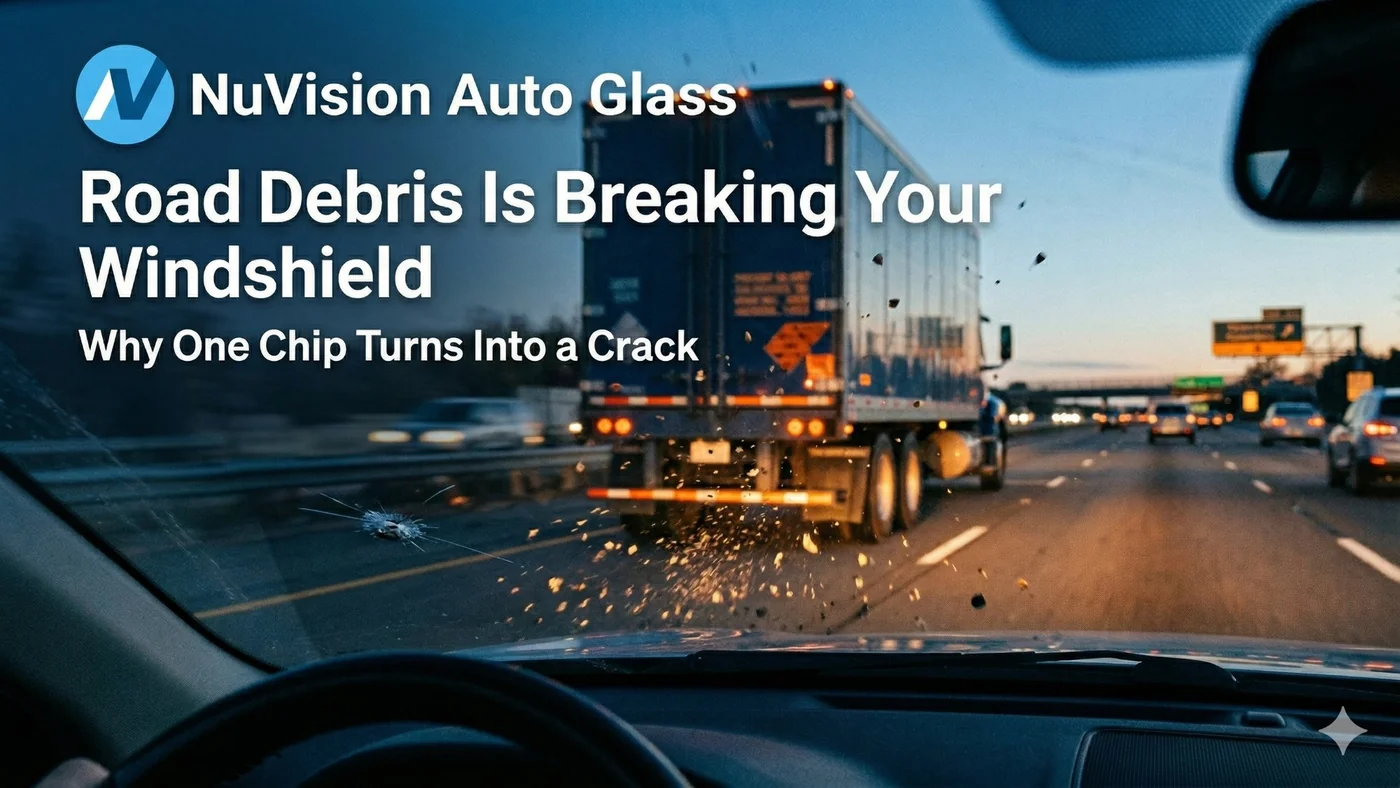
A customer in Chandler got a chip on I-10 behind a dump truck. It was small, about the size of a dime. He figured he’d deal with it over the weekend.
By day nine, the chip had turned into a seven-inch crack across the sightline. The chip would have cost $75–150 to repair. The replacement cost him $340.
This is the most consistent pattern we see. The issue is not the impact itself, but rather the delay that follows it.
78% of ignored chips become unrepairable cracks. In Arizona’s summer heat, a chip can progress to a crack in 7–14 days. The repair window is 48 hours — after that, the risk of full replacement increases significantly every day.
Why Does Speed Matter So Much When Debris Hits Your Windshield?
Impact energy doesn’t increase in a straight line with speed — it increases exponentially. The physics formula is kinetic energy = ½ mass × velocity². That squared relationship is what makes highway chips so much more damaging than the same stone at city speeds.
A 5-gram pebble at 30 mph hits with about 4.5 joules of force. At 45 mph, that same pebble delivers 10.1 joules — more than double. At 70 mph, it’s 24.5 joules. Modern windshields are built to absorb roughly 8–12 joules before chipping. Above that threshold, you get a chip. Well above it, you get a star break.
This is why following distance behind trucks on the interstate isn’t just a safety courtesy; it’s the single most effective thing you can do to reduce windshield chip risk.
| Following Distance | Debris Impact Speed (45 mph) | Chip Probability |
|---|---|---|
| 1 second (tailgating) | ~45 mph (full velocity) | 90%+ |
| 2 seconds | ~40 mph | 70% |
| 3 seconds | ~35 mph | 40% |
| 4+ seconds | ~30 mph | 15% |
Why Does a Small Chip Turn Into a Large Crack?
When debris hits your windshield, what you see is only part of the damage. The visible chip is typically 5–15mm in diameter. What you can’t see is the stress fracture network radiating 8–25 mm beyond that in an area 3–4 times larger than the chip itself. The glass structure is already weakened before a crack appears.
Three things drive what happens next:
Temperature cycling. Every time the glass heats up, it expands slightly. Every time it cools, it contracts. Each cycle widens the stress fractures microscopically. Over 100–200 cycles, the fractures grow until a visible crack appears. In Phoenix, day-to-night temperature swings can reach 40°F or more, allowing for 3–5 cycles per day. That’s why Arizona chips progress faster than anywhere else.
Vibration. The road surface transmits vibration through the chassis to the windshield. The glass flexes — and that flex concentrates stress at the chip location. On a rough road, you’re generating 500–1,000 flex cycles per mile. On a smooth highway, it’s 100–300. Every mile adds to the fatigue.
Secondary impacts. Wiper blades passing over a chip apply mechanical stress with every stroke. High-pressure car wash water forces itself into the chip and expands it. Even pressing a cleaning cloth against the area can accelerate the damage if the chip is in the right position.
How Fast Does a Chip Become a Crack in Arizona, Florida, and South Carolina?
The timeline varies significantly by state — and knowing it tells you how urgently you need to act.
| State | Chip → Crack Timeline | Primary Accelerator | Repair Window |
|---|---|---|---|
| Arizona | 7–14 days | Extreme heat cycling (3–5 cycles/day) | 24–48 hours — critical |
| Florida | 30–60 days | Humidity moderates swings (2–3 cycles/day) | Within 1 week |
| South Carolina | 14–30 days | Freeze-thaw (water in chip expands when frozen) | Before first freeze — mandatory |
The South Carolina freeze-thaw note is important. Water enters the chip through rain or washing. When that water freezes, it expands and forces the stress fractures wider — every freeze cycle does measurable damage. A chip that would have stayed stable through fall can crack fully in a single cold week.
Where Does Most Road Debris Come From?
65% of chips we see originate from Interstate truck traffic. Commercial truck dual rear wheels trap stones between tires and eject them at high speed up to 15–30 feet behind the vehicle. Construction trucks and dump trucks shed materials even when tarped. The remaining breakdown: 20% from construction zones, 10% from two-lane highway passing vehicles, and 5% from environmental sources like hail or storm debris.
High-risk conditions by road type:
Interstates behind trucks. The highest chip risk scenario. Pass trucks quickly to minimize time in the debris zone. Middle lanes accumulate less debris than edge lanes. The far-left lane has the highest speed and, therefore, the highest impact energy on anything that hits.
Construction zones. Loose gravel, broken pavement fragments, and metal shavings are common. Slow 10–15 mph below the posted construction limit at 55 mph vs 70 mph, you’re reducing impact energy by 62%. Provide 6+ seconds of following distance. Early morning and evening tend to have less active work.
Two-lane highways with oncoming traffic. Oncoming vehicles kick debris toward your windshield at the combined relative velocity of both vehicles, often 100+ mph combined. Moving slightly right in your lane and reducing speed when a large vehicle approaches reduces exposure meaningfully.
Unpaved and gravel roads. Your tires kick debris onto your windshield. Keep speed under 20–30 mph and increase following distance to stay out of the dust cloud from the vehicle ahead.
What Should You Do Immediately After a Debris Impact?
The first 60 seconds matter more than most drivers realize.
Assess safely first. If you can pull over safely, do it. If you’re on a highway, wait for the next exit. Don’t stop on a shoulder unless the damage is obstructing your view. Once stopped, check the chip size against a coin: dime-sized or smaller is almost always repairable. Quarter-sized or larger needs professional assessment to determine repairability.
Cover it temporarily. Clear packing tape applied over the chip prevents moisture and dirt from entering and accelerating damage. It’s not a repair — it buys you time to get to a shop. Don’t apply pressure to the chip itself.
Avoid these until it’s repaired:
- Car washes—water pressure forces into the chip
- Extreme temperature changes—don’t blast AC on a hot windshield
- Pressing on the glass around the chip when cleaning
- Driving on rough roads if you can route around them
Please have it assessed within 24–48 hours. Chips under 1 inch are repairable in about 90% of cases. Most comprehensive insurance policies cover chip repair at a $0 deductible. In Arizona, glass claims are protected from affecting your premium by law. The repair takes 30–45 minutes.
What’s the Real Cost Difference Between Repairing and Replacing?
The math is straightforward. A quarter-sized chip repaired within 48 hours costs $75–150, often $0 with insurance, and takes under an hour. The same chip left for two to four weeks long enough to propagate to a 6-inch crack becomes a full replacement at $300–500 for a standard vehicle or $600–1,200 for a modern vehicle with ADAS cameras mounted to the windshield.
On ADAS-equipped vehicles, replacement also requires recalibration of the camera and sensor systems — adding cost and time. The repair vs. replacement decision guide covers the criteria in detail if you’re assessing existing damage.
Chip repaired within 48 hours: $75–150 (often $0 with insurance)
Same chip ignored for 2–4 weeks: $300–1,200 replacement + potential deductible
Cost of delay: $225–1,050 for the same damage
Frequently Asked Questions
How quickly does a windshield chip turn into a crack?
In Arizona, 7–14 days during summer heat. In Florida, 30–60 days. In South Carolina, 14–30 days faster if a freeze hits before it’s repaired. In all three states, the 48-hour repair window gives you the best chance of avoiding replacement.
Can I drive with a chip in my windshield?
Short-term, yes. But every drive adds temperature cycling, vibration, and the chance of a secondary impact all of which accelerate progression. A chip in the driver’s sightline is a visibility hazard even before it cracks. Get a free assessment within 24–48 hours of impact.
What’s the best following distance to avoid chips from trucks?
4 seconds minimum on highways behind trucks. At 4 seconds, debris impact speed drops to around 30 mph and chip probability falls to about 15%. At 1–2 seconds following distance, you’re in the 70–90% chip probability range.
Does insurance cover windshield chip repair?
Comprehensive auto insurance typically covers chip repair at $0 deductible. In Arizona, glass claims can’t affect your premium by law. In Florida and South Carolina, zero-deductible coverage depends on your specific policy. A quick call to your insurer before booking confirms it in most cases.
Is a chip repairable or does the whole windshield need replacing?
Chips under 1 inch not in the driver’s direct sightline are repairable about 90% of the time. Once a chip becomes a crack over 6 inches, or reaches the windshield edge, replacement is typically required. See the full chip vs. pit guide for damage assessment criteria.
The Chip Isn’t the Problem. The Delay Is.
Road debris is unavoidable at highway speeds. A 4-second following distance behind trucks, a slower pace through construction zones, and middle-lane positioning on multi-lane roads reduce the risk significantly but don’t eliminate it.
What you can control is the response time. A chip assessed and repaired within 48 hours stays a chip. A chip ignored for two weeks in an Arizona summer becomes a crack. The outcome is determined by what happens after the impact, not the impact itself.
If you’ve got a chip and you’re in Arizona, Florida, or South Carolina — get a free assessment at nuvisionautoglass.com/get-a-quote. Same-day appointments available. We’ll tell you straight whether it’s a repair or a replacement.
Find us on Google Maps:
NuVision Auto Glass — Arizona
NuVision Auto Glass — Florida