Selling Your Car? A Cracked Windshield Costs You More Than It Costs to Fix
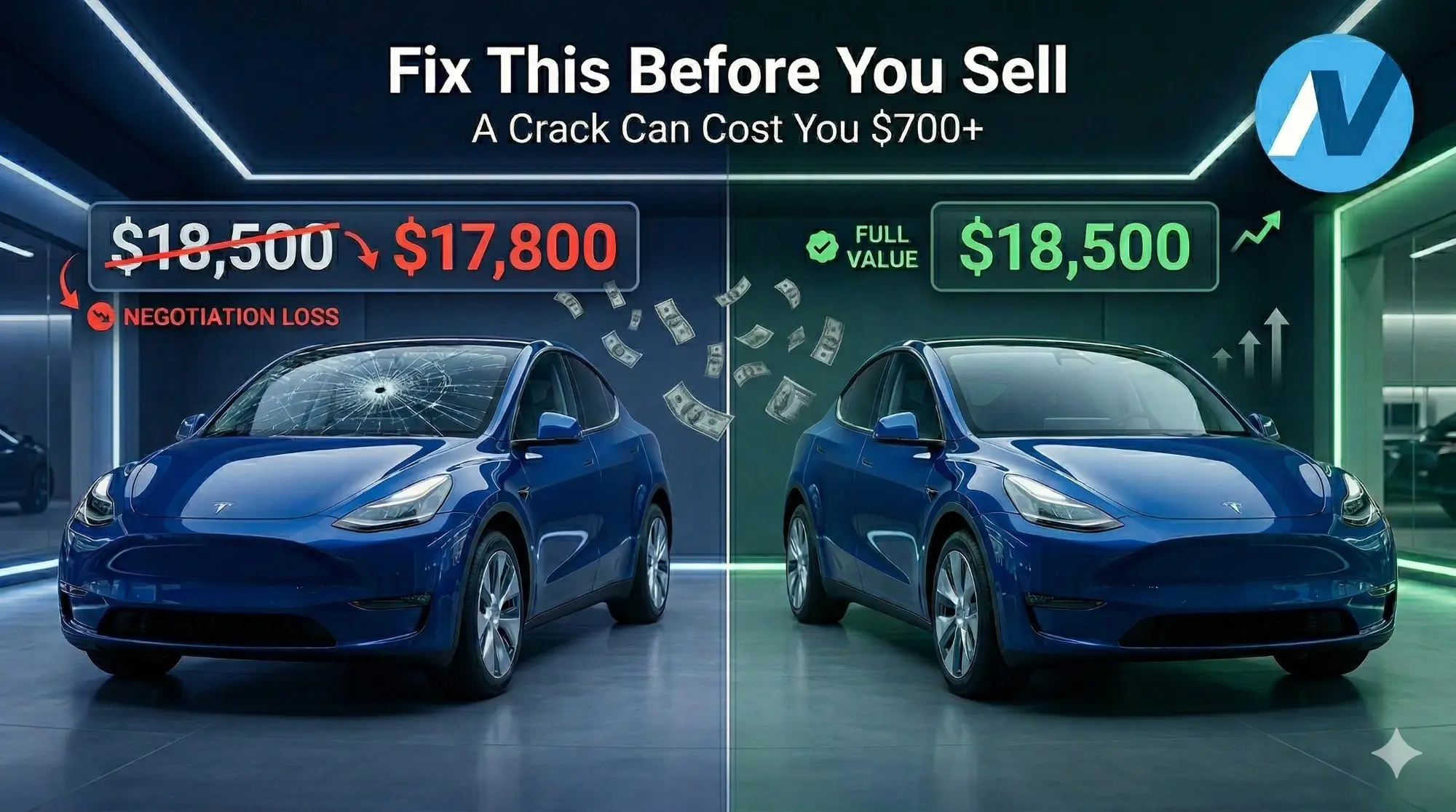
Pre-sale windshield replacement is one of the highest-return preparation steps a private seller can take — and one of the least commonly taken. We’ve had sellers call us the same week they list, after a buyer’s inspection turned a cracked windshield into a $700 price reduction on a $12,000 car. The replacement would have cost $290. The math wasn’t close.
A customer in Chandler listed his 2019 Honda CR-V last spring at $18,500. He had a seven-inch crack running from the lower driver’s corner toward the centre. He knew about it. He figured he’d disclose it and see what happened.
The first serious buyer walked around the car, pointed at the crack, and offered $17,400. The seller countered at $18,200. They settled at $17,800. The crack cost him $700 in negotiating leverage.
We replaced the crack the following week for a different seller with the same model. That seller listed at $18,500 and closed at $18,300.
A windshield crack gives buyers visible, documented leverage. Most buyers use it to negotiate $500-1,500 off the asking price — 2-3x what the replacement actually costs. In Arizona, the replacement costs $0 with comprehensive insurance. In Florida, same. The ROI on fixing it first is rarely negative.
Why Does a Cracked Windshield Give Buyers So Much Negotiating Power?
A cracked windshield is visible from 10 feet away during a walk-around. It signals two things to a buyer simultaneously: there is a known repair cost attached to this vehicle, and the seller didn’t address it before listing.
The first point gives buyers a concrete dollar figure to attach to their offer reduction. The second gives them a softer reason to wonder what else wasn’t addressed. Neither of those perceptions works in the seller’s favour.
Buyers also tend to overestimate repair costs. A seller who knows the crack costs $280 to fix may be blindsided by a buyer who assumes it costs $600 and deducts accordingly. The buyer’s number becomes the negotiating anchor, not the seller’s.
There’s a secondary effect on time-to-sale. Listings with visible damage get fewer serious inquiries. Buyers scrolling through photos see the crack, assume the seller is either unaware or unmotivated to fix it, and move to the next listing. A clean windshield keeps more buyers in the conversation long enough to make an offer.
What Is the Actual ROI on a Pre-Sale Windshield Replacement?
| Scenario | Replacement Cost | Typical Buyer Deduction | Net Gain from Fixing |
|---|---|---|---|
| Standard vehicle, AZ or FL (insurance covers) | $0 | $500-900 avoided | $500-900 |
| Standard vehicle, paying out of pocket | $175-350 | $600-1,000 avoided | $250-825 |
| ADAS-equipped vehicle (incl. recalibration) | $350-600 | $800-1,500 avoided | $200-1,150 |
| Chip repair only (no crack) | $75-150 | $200-500 avoided | $50-425 |
| Low-value vehicle (<$5,000) | $175-350 | $300-600 avoided | Assess case by case |
The low-value vehicle row is the only scenario where the math gets complicated. On a $4,500 car, a $300 replacement that prevents a $400 reduction is a $100 net gain — worthwhile, but narrow. On a $4,500 car where insurance covers the replacement at zero cost, the decision is straightforward.
The ADAS row is worth noting. Modern vehicles with lane departure, automatic emergency braking, and adaptive cruise control require ADAS recalibration after windshield replacement. Buyers of these vehicles know this — or their buyer’s agent does. A replacement without recalibration is an incomplete job, and a sophisticated buyer will ask whether it was done.
What Do Buyers Actually Do When They See a Cracked Windshield?
We’ve had sellers tell us what their buyers said. The patterns are consistent.
They get a quote before making an offer. Experienced private-party buyers know exactly what to do with a cracked windshield. They take a photo, call a shop or check online, get a replacement estimate, and subtract it — plus a buffer — from their offer. The buffer is the friction tax. They don’t want the hassle of dealing with it, so they discount more than the actual cost.
They use it as an opening rather than a dealbreaker. Most buyers aren’t walking away over a windshield. They’re using it to establish that the seller has to negotiate. Once that dynamic is set, every subsequent issue — minor scratches, tyre tread, service history gaps — becomes another reason to press. The windshield crack opens the door to a broader negotiation that the seller is now losing from a weaker position.
They flag it in their financing or inspection contingency. Buyers going through a dealer or using a third-party inspection service will have the crack documented. Once it’s in writing, the seller has even less ability to hold the asking price. A documented defect has a documented cost attached to it.
They share it in their review if they buy from a private platform. On platforms like Facebook Marketplace, Craigslist, and CarGurus, photos are scrutinised. A listing photo that shows a windshield crack — or that conspicuously avoids showing the windshield — creates doubt before the buyer even contacts the seller.
Does This Work for Trade-Ins as Well as Private Sales?
Yes — and the dynamic is actually sharper with trade-ins, because dealership appraisers are professional and unsentimental about it.
When a dealer appraises a trade-in with a cracked windshield, they calculate the reconditioning cost at their vendor rate — which is typically higher than what you’d pay an independent shop. A crack that costs $280 to fix independently might be valued at $450 in the dealer’s reconditioning budget. They deduct that, plus a margin, from the trade-in offer.
A seller who replaces the windshield independently before the trade-in appraisal removes that deduction entirely. The cost is $280. The benefit is the full elimination of a $450-600 reconditioning deduction. That’s a $170-320 net gain before considering the improved negotiating position on the vehicle price itself.
The same logic applies to certified pre-owned (CPO) programmes. CPO vehicles require passing a multi-point inspection that includes glass condition. A cracked windshield fails the glass inspection, disqualifying the vehicle from CPO pricing — which typically commands a $1,000-2,000 premium over standard used pricing. The $300 replacement that keeps the vehicle CPO-eligible is one of the clearest ROI calculations in pre-sale preparation.
Does Insurance Cover Windshield Replacement Before a Sale in Arizona, Florida, and South Carolina?
It does — and sellers in Arizona and Florida have the most straightforward path.
Arizona. Arizona Revised Statute 20-263 mandates zero deductible on comprehensive glass claims and prohibits the insurer from using the claim to raise your premium. An Arizona seller with comprehensive coverage can replace a cracked windshield at zero cost before listing. The claim follows the vehicle, not the person — so it can be filed even if the sale is imminent. This makes the pre-sale ROI calculation trivial: the replacement costs nothing, and the benefit is $500-900 in preserved asking price.
Florida. Florida Statute 627.7288 also mandates zero deductible on comprehensive glass claims. Same calculation as Arizona: file the claim, get the replacement, list with a clean windshield. Florida sellers who don’t do this before listing are leaving money on the table for a straightforward reason.
South Carolina. No zero-deductible statute here — your standard deductible applies. If your deductible is $250 and the replacement costs $300, you pay $250 and the insurer covers $50. That’s still significantly cheaper than the $600-900 price reduction a crack typically generates. If your deductible is $500 on a $350 replacement, paying out of pocket is the better path. Either way, the replacement before listing is almost always the right financial move.
One important note on timing: file the claim and complete the replacement before transferring ownership. Insurance follows the policyholder — once the vehicle is sold, your coverage on it ends. The claim needs to be open and the work done while you’re still the owner.
Frequently Asked Questions
Should I replace the windshield before selling my car?
In most cases yes. Buyers use visible glass damage to negotiate $500-1,500 off asking price — 2-3x the replacement cost. In Arizona and Florida, insurance covers the replacement at zero deductible, making the decision automatic. In South Carolina, compare your deductible to the typical buyer deduction. The replacement almost always comes out ahead.
Will insurance cover a windshield replacement before I sell?
Yes, if you have comprehensive coverage. File the claim before transferring ownership — coverage follows you as the policyholder, not the vehicle once it’s sold. In Arizona and Florida, there’s zero deductible on glass claims by law. In South Carolina, your standard deductible applies. Complete the replacement before the sale closes.
Does a windshield crack affect trade-in value?
Yes — dealerships calculate reconditioning costs at their vendor rate, which is typically higher than independent shop pricing. A $280 repair is valued at $450-600 in the dealer’s deduction. Replacing independently before appraisal removes that deduction entirely and can preserve CPO eligibility, which adds $1,000-2,000 in pricing premium.
What if my car only has a chip, not a full crack?
A chip repair costs $75-150 and takes 30-45 minutes. A professionally repaired chip is significantly less visible than an unrepaired one, and buyers understand it was addressed. Repairing chips before listing removes a visible negotiating point. The only case for not doing it is if insurance covers the full chip repair at zero cost — in which case there’s no reason not to.
Does replacing the windshield before a sale require ADAS recalibration?
On any post-2016 vehicle with a forward-facing camera, yes. Skipping recalibration leaves the lane departure and automatic braking systems miscalibrated — which becomes a liability issue for the seller if the new buyer relies on those systems. Complete the full job. The recalibration is typically covered alongside the glass claim under comprehensive insurance.
Fix It Before You List. The Math Is Almost Never Close.
The Chandler seller lost $700 to a crack that would have cost $290 to fix — and he had comprehensive insurance that would have covered it at zero cost in Arizona. He just didn’t think to check before listing.
That’s the whole story. The windshield is the first thing a buyer walks up to. It’s the easiest visible defect to price. And it’s frequently the cheapest thing for a seller to fix before it becomes a negotiating anchor.
If you’re preparing to sell and you’re in Arizona, Florida, or South Carolina, book a free assessment at nuvisionautoglass.com/get-a-quote. We’ll confirm your coverage, tell you whether it’s a repair or replacement, and have it done before your first showing.
Find us on Google Maps:
NuVision Auto Glass — Arizona
NuVision Auto Glass — Florida