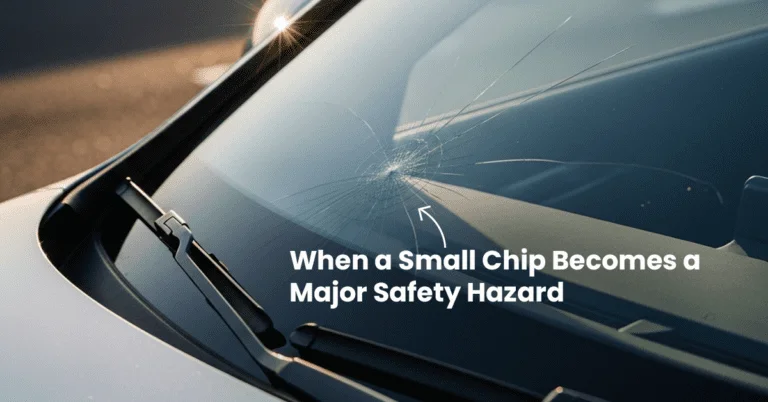

A small windshield chip transforms into a major safety hazard within 24-72 hours under the right conditions, particularly in extreme climates. What begins as a quarter-size impact point can propagate into a 6+ inch crack that compromises structural integrity, impairs visibility, and requires full windshield replacement. Temperature differentials exceeding 40°F, vehicle vibration, and additional stress from normal driving accelerate this progression, turning a $75-150 repair into a $300-500 replacement while eliminating the safety margin your windshield provides.
For drivers in Arizona, Florida, and South Carolina, the timeline from minor chip to major hazard is dramatically compressed. Arizona’s 70-110°F temperature swings between exterior and air-conditioned interior create thermal shock that cracks glass within hours. Florida’s humidity penetrates chips, causing internal delamination that’s invisible until catastrophic failure. South Carolina’s freeze-thaw cycles expand and contract damaged areas with each temperature change. This article examines the physics of chip propagation, how to recognize critical damage, and why immediate repair prevents dangerous consequences.
The Anatomy of a Windshield Chip
Understanding how chips form and why they’re unstable clarifies why even small damage demands immediate attention.
Windshields consist of two layers of glass bonded to a plastic PVB (polyvinyl butyral) interlayer, a laminated safety glass structure designed to contain impacts rather than shatter. Understanding what makes an OEM windshield different starts with this laminated construction. When a rock or debris strikes your windshield, it creates several damage zones:
Impact point: The visible crater where the object struck. This might be the size of a dime to a quarter, with glass pulverized in a small area.
Radial cracks: Fine lines radiating outward from the impact point. These may extend 1-3 inches initially, barely visible without close inspection. These cracks relieve the stress created by impact, but they also create permanent weak points.
Subsurface damage: Invisible fractures within the glass layers and potential delamination of the PVB interlayer. This hidden damage is why chips are far more serious than they appear.
Stress concentration: The damaged area becomes a focal point for all subsequent forces acting on the windshield. Every vibration, temperature change, and aerodynamic pressure concentrates at the chip.
The Auto Glass Safety Council conducted testing on chipped windshields, subjecting them to temperature cycling and vibration stress. Within 72 hours of simulated normal driving conditions, 67% of unrepaired chips developed cracks exceeding 3 inches. Within one week, 89% had propagated into replacement-necessary damage.
Chip types and propagation risk:
| Chip Type | Description | Propagation Risk | Typical Timeline to Crack |
| Bull’s-eye | Circular impact with cone-shaped damage | Moderate | 3-7 days in extreme heat |
| Star break | Central impact with radiating cracks | High | 1-3 days with temperature stress |
| Combination | Bull’s-eye with radiating cracks | Very High | 24-48 hours in Arizona summer |
| Partial bull’s-eye | Semi-circular impact | Moderate | 3-5 days with vibration |
| Pit | Small surface damage, no radiating cracks | Low | May remain stable indefinitely |
| Crack chip | Impact with crack already extending | Critical | Actively growing—immediate attention |
Temperature: The Primary Propagation Driver
Temperature differential, not absolute temperature, drives chip-to-crack progression. When one part of the windshield heats or cools faster than surrounding areas, thermal stress concentrates at weak points like chips.
Arizona Scenario
Summer afternoon, your car sits in a parking lot. Windshield surface temperature reaches 140-160°F. You start the engine and direct maximum air conditioning at the windshield interior. Interior glass surface temperature drops rapidly to 70-80°F within minutes. The resulting 60-80°F differential creates immense stress.
Think of it like this: glass expands when heated and contracts when cooled. The hot exterior glass is expanded while the cold interior glass is contracted. The chip sits right at this stress boundary. Something has to give, and it’s always the weakest point. The chip extends into a crack.
The University of Arizona’s Materials Science department studied windshield thermal stress. They found that temperature differentials exceeding 40°F cause existing chips to propagate at rates 5-10 times faster than ambient temperature changes. Arizona regularly experiences differentials of 70-90°F when vehicles transition from outdoor heat to air-conditioned interiors. Drivers in Phoenix, Mesa, and Scottsdale experience these conditions for 5-6 months of the year.
Florida Scenario
High humidity creates different problems. Moisture penetrates chips through capillary action, with water molecules entering microscopic gaps in damaged glass. When temperatures rise, this trapped moisture expands, creating internal pressure. When it freezes during rare cold snaps, expansion is even more dramatic. The result: progressive delamination where the PVB layer separates from glass.
Florida’s frequent temperature cycling (air conditioning in vehicles, buildings, then back to humid heat) causes dozens of expansion-contraction cycles daily. What seems stable one week becomes a spreading crack the next. Whether you’re commuting through Miami, Tampa, or Orlando, humidity is attacking your damaged glass every day.
South Carolina Scenario
Winter freezing followed by daytime thawing creates the worst possible conditions for chips. Water enters the chip during rain or car washing. When temperatures drop below freezing, water expands by 9% as it becomes ice. This expansion forces the crack to widen. During daytime thaw, the ice melts but the crack remains enlarged, allowing more water to enter. The next freeze-thaw cycle enlarges it further.
South Carolina drivers from Charleston to Greenville to Columbia face this cycle repeatedly from November through March. A chip that appears stable in September becomes a replacement-necessary crack by December.
Regional temperature factors:
| State | Primary Temperature Risk | Differential Range | Propagation Rate |
| Arizona | Extreme AC vs exterior heat | 70-110°F | 5-10x faster than baseline |
| Florida | Humidity + AC cycling | 40-70°F with moisture | 3-7x faster with delamination risk |
| South Carolina | Freeze-thaw cycles | 30-60°F seasonal | 4-8x faster during winter months |
Vibration and Road Stress
Every mile driven subjects your windshield to continuous vibration. Engine vibration, road surface irregularities, and aerodynamic buffeting all flex the glass microscopically. For an intact windshield, this flexing is negligible. For a chipped windshield, each vibration cycle stresses the damage area.
Highway driving creates particularly aggressive conditions. At 65-75 mph, aerodynamic pressure on the windshield varies constantly as you pass trucks, encounter crosswinds, or drive through vehicle wake turbulence. These pressure variations cause the glass to flex slightly, motion that’s invisible but measurable.
Research by the Society of Automotive Engineers quantified windshield flex during highway driving: 0.5-1.5mm of deflection at the center of the windshield during normal driving. At chip locations, stress concentration can amplify deflection by 200-300%. This repeated flexing fatigues the damaged glass, propagating cracks incrementally with each mile.
Arizona’s I-10 and I-17, Florida’s I-95 and I-75, and South Carolina’s I-26 and I-85 all expose windshields to sustained high-speed vibration. The combination of temperature stress and vibration creates ideal conditions for rapid chip-to-crack progression.
- Highway speeds (65+ mph): Aerodynamic pressure variations
- Rough pavement: Increased vehicle vibration transmitted to windshield
- Truck wake turbulence: Sudden pressure changes when passing large vehicles
- Off-road driving: Severe vibration from uneven terrain
- Engine vibration: Idle vibration in older vehicles
- Door slamming: Sudden pressure waves through cabin
Additional Impacts: The Cascade Effect
A chipped windshield has dramatically reduced impact resistance at the damage location. What would have been deflected by intact glass now creates additional damage. This “cascade effect” rapidly transforms minor chips into extensive crack networks.
Consider this scenario: you have a small chip from last week. Today, a tiny pebble (far smaller than the original impact) hits near the chip. On intact glass, this would cause no damage. On your chipped windshield, it creates a new crack that connects to the existing chip. Suddenly you have a complex crack pattern spanning 8-10 inches. Over time, this kind of repeated debris exposure contributes to windshield pitting that further weakens the glass.
The Insurance Institute for Highway Safety (IIHS) reports that 31% of windshields requiring replacement had initial damage that was repairable, but secondary impacts occurred before repair was completed. Each day you delay repair, you’re gambling that another impact won’t turn your chip into a major crack.
Arizona and Florida both rank in the top 10 states for windshield damage claims, largely due to highway debris from commercial traffic. South Carolina’s I-95 corridor carries extensive truck traffic from the Port of Charleston, creating constant debris exposure. In these environments, secondary impacts are nearly inevitable, it’s a question of when, not if.
Visibility Degradation: The Progressive Hazard
Chips don’t just create structural concerns, they progressively impair vision. Even a small chip causes light distortion, particularly noticeable at night when headlight beams hit the damaged area. As chips propagate into cracks, visibility problems multiply.
Sunlight distortion: During Arizona’s long periods of direct sun exposure, chips and cracks create intense glare and visual artifacts. Driving east or west during sunrise/sunset becomes genuinely dangerous as light refracts through damaged glass in unpredictable patterns. For strategies on managing this, see our guide on tips to minimize windshield glare for safer driving.
Night driving impairment: LED and HID headlights create severe starbursts and halos when their intense light strikes chip damage. What was barely noticeable during daytime becomes blinding at night. Our detailed guide on how windshield damage affects night driving covers this in depth, but the key point is that chips progressively worsen night vision as damage extends.
Rain and moisture: Florida drivers experience frequent rain. Water collects in chips and cracks, creating additional refraction and distortion. Light reflects off water surfaces within the damage, creating visual noise that makes it difficult to see through affected areas.
The National Highway Traffic Safety Administration (NHTSA) considers any windshield damage in the driver’s direct sight line to be a safety violation. As chips grow into cracks, they increasingly intrude into sight lines. What started outside your direct view can migrate into central vision areas as propagation continues.
The Repair Window: Why 24-48 Hours Matters
Windshield chip repair involves injecting specialized resin into the damaged area under vacuum and pressure. The resin fills voids, bonds to glass, and stabilizes the damage. However, repair is only effective when:
- The chip hasn’t propagated into long cracks (generally repairable if cracks are under 3 inches)
- The damage hasn’t been contaminated with dirt, moisture, or debris
- The PVB interlayer hasn’t delaminated extensively
- The glass hasn’t developed secondary crack networks
Every hour that passes after chip formation increases contamination risk and propagation likelihood. By 24-48 hours in extreme climates, many chips have already progressed beyond repairable stages.
Repair Success Rates by Time
- 0-24 hours: 95% successfully repaired with excellent optical clarity
- 24-48 hours: 80-85% repairable, some optical artifacts may remain
- 48-72 hours: 60-70% repairable, higher probability of residual visibility issues
- 1 week+: 30-40% repairable, many have propagated to replacement-necessary
These timelines are dramatically compressed in Arizona summer (reduce by 50%) and during Florida humidity exposure (reduce by 30%). South Carolina winter freeze-thaw cycles similarly accelerate timeline compression.
NuVision Auto Glass recommends same-day repair for any chip. Mobile service brings repair equipment to your location, with no need to drive with compromised glass or wait for shop availability. Most repairs complete in 30-45 minutes with minimal cost ($75-150, often covered fully by insurance).
Cost Comparison: Repair vs. Delayed Replacement
The financial logic strongly favors immediate repair:
Immediate Repair (Day 1)
- Cost: $75-150 (often $0 with insurance)
- Time: 30-45 minutes
- Structural integrity: Restored to 80-90% of original
- Visibility: Excellent optical clarity maintained
- Risk: Minimal, damage stabilized
Delayed Replacement (Week 2+)
- Cost: $300-500 before insurance
- Time: 60-90 minutes plus cure time
- Structural integrity: New windshield fully structural after 24 hours
- Visibility: Perfect optical clarity
- Risk: Drove with compromised windshield for extended period
- Additional concern: Potential for damage progression during highway driving or long trips
Beyond direct costs, driving with chip damage creates risks including sudden propagation during critical driving situations, increased accident probability from visibility impairment, and potential liability issues if damage contributes to a crash. For a full breakdown of what replacement costs, check our guide on how much it costs to replace a windshield.
Arizona’s cashback offers (up to $375 with NuVision) can make replacement essentially profitable, but this doesn’t negate the value of immediate repair. Repair keeps your original factory windshield and adhesive bond intact, with no cure time, no installation variables, and no concerns about glass quality or proper installation.
When Chips Cross Into Critical Territory
Some chip damage requires immediate replacement rather than repair:
Immediate Replacement Needed
- Edge chips (within 2 inches of windshield frame): Compromise the structural bond that provides up to 60% of your vehicle’s crash protection
- Driver’s sight line chips: Federal regulations prohibit repair in direct view zones on some vehicles
- Multiple chip clusters: Three or more chips within 6 inches of each other
- Chips with long radiating cracks: If cracks exceed 3 inches from impact point
- Deep chips penetrating to PVB layer: Visible white or opaque areas indicating severe damage
- Previously repaired areas with new damage: Repairs don’t restore full strength, secondary damage often necessitates replacement
Repair Acceptable
- Single chips smaller than a quarter
- Outside driver’s direct sight line
- Minimal or no radiating cracks (under 3 inches)
- Recent damage (within 24-48 hours, no contamination)
- No edge proximity (more than 2 inches from frame)
If you’re uncertain whether damage is repairable, professional inspection takes minutes. NuVision Auto Glass offers free assessments, with technicians evaluating damage and recommending repair or replacement based on safety standards, not profit maximization.
State Laws and Enforcement
While Arizona, Florida, and South Carolina all prohibit driving with windshield damage that impairs vision, enforcement focuses primarily on large cracks rather than chips. However, this doesn’t mean chips are legal or safe, just that they’re less visible to law enforcement.
Arizona (ARS 28-959): Windshields must be “free from defects” that impair driver vision. Chips in the driver’s sight line can technically trigger citations, though enforcement is inconsistent.
Florida (FS 316.610): Windshields must be in “good repair.” Officers have discretion, but obvious damage can result in citations and mandatory fix-it requirements.
South Carolina (Code 56-5-5010): Windshields must be “free from cracks or discoloration” impairing vision. Similar to other states, enforcement varies.
More importantly, insurance implications exist. If windshield damage contributes to an accident (via visibility impairment or structural failure), liability insurers may deny or reduce claims. Documentation showing you promptly addressed damage protects against these concerns.
Insurance Coverage for Chip Repair
Comprehensive auto insurance almost universally covers windshield chip repair with zero deductible. This means repair costs you nothing out of pocket. Insurance companies prefer paying $100 for repair over $400 for replacement, so they waive deductibles to encourage prompt repair.
Arizona: Full coverage with deductible waiver common. Cashback offers (up to $375) apply to replacement, not repair.
Florida: Zero-deductible glass repair standard. The 2023 law reforms (SB 1002) that prohibited Assignment of Benefits and cashback offers don’t affect legitimate repair coverage.
South Carolina: Comprehensive policies typically include zero-deductible glass repair.
Importantly, glass claims don’t increase insurance rates. They’re classified as comprehensive claims (acts of nature/unavoidable events) rather than collision or at-fault claims. You can file glass claims without premium impact. Document damage with photos when it occurs, file claims promptly, and complete repair within 48 hours to maintain optimal coverage.
Professional Repair vs. DIY Kits
Retail stores sell DIY windshield repair kits for $10-20. While these can work for minor surface damage, they don’t match professional repair quality for several reasons:
Vacuum capability: Professional equipment creates strong vacuum to extract air and moisture from the damaged area before resin injection. DIY kits lack effective vacuum, leaving air pockets that reduce strength and clarity.
Resin quality: Professional-grade resin has specific viscosity, curing properties, and UV resistance. DIY kit resin is often inferior, creating visible repairs that deteriorate over time.
Technique: Proper repair requires understanding damage patterns, knowing how much resin to inject, when to apply pressure vs. vacuum, and how to cure resin without creating optical distortion. This expertise comes from training and experience.
Curing method: UV curing requires proper wavelength and intensity. DIY kits often use sunlight, which provides inconsistent curing and can leave soft spots.
The Auto Glass Safety Council studied DIY repair outcomes: only 34% achieved satisfactory results, while 43% actually made damage worse (introducing air, contamination, or causing propagation during attempted repair). Professional repair succeeds 90-95% of the time when performed within the proper time window.
Regional Best Practices
Arizona Drivers
- Repair chips same-day during summer months (don’t wait even 24 hours)
- Park in shade or covered areas when possible
- Avoid maximum AC directly on windshield immediately after starting vehicle
- Carry repair coverage documentation (law enforcement may request proof during stops)
Florida Drivers
- Repair immediately due to humidity penetration risk
- Particularly urgent during rainy season (June-November)
- Cover chips with clear tape if repair must be delayed to prevent moisture intrusion
- Check damage after thunderstorms, as hail and debris can cause chips
South Carolina Drivers
- Winter months are highest risk, repair before first freeze
- Monitor chips during temperature swings (fall and spring)
- Highway I-95 and I-26 have high debris risk, inspect windshield regularly
- Coastal salt air accelerates glass and seal degradation, annual inspections recommended
Conclusion: Don’t Gamble on Chip Progression
Small windshield chips are ticking time bombs, particularly in the extreme climates of Arizona, Florida, and South Carolina. Temperature stress, vibration, and additional impacts transform repairable chips into replacement-necessary cracks within 24-72 hours. What costs $0-100 to repair today becomes a $300-500 replacement tomorrow, while eliminating the structural integrity and visibility your windshield provides.
- 67% of unrepaired chips propagate into cracks within 72 hours under stress
- Temperature differentials above 40°F accelerate crack growth 5-10 times
- Repair success rate is 95% within 24 hours, dropping to 30-40% after one week
- Insurance covers repair at zero deductible in most comprehensive policies
- Chips in Arizona summer can propagate in hours, not days
For Arizona, Florida, and South Carolina drivers, the compressed timeline from chip to crack demands immediate action. If you notice a chip, even a small one, don’t wait for it to become a major safety hazard. Professional repair stabilizes damage, restores structural integrity, and prevents the inevitable progression to replacement. Same-day service, zero out-of-pocket cost with insurance, and 30-45 minutes is all it takes.
Get a Free Quote in 60 Seconds →
Frequently Asked Questions
Can I just leave a small chip if it’s not in my sight line?
Technically yes, but practically no. Chips almost always propagate into cracks within days or weeks. Repairing now costs little ($0 with insurance) and prevents future replacement. Waiting guarantees the chip will worsen, it’s just a question of when.
Will repair be visible?
Professional repairs achieve 80-90% optical clarity. You may see slight distortion under specific lighting conditions, but it’s far less noticeable than unrepaired damage and doesn’t worsen over time.
How long does chip repair take?
30-45 minutes for most chips. Mobile service means technicians come to you, so you can get the repair done while you work, eat lunch, or handle other tasks.
Does repair restore full structural strength?
Repair restores 80-90% of original strength. While not quite equal to undamaged glass, it’s far superior to unrepaired chips which reduce strength by 15-25% and worsen over time.
What if my chip has already started to crack?
If cracks are under 3 inches, repair may still be possible. Beyond 3 inches, replacement is usually necessary. Every hour matters, so contact a professional immediately for evaluation.
Can I wash my car with a chip?
Yes, but avoid high-pressure spray directly on the chip, and dry the area afterward. Moisture intrusion complicates repair and accelerates propagation.