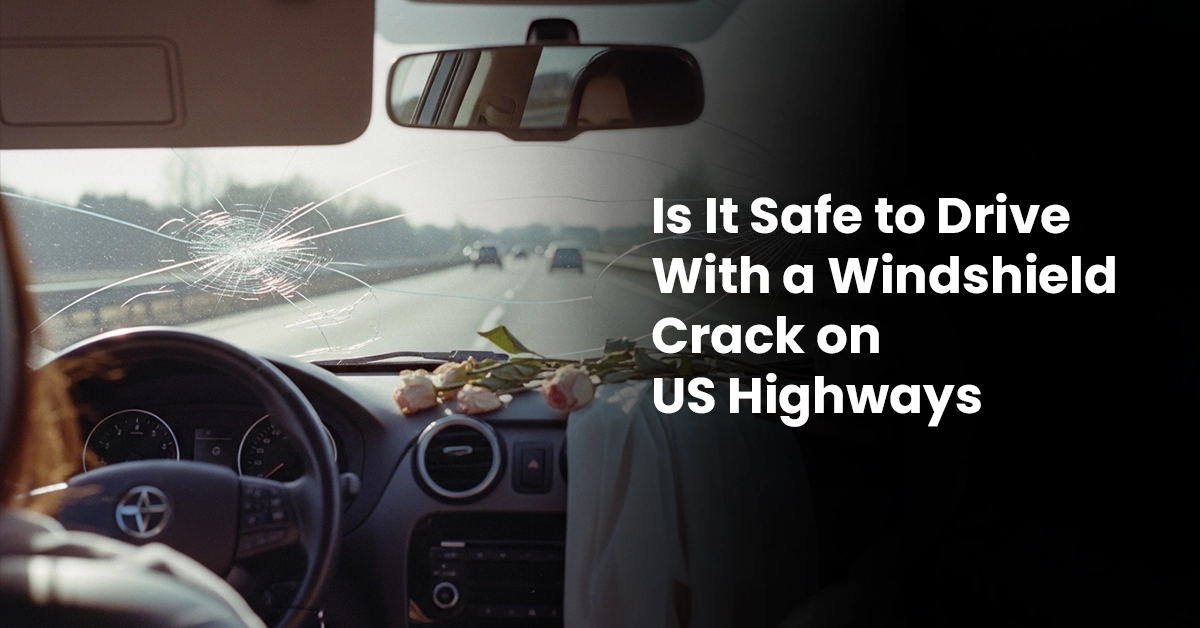

No, driving with a windshield crack is not safe, especially on US highways where speeds exceed 55 mph. A cracked windshield reduces structural integrity by 30-50%, impairs visibility, increases the risk of complete failure during impacts, and may compromise airbag deployment. While minor chips under a quarter-inch might be temporarily acceptable, any crack, regardless of size, creates a safety hazard that worsens with time, temperature changes, and vibration from highway driving.
For drivers in Arizona, Florida, and South Carolina, highway conditions and climate factors accelerate crack progression. Arizona’s I-10 and I-17 experience extreme heat that expands cracks rapidly. Florida’s I-95 and I-75 corridors see heavy debris from commercial traffic. South Carolina’s I-26 and I-85 endure temperature swings that stress damaged glass. This article examines the specific risks, legal considerations, and when immediate windshield replacement becomes critical.
The Structural Risk: How Cracks Compromise Safety
Your windshield contributes up to 45% of your vehicle’s structural strength during a rollover and 60% during a frontal collision. Laminated safety glass consists of two glass layers bonded to a plastic PVB (polyvinyl butyral) interlayer. This design keeps glass fragments contained during impact, but cracks fundamentally weaken the structure. Understanding what makes an OEM windshield different helps you appreciate why the quality of that glass matters so much.
According to the National Highway Traffic Safety Administration (NHTSA), windshields must withstand specific load requirements to protect occupants. A cracked windshield fails to meet these standards. During a rollover, the windshield prevents roof collapse, and cracks reduce this load-bearing capacity by 30-50% depending on damage location and severity.
The danger intensifies at highway speeds. When traveling 65-75 mph on interstates, your vehicle encounters aerodynamic pressures, vibrations, and potential debris strikes that stress the glass continuously. A crack acts as a focal point for these forces, much like a perforated line designed to tear. What might seem stable at city speeds can fail catastrophically during highway driving.
How Cracks Compromise Vehicle Structure
- Reduced rigidity: Cracked glass flexes excessively under load, weakening the entire vehicle frame
- Stress concentration: Forces accumulate at crack endpoints, accelerating growth with every mile
- Bond failure risk: Cracks near edges can separate from the urethane seal that holds the windshield to the frame
- Impact vulnerability: Secondary impacts, even minor ones, can cause total windshield failure
- Aerodynamic stress: Highway speeds create pressure differentials that continuously flex the windshield
Research from the Auto Glass Safety Council shows that 73% of windshield failures during accidents involved pre-existing damage. In crashes at highway speeds, occupants in vehicles with compromised windshields experienced injury rates 40% higher than those with intact glass.
Visibility Impairment at Highway Speeds
Cracks distort your view, and that becomes particularly problematic at 65+ mph where reaction time is critical. You travel 95 feet per second at 65 mph, covering the length of a basketball court before you can react. Anything that impairs vision reduces your ability to identify hazards, read signs, or track other vehicles. For more on managing visibility issues, see our guide on tips to minimize windshield glare for safer driving.
Cracks create several visibility problems on the highway:
Light Refraction
Glass cracks bend light at different angles, creating visual distortions particularly noticeable in bright sunlight or at night when facing oncoming headlights. Arizona drivers on east-west highways like I-10 face direct sunrise and sunset glare that combines with crack distortion to create dangerous blind spots.
Glare Amplification
Damaged glass scatters light, multiplying glare from the sun, headlights, and reflective road surfaces. Florida drivers on I-4 and I-75 during afternoon thunderstorms report that cracks make it nearly impossible to see through the combination of rain, reflection, and scattered light. For additional strategies, read our guide on how to reduce glare on your windshield.
Visual Disruption
Your brain constantly processes information from across your visual field. A crack in your direct sight line forces your eyes to continually refocus, causing eye strain and missing peripheral threats. At highway speeds, even a quarter-second of visual disruption can mean missing a brake light or lane-changing vehicle.
A Virginia Tech Transportation Institute study found that visual distractions lasting just 2 seconds double crash risk. Windshield cracks create continuous micro-distractions as your eyes unconsciously track the damage line instead of focusing on the road ahead.
- 2-second distraction doubles crash risk (VTTI study)
- 95 feet per second traveled at 65 mph (reaction time critical)
- 40% of drivers report significant glare from cracked windshields at night
- 23% longer reaction time when visual field includes windshield damage
For South Carolina drivers navigating I-26 through the mountains, where curves and elevation changes demand constant visual attention, windshield cracks eliminate the margin of safety needed for emergency maneuvers.
Temperature Extremes on Interstate Highways
Highway driving exposes windshields to severe temperature gradients that rapidly worsen cracks. In Arizona, summer asphalt temperatures reach 140-180 degrees while air conditioning keeps the interior at 70-75 degrees. This 70-110 degree differential creates immense stress on already-compromised glass.
Consider a typical Arizona summer highway scenario: your windshield surface heats to 140 degrees in the sun. You activate air conditioning, directing cold air onto the interior glass surface. The interior glass temperature drops rapidly while the exterior remains hot. This thermal shock causes the crack to propagate, often growing several inches in minutes.
The University of Arizona conducted thermal stress testing on cracked windshields and found that cracks exposed to temperature differentials exceeding 60 degrees grew at rates 3-5 times faster than ambient conditions. On Arizona highways in summer, these conditions exist for 8-10 hours daily. Drivers in Phoenix, Mesa, and Scottsdale face this risk every time they get behind the wheel.
Florida presents different challenges. Highway driving generates windshield temperatures of 110-130 degrees, combined with 70-85% humidity. Moisture penetrates cracks and reaches the PVB interlayer, causing delamination, where the plastic layer separates from glass. This invisible damage appears minor until impact stress causes the windshield to separate entirely. Whether you’re in Miami, Tampa, Orlando, or Jacksonville, humidity is working against your damaged glass every day.
South Carolina’s temperature swings between summer heat and winter freezing create expansion-contraction cycles. A crack stable at 75 degrees expands in 95-degree heat and contracts in 25-degree cold. Each cycle propagates the crack slightly. Highway vibration accelerates this process, and I-95 truck traffic generates continuous resonance that stresses glass. From Charleston to Greenville to Columbia, this cycle repeats through every season.
Debris and Impact Risk on Major Corridors
US highways present constant debris hazards that pose greater risk to already-damaged windshields. Commercial truck traffic on I-10 (Arizona), I-95 (Florida), and I-85 (South Carolina) kicks up rocks, tire fragments, and road debris at high velocity.
A windshield crack reduces impact resistance by 60-70%. What would normally be a minor rock strike on intact glass can cause complete windshield failure when it hits near an existing crack. The Insurance Institute for Highway Safety (IIHS) reports that 14% of all windshield failures during operation result from secondary impacts to already-damaged glass.
Florida’s Highway Hazards
The state ranks third nationally for windshield damage claims, with I-4 between Tampa and Orlando identified as the highest-risk corridor. Heavy truck traffic, frequent construction, and exposed aggregate road surfaces create a gauntlet of potential projectiles. If you experience sudden damage on these roads, our emergency auto glass repair service can help fast.
Arizona’s Desert Debris
Dust storms (haboobs) reduce visibility to near-zero while propelling sand and small rocks at high velocity. These particles sandblast windshields, and when they strike cracked glass, they often cause instant propagation. The I-10 corridor between Phoenix and Tucson sees 3-5 significant dust storm events annually. Learn more about how debris and environmental conditions contribute to windshield pitting over time.
South Carolina’s Road Debris
Drivers face debris from timber trucks on rural interstates and heavy container traffic from the Port of Charleston on I-26. The state’s red clay soil becomes projectile material during heavy rains, particularly on I-85 through the Upstate region near Greenville.
- 14% of windshield failures result from secondary impacts to damaged glass (IIHS)
- 60-70% reduced impact resistance in cracked windshields
- I-4 in Florida ranks among highest-risk corridors for windshield damage nationally
- 3-5 annual dust storms on Arizona I-10 create extreme projectile hazards
Legal and Insurance Implications
Driving with a cracked windshield may violate state vehicle equipment laws and can affect insurance coverage and liability.
Arizona law prohibits driving with a windshield crack that impairs the driver’s vision. Arizona Revised Statute 28-959 requires windshields to be “free from defects.” While enforcement focuses on cracks in the driver’s direct sight line, any significant damage technically violates the statute. Traffic stops for windshield violations can result in $150-200 citations, though officers often issue fix-it tickets that are dismissed upon proof of repair. NuVision provides fast windshield replacement in Arizona to help you resolve citations quickly.
Florida Statute 316.610 requires windshields to be “in good repair.” Law enforcement interpretation varies, but cracks longer than 6 inches or any crack in the driver’s line of sight typically trigger citations. Florida’s 2023 auto glass reform law (SB 1002) increased insurer scrutiny of claims, so documenting damage promptly is now critical for coverage. Drivers in Fort Lauderdale, Miami, and across the state should act fast.
South Carolina Code 56-5-5010 mandates that windshields be “free from any crack or discoloration that would impair the driver’s vision.” Like Arizona, enforcement focuses on sight-line obstructions, but significant cracks anywhere on the windshield can result in citations.
Insurance Considerations
- Comprehensive coverage typically includes glass damage with minimal or zero deductible
- Delaying repair may void coverage if damage worsens into a “pre-existing condition”
- Liability risk: If a cracked windshield contributes to an accident, insurers may claim negligence
- No rate increase: Most insurers don’t increase rates for glass claims (comprehensive, not collision)
- Document promptly: Take photos and file claims as soon as damage occurs
Beyond citations, driving with obvious windshield damage during an accident can affect liability determination. If investigators conclude that impaired visibility contributed to the crash, insurance companies may reduce payouts or deny claims entirely. For a full breakdown of costs and coverage, check our guide on how much it costs to replace a windshield.
When Highway Driving Becomes Immediately Dangerous
Certain damage patterns require you to exit the highway immediately and seek replacement:
Critical Damage Requiring Immediate Action
- Cracks in driver’s sight line: Any obstruction to your direct view ahead
- Edge cracks: Damage within 2 inches of the windshield frame (structural failure risk)
- Cracks exceeding 6 inches: Significant structural compromise
- Multiple intersecting cracks: “Spider web” patterns indicating imminent failure
- Growing cracks: Visible propagation during driving (stress failure in progress)
- Delamination: Cloudy or hazy areas where PVB layer is separating
- Chips that become cracks: If a chip develops a crack during highway driving, the stress is actively failing the glass
Damage That May Allow Careful Highway Driving to Reach Service
- Small edge chips: Under 1 inch from edge, not actively cracking
- Short cracks: 3-6 inches, not in sight line, not at edge
- Passenger-area chips: Not in driver’s direct view
If your damage falls in the second category, our windshield repair service may be able to restore structural integrity without a full replacement.
If You Experience Windshield Damage While on the Highway
- Step 1 – Assess: Check whether the crack is in your sight line or at edges. If yes, exit immediately
- Step 2 – Slow down: Reduce speed to 45-55 mph if safe to do so
- Step 3 – Avoid temperature shock: Don’t blast AC at maximum onto the windshield
- Step 4 – Increase distance: Back off from vehicles ahead to reduce debris exposure
- Step 5 – Exit: Get off at the nearest city with glass repair facilities
- Step 6 – Act now: Damage worsens by the hour, especially in heat
The Cost of Delay vs. Immediate Replacement
Waiting to address windshield damage rarely saves money and dramatically increases risk. A repairable chip ($75-150) becomes a replacement-necessary crack ($300-400) within days in Arizona heat. Insurance typically covers both repair and replacement, often with no deductible.
- Day 1: Quarter-size chip is easily repairable
- Day 3-5 (Arizona summer): Chip has propagated into 2-3 inch crack, may still be repairable
- Day 7-10: Crack exceeds 6 inches, requires full replacement
- Day 14+: Crack has compromised structural integrity, increased accident risk by 30-40%
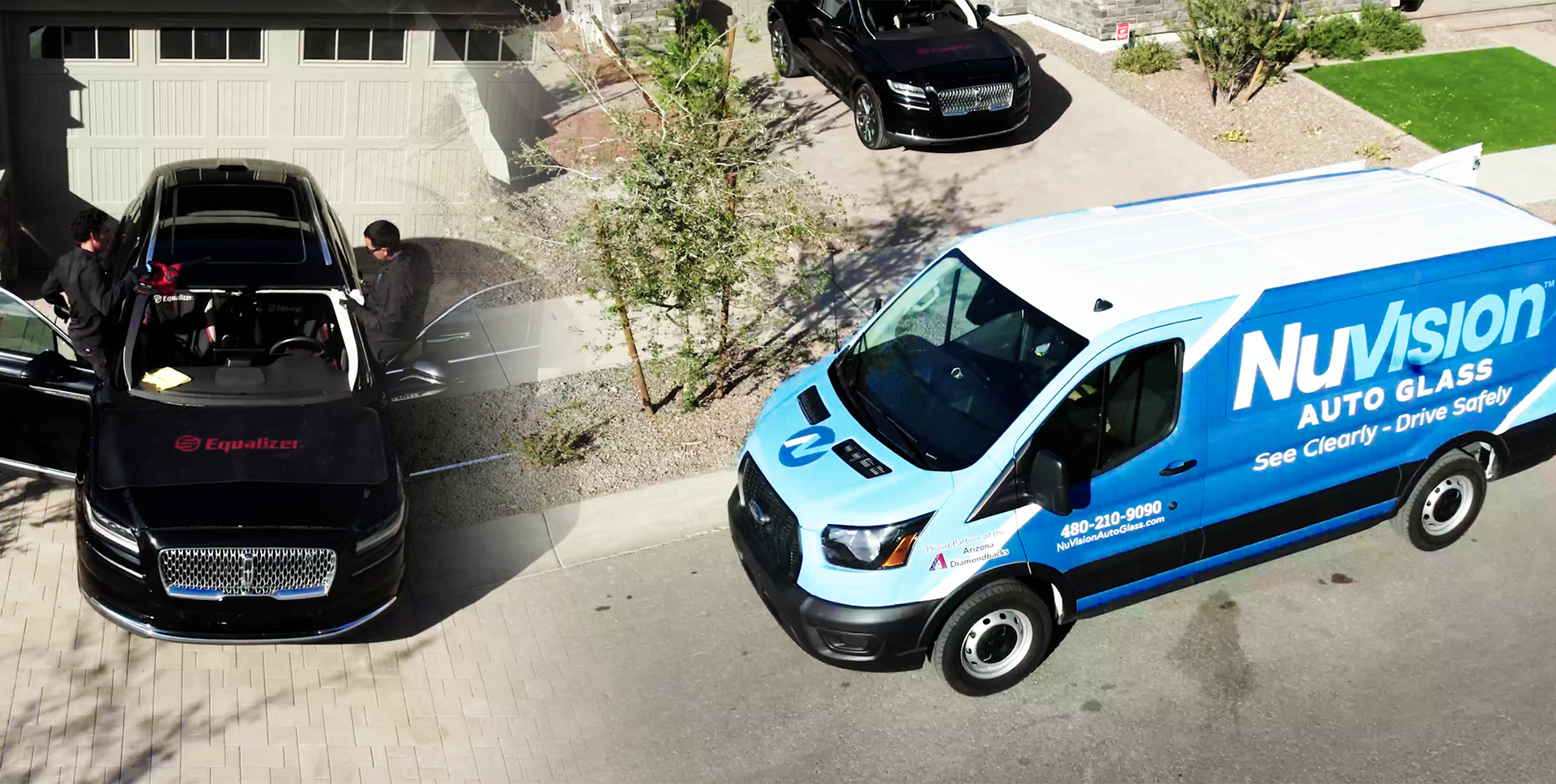
NuVision Auto Glass offers mobile service throughout Arizona, Florida, and South Carolina. Technicians come to your location, work directly with insurance, and complete most replacements in 60-90 minutes. The windshield is safe to drive after the minimum 1-hour adhesive cure time, though 24 hours is recommended before highway speeds. Wondering about out-of-pocket costs? Check our full breakdown of windshield replacement costs.
What Professional Installation Means for Highway Safety
Not all windshield replacements are equal. Proper installation determines whether your new windshield will withstand highway stresses and protect you during an accident.
- OEM-equivalent glass: Must meet Federal Motor Vehicle Safety Standard (FMVSS) 212 for optical quality and strength. Learn how to verify if your replacement windshield is OEM
- Complete urethane removal: Old adhesive must be fully scraped away (no layering over existing)
- Proper primer application: Both glass and frame must be primed for adhesive bonding
- Correct urethane bead: Size, shape, and placement following manufacturer specifications
- Minimum cure time: 60 minutes before moving vehicle, 24 hours before highway speeds
- ADAS recalibration: Mandatory for vehicles with forward-facing cameras or sensors. NuVision provides full ADAS calibration on-site
Drive-away adhesives that allow immediate driving compromise long-term bond strength. While convenient, they don’t achieve full cure for 24-48 hours. Highway vibration and stress during this period can create micro-separations that reduce structural integrity permanently.
What NuVision Includes with Every Installation
- Free mobile service (we come to you)
- Insurance claim handling (paperwork and direct billing)
- Quality OEM-equivalent glass
- Proper adhesive cure times
- ADAS recalibration when required (68% of vehicles now need this)
- Lifetime workmanship warranty
This applies whether you drive a Toyota, a Honda, a Ford, a Tesla, a Chevrolet, or any other vehicle make we service.
Highway-Specific Risk Scenarios
Scenario 1: Long-Distance Highway Travel (100+ Miles)
Even a small crack poses risk during extended highway driving. Continuous vibration, sustained high speeds, and limited exit options in rural areas create conditions where windshield failure becomes life-threatening. If planning a long highway trip, replace any windshield damage beforehand.
Scenario 2: Night Highway Driving
Headlight glare through cracks impairs vision severely. Oncoming high-beams and reflective road markers create starbursts and distortions that make it difficult to judge distances and track lane position. Night highways with a cracked windshield are particularly dangerous.
Scenario 3: Weather Events (Rain, Dust, Snow)
Reduced visibility from weather combined with distortion from cracks creates compounding risks. Florida summer thunderstorms, Arizona dust storms, and South Carolina winter weather all demand maximum visibility. A cracked windshield eliminates your safety margin entirely.
Scenario 4: Emergency Maneuvers
Highway driving occasionally requires sudden braking, swerving, or evasive action. These maneuvers generate forces that stress the windshield. A crack can propagate instantly during aggressive steering or heavy braking, suddenly obscuring your vision during the critical moment you need it most. This is also the moment when your windshield’s role as an airbag backstop becomes critical.
Conclusion: Highway Driving Demands Intact Glass
Driving with a cracked windshield on US highways is unsafe under any circumstances. The combination of high speeds, sustained vibration, debris exposure, temperature extremes, and the critical role windshields play in vehicle structure creates unacceptable risk. What seems like a minor cosmetic issue can become a life-threatening failure without warning.
- Cracked windshields reduce structural strength by 30-50%, critical during highway crashes
- Highway conditions (vibration, heat, debris) accelerate crack growth exponentially
- Visibility impairment at 65+ mph eliminates reaction time margin
- Insurance typically covers replacement at little or no cost
- Mobile service means no excuse for delaying replacement
For Arizona, Florida, and South Carolina drivers, regional conditions make delayed replacement even more dangerous. If you’re driving with windshield damage, schedule replacement today. NuVision Auto Glass provides free mobile service, works directly with insurance, and can have you back on the highway safely within 24 hours with properly installed glass that meets all safety standards.
Don’t gamble with highway safety. The few hours needed for professional replacement can prevent the catastrophic consequences of windshield failure at speed.
Get a Free Quote in 60 Seconds →
Frequently Asked Questions
Can I drive on highways with a small chip that hasn’t cracked?
Chips under a quarter-inch, not in your direct sight line, and not at the edge are relatively safe for limited highway driving. However, get them repaired within 24-48 hours. Highway vibration and temperature changes can cause them to crack suddenly. Our windshield repair service can address chips before they spread.
How fast can a crack grow during highway driving?
In Arizona summer heat, a crack can grow several inches in 30-60 minutes of highway driving. Temperature differential from air conditioning and road vibration accelerate propagation dramatically. Drivers in Phoenix and Scottsdale see this happen constantly during summer months.
Will police pull me over for a cracked windshield?
Possibly. Officers have discretion, but cracks in the driver’s sight line or obviously large cracks often trigger traffic stops. Citations range from $150-250, though fix-it tickets are common in Arizona, Florida, and South Carolina.
What if my windshield cracks while I’m on the highway far from cities?
If the crack is in your sight line or at the edges, exit at the nearest opportunity and seek repair facilities. If the damage is on the passenger side and not critical, you can carefully continue at reduced speed to reach a city with glass services. NuVision’s emergency auto glass repair covers locations across all three states.
Does insurance cover windshield replacement for highway damage?
Yes, comprehensive coverage typically includes glass damage regardless of how it occurred. Most policies have zero deductible or minimal deductible ($50-100) for glass claims. See our detailed windshield replacement cost guide for more details.
How long after replacement before I can drive on highways?
Minimum 60 minutes for adhesive to reach safe cure level. Ideally, wait 24 hours before sustained highway speeds (65+ mph). This allows the urethane bond to achieve full strength. If your vehicle requires ADAS calibration, NuVision handles that on-site as part of the replacement.